























NASA and DoD Collaborate on Artemis II Emergency Rescue Simulations
In an impressive display of interagency cooperation, NASA and the Department of Defense (DoD) joined forces on June 11 and 12 to conduct crucial emergency simulations. These exercises are designed to prepare for the unlikely event of a launch emergency involving the Artemis II mission. This mission, slated for next year, aims to send four astronauts around the Moon and back, marking NASA’s first crewed Artemis mission.
The simulations took place off the coast of Florida and involved comprehensive coordination among various teams, including launch and flight control units. These exercises are an essential step in ensuring the safety and readiness of the crew aboard NASA’s Orion spacecraft, which will be propelled by the Space Launch System (SLS) rocket.
Simulation Details and Objectives
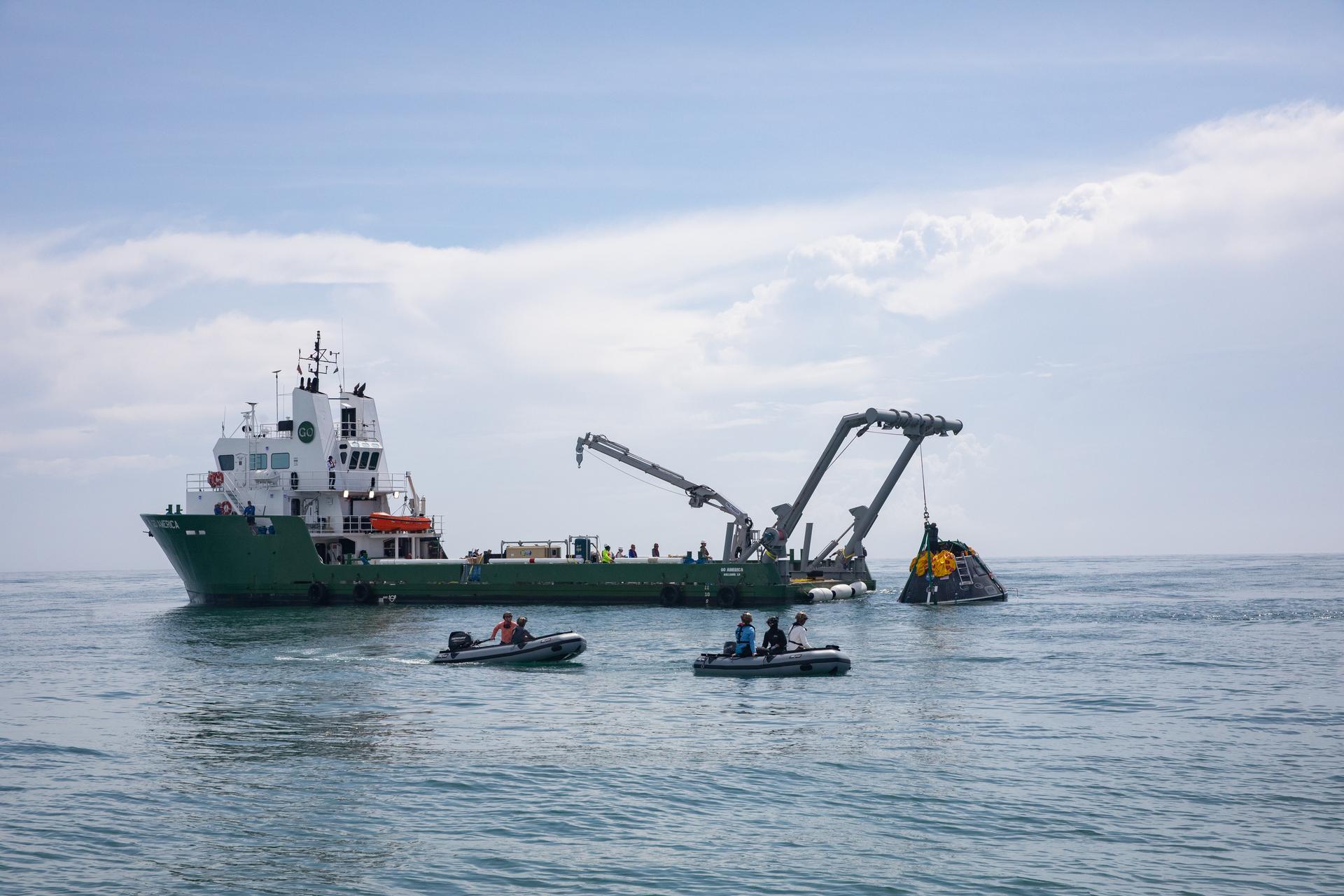
The primary objective of these simulations was to practice rescue procedures in two critical scenarios: an abort situation while the Orion spacecraft is still on the launch pad and another during its ascent to space. The tests featured a set of mannequins and a realistic version of the Orion capsule known as the Crew Module Test Article.
The simulation involved various teams working in unison. The launch team stationed at NASA’s Kennedy Space Center in Florida, flight controllers at the Johnson Space Center in Houston, and the mission management team all collaborated to test their integrated emergency response procedures.
Lakiesha Hawkins, NASA’s assistant deputy associate administrator for the Moon to Mars Program and chair of the mission management team for Artemis II, emphasized the importance of these simulations: "Part of preparing to send humans to the Moon is ensuring our teams are ready for any scenario on launch day. We’re getting closer to our bold mission to send four astronauts around the Moon, and our integrated testing helps ensure we’re ready to bring them home in any scenario."
Launch Pad Abort Scenario
The first scenario tackled was an abort situation on the launch pad. Here, the team conducted a standard launch countdown before simulating an abort, just before the rocket was set to launch. In a real emergency, Orion’s launch abort system is designed to quickly propel the spacecraft and its crew a safe distance away, orienting the capsule for a safe splashdown. The capsule’s parachutes would then deploy to ensure a smooth landing in the ocean off Florida’s coast.
For the simulation, the test version of Orion, complete with mannequins, was placed in the water approximately five miles east of Kennedy. Upon the simulated abort call, two Navy helicopters, carrying U.S. Air Force pararescuers, departed from nearby Patrick Space Force Base. These rescuers parachuted into the water equipped with specialized DoD and NASA rescue equipment. Their mission was to safely approach the spacecraft, retrieve the mannequin crew, and transport them for medical assessment in the helicopters, mirroring the procedures that would be followed during a real pad abort in the Artemis II mission.
Ascent Abort Scenario
The following day, the focus shifted to an abort scenario during the rocket’s ascent to space. In this simulation, the Artemis recovery team set up another exercise at sea, 12 miles east of Kennedy. Using the Orion crew module test article and mannequins, the rescue team sprang into action after receiving the simulated ascent abort call.
Flight control teams supported the operation, alongside the Artemis II crew, who were inside a simulator at Johnson Space Center. The rescue operation involved a C-17 aircraft and U.S. Air Force pararescuers. Upon reaching the capsule, the rescuers jumped from the aircraft with specialized rescue gear. In a real ascent abort, the Orion spacecraft would instantly separate from the rocket, deploy its parachutes, and safely splash down.
Drawing Parallels with Past Tests
This simulation exercise shares similarities with the Underway Recovery Test conducted off the California coast in March. That demonstration concluded with opening the hatch and extracting the mannequins from the capsule, stopping short of the helicopter transportation that would occur in a real rescue scenario.
Importance of Emergency Preparedness
Practicing procedures for extreme scenarios is a vital aspect of NASA’s mission to ensure crew safety. The Artemis program represents a significant leap forward in space exploration, aiming to send astronauts to the Moon for scientific discovery and economic gains. It also lays the groundwork for humanity’s first crewed missions to Mars, with far-reaching benefits for all.
The collaboration between NASA and the DoD underscores the importance of teamwork and preparedness, ensuring that every possible scenario is accounted for as we embark on ambitious space exploration missions. These exercises are crucial in building confidence and ensuring the safety of the astronauts who will participate in future missions.
Broader Implications and Future Outlook
The Artemis missions are not just about reaching the Moon. They are a stepping stone toward more profound space exploration endeavors, such as Mars missions. By conducting these meticulous simulations, NASA is showcasing its commitment to safety and preparedness, which are paramount in the high-stakes environment of space exploration.
As NASA and its partners continue to refine their procedures and technologies, the lessons learned from these simulations will play a crucial role in shaping the future of space travel. The ability to respond swiftly and effectively to potential emergencies is essential, not only for the safety of the astronauts but also for the success of the missions that promise to expand our understanding of the cosmos.
The Artemis II mission is a key milestone in NASA’s broader Artemis program, which aims to establish a sustainable human presence on the Moon and pave the way for future exploration of Mars. Through continued collaboration and rigorous testing, NASA is ensuring that the future of space exploration is both bold and secure, offering new opportunities for scientific discovery and international cooperation.
For more details on the Artemis missions and the ongoing preparations, you can visit the official NASA Artemis II mission page.
For more Information, Refer to this article.