

















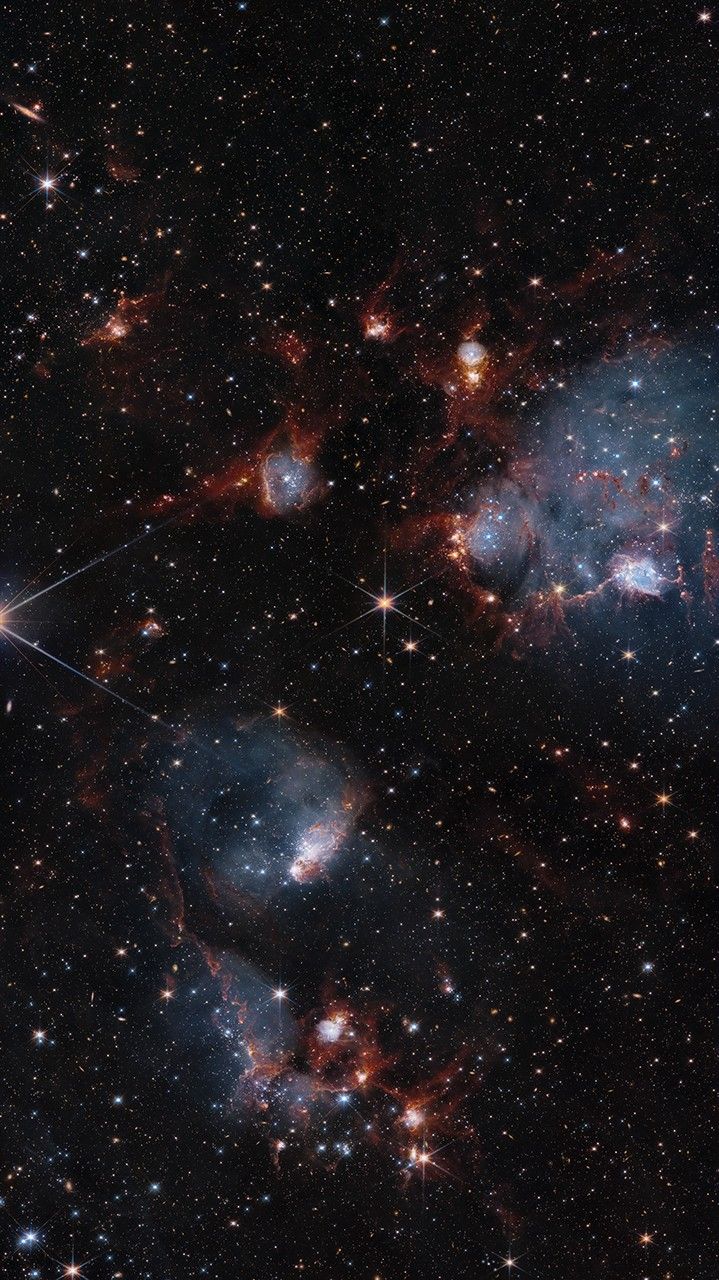
In a fascinating new image, a vibrant scene unfolds with a spectacular array of gas, dust, and stars, all showcased in an intricate display captured by NASA’s Hubble and Webb space telescopes. These images spotlight the duo of star clusters known as NGC 460 and NGC 456, residing within the Small Magellanic Cloud – a dwarf galaxy that orbits our own Milky Way.
Open clusters like NGC 460 and NGC 456 are fascinating cosmic structures comprising anywhere from a few dozen to several thousand young stars. These stars are loosely held together by the force of gravity. What makes these clusters even more intriguing is their connection to a larger complex of star clusters and nebulae, which are likely interlinked. The process of star formation begins when clouds of gas collapse under gravity, giving birth to new stars. These nascent stars are often hot and emit powerful stellar winds that sculpt the surrounding nebulae, carving out the clouds and instigating further collapses. This domino effect leads to the creation of even more stars.
The combined views from Hubble and Webb offer a striking perspective on this cosmic ballet. Hubble’s imagery captures the luminous, ionized gas as stellar radiation forms “bubbles” within the clouds of gas and dust, often appearing in hues of blue. Meanwhile, Webb’s infrared imaging brings forth the intricate clumps and delicate filamentary structures of the dust, highlighted in red. In Hubble’s images, dust frequently appears silhouetted against the backdrop, obstructing light. However, in Webb’s vision, this dust, warmed by starlight, emits its own infrared glow. This blend of gas and dust that exists between stars in the universe is referred to as the interstellar medium.
The nodules visible in these images are active star-forming regions, teeming with stars that range from just one to ten million years old. In stark contrast, our Sun is an ancient 4.5 billion years old. The area hosting these clusters, known as the N83-84-85 complex, is also home to several rare O-type stars. These are hot, extremely massive stars that burn hydrogen, much like our Sun, though they are far more luminous and short-lived. Among the approximately 400 billion stars in the Milky Way, astronomers estimate that only about 20,000 are O-type stars.
The Small Magellanic Cloud holds a particular allure for researchers due to its low metal content compared to the Milky Way. In the language of astronomy, “metals” refer to all elements heavier than hydrogen and helium – essentially, elements with more than two protons in their nucleus. This elemental composition mirrors conditions thought to be prevalent in the early universe, making the Small Magellanic Cloud a relatively nearby laboratory for exploring theories about star formation and the interstellar medium in the nascent stages of cosmic history.
Through these observations of clusters NGC 460 and NGC 456, scientists aim to delve deeper into several research avenues. They hope to study how gas flows within the region either converge or diverge, refine the collision history between the Small Magellanic Cloud and its neighboring dwarf galaxy, the Large Magellanic Cloud, and examine how bursts of star formation occur as a result of gravitational interactions between galaxies. Additionally, these observations will aid in enhancing our understanding of the interstellar medium.
### Explore More
The significance of these observations extends beyond mere visual splendor; they offer invaluable insights into the dynamics of star formation and galaxy evolution. As researchers continue to unravel the mysteries of the Small Magellanic Cloud, each discovery adds a new piece to the cosmic puzzle, helping to shape our understanding of the universe’s intricate tapestry.
For those interested in diving deeper into the celestial wonders captured by Hubble and Webb, NASA’s Goddard Space Flight Center offers a wealth of resources and information. Enthusiasts and scholars alike are encouraged to explore further into the missions of these remarkable telescopes and the breathtaking discoveries they continue to unveil. As we peer into the depths of the universe through these powerful eyes in the sky, each image and each revelation brings us one step closer to comprehending the vast and awe-inspiring cosmos we are a part of.
For more detailed information and updates on these intriguing space explorations, the NASA Science website remains a comprehensive source.
For more Information, Refer to this article.