In a recent exploration update from Mars, scientists from the Curiosity rover team have been excited by the discovery of a small ridge in the Martian landscape. This ridge, along with other raised structures in the vicinity, has become a primary focus of Curiosity’s ongoing mission. The team is particularly interested in these features because of the potential role that water may have played in their formation. Water, when interacting with minerals, can cause chemical reactions that lead to the formation of new compounds. These compounds can precipitate within the pore spaces of rocks, acting as a ‘cement’ that hardens the rock structure. This process is one way that such features may have developed their resistant nature, although it’s not the only possibility. The team is keen to gather all available details to assess whether water was indeed a significant factor in creating these formations.
The ridge that has captured the team’s attention stands prominently above the landscape and is conveniently accessible for the rover. This accessibility is exciting for the team as both side and top views of the structure are available, allowing a comprehensive analysis of its geological record. Such raised formations, referred to as "outcrops," are invaluable to field geologists, including those working with the Curiosity rover.
The rover’s previous drive ended approximately 10 meters from this intriguing structure, providing a strategic vantage point for planning subsequent exploration activities. This deliberate positioning allows scientists to direct the rover with precision, ensuring optimal data collection. For those interested in following this mission closely, images taken by Curiosity’s Mast Camera are available online, offering a visual representation of the ridge and its surroundings. These images are continually updated, providing fresh insights into the rover’s findings.
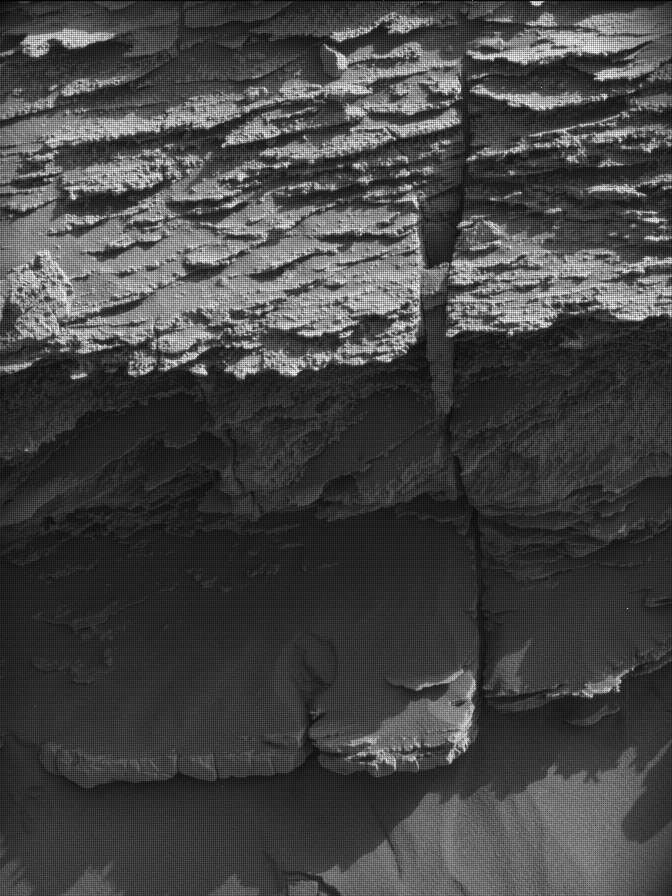
Curiosity has now been maneuvered into an ideal position to utilize its suite of scientific instruments. In direct view of the rover lies a section of the formation known as Volcán Peña Blanca, which appears to consist of several distinct units. Despite being a mineralogist rather than a sedimentologist, the author of the report notes at least three distinct layers within the formation. Anticipation is high for the chemical data that will soon be obtained, as sedimentologists on the team are particularly interested in the varied angles of the smaller layers embedded within the larger ones. High-resolution images from Curiosity’s Mars Hand Lens Imager (MAHLI) will be closely examined to gain further insight into these formations.
The current plan for Curiosity is extensive and involves multiple scientific activities. The Alpha Particle X-ray Spectrometer (APXS) will conduct two separate measurements. The first target, named "Parinacota," is located on the upper part of the outcrop and will be cleared of dust using the rover’s Dust Removal Tool (DRT) to ensure accurate readings. MAHLI will then capture close-up images to reveal fine structures and possibly individual grains. The second APXS target, "Wila Willki," is situated in the middle of the outcrop and will also be documented by MAHLI. Additionally, MAHLI will perform a "dog’s-eye view" assessment, positioning itself low to the ground to obtain a direct view of the outcrop’s structures, offering a glimpse beneath some of the ledges. The team eagerly awaits the arrival of these images, which will be available in the raw images section upon release.
The Chemistry and Camera complex (ChemCam) will also play a crucial role, targeting two locations with its Laser-Induced Breakdown Spectroscopy (LIBS) capability. The first target, "Pichu Pichu," is on the upper part of the outcrop, while "Tacume" is located in the middle. Following these detailed close-up examinations, ChemCam will use its Remote Micro-Imager (RMI) to focus on another raised feature in the mid-field and examine the distant upper contact of the boxwork unit with the unit above it.
The Mast Camera (Mastcam) will support these efforts by capturing a comprehensive mosaic of Volcán Peña Blanca, documenting the LIBS targets, and examining two distant areas where small troughs are visible around exposed bedrock.
In addition to geological studies, atmospheric observations are also part of the mission’s plan, as it’s currently aphelion cloud season on Mars, a time when clouds are expected to form at the farthest point of Mars’ orbit from the Sun. Dust continues to be of great interest, with regular monitoring of atmospheric opacity and ongoing searches for dust devils. Understanding these phenomena is critical for comprehending how and why they form and move across the Martian surface.
Curiosity is fully engaged in these diverse scientific tasks, and the team is eager to unlock more secrets of this intriguing Martian feature. This exploration forms a critical piece of the broader puzzle to understand the area known as the boxwork region on Mars.
For those who wish to delve deeper into this ongoing mission, further information and updates can be accessed through the NASA Science Mars Exploration Program. This resource provides comprehensive coverage of Curiosity’s journey and the scientific discoveries it continues to make.
For more Information, Refer to this article.