
























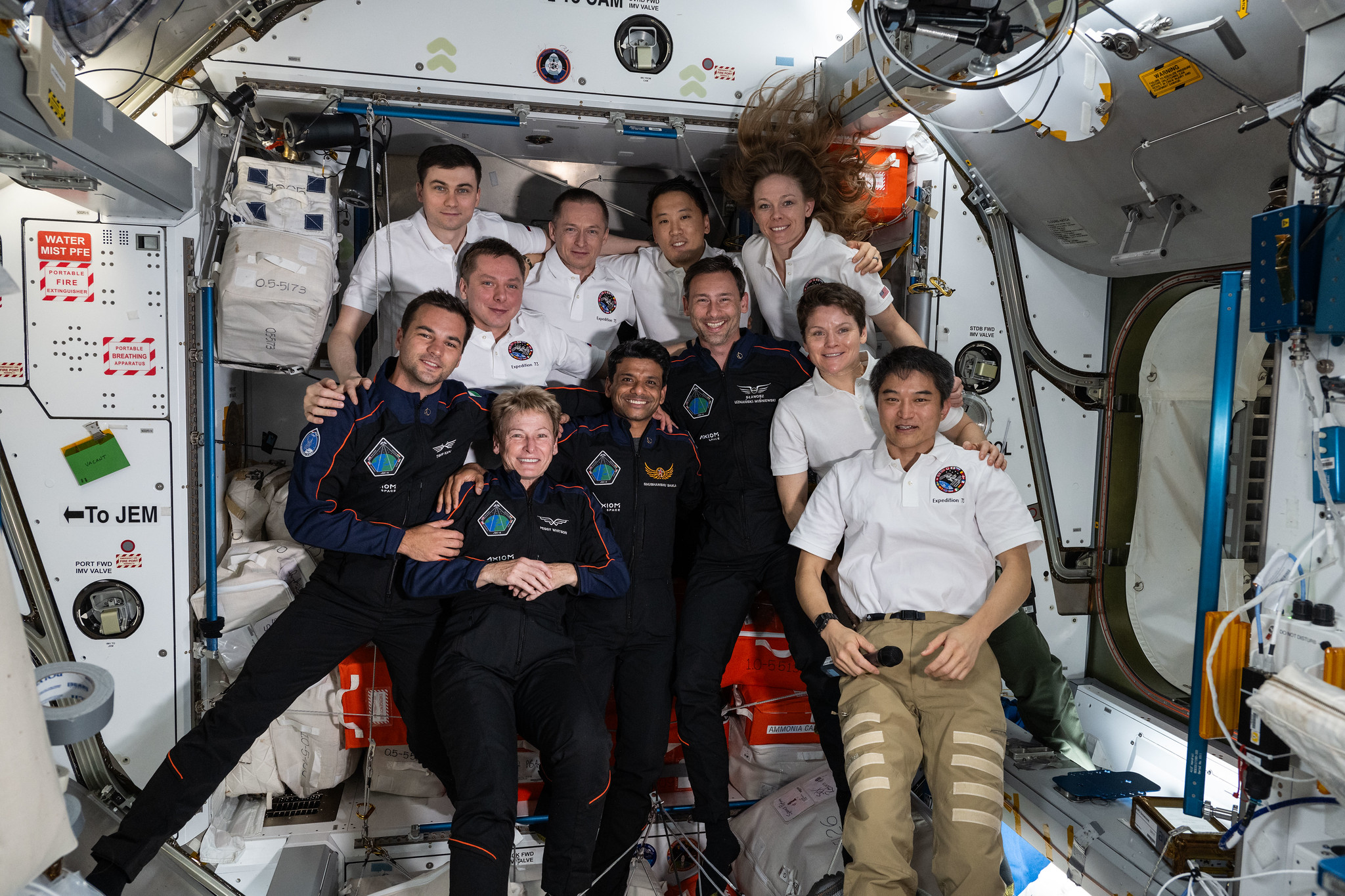
NASA is preparing to broadcast the undocking and departure of the Axiom Mission 4, a private astronaut mission, from the International Space Station (ISS). This event marks a significant milestone in the collaboration between NASA and private entities, showcasing the growing role of commercial spaceflight in modern space exploration.
Scheduled for July 14, the four-member astronaut crew will undock from the ISS’s Harmony module at approximately 7:05 a.m. Eastern Daylight Time (EDT), assuming favorable weather conditions. The astronauts will be aboard the SpaceX Dragon spacecraft, which will transport them back to Earth, culminating in a splashdown off the coast of California.
NASA has planned extensive coverage for this event, starting with the hatch closing at 4:30 a.m. This coverage will be available on NASA’s streaming platform, NASA+, which offers viewers a seamless experience across various platforms, including social media. This accessibility underscores NASA’s commitment to engaging the public in its space endeavors.
The Axiom Mission 4 crew comprises Peggy Whitson, a former NASA astronaut now serving as the director of human spaceflight at Axiom Space, Shubhanshu Shukla from the Indian Space Research Organization (ISRO), Sławosz Uznański-Wiśniewski representing the European Space Agency (ESA) from Poland, and Tibor Kapu from Hungary’s HUNOR program. By mission’s end, they will have spent approximately two weeks in space, contributing to a range of scientific and technical objectives.
A significant aspect of this mission is the return of over 580 pounds of cargo. This includes crucial NASA hardware and data from more than 60 experiments conducted during their stay. These experiments are vital for advancing our understanding of space and developing technologies for future missions.
NASA’s detailed schedule for the event is as follows:
Monday, July 14
4:30 a.m. – Coverage of the hatch closing begins on NASA+.
4:55 a.m. – The crew enters the spacecraft, followed by the hatch closing.
6:45 a.m. – Undocking coverage begins on NASA+, Axiom Space, and SpaceX channels.
7:05 a.m. – Undocking occurs.
NASA’s live coverage will conclude approximately 30 minutes after undocking, once joint operations with Axiom Space and SpaceX are completed. Axiom Space will then continue to provide coverage of the Dragon spacecraft’s re-entry and splashdown on their official website.
This mission is the result of a collaborative effort between NASA and ISRO, bringing to fruition a commitment made by former President Donald Trump and Indian Prime Minister Narendra Modi to send the first ISRO astronaut to the ISS. The collaboration involved five joint scientific investigations and two demonstrations revolving around science, technology, engineering, and mathematics (STEM) in orbit. This partnership underscores the long-standing relationship between NASA and ISRO, built on a shared vision to push the boundaries of scientific knowledge and foster international space collaboration.
Additionally, the mission marks a historic achievement by carrying the first astronauts from Poland and Hungary to the ISS. This milestone highlights the growing international participation in space exploration, facilitated by the burgeoning commercial space sector.
The ISS serves as a pivotal platform for developing a sustainable low Earth orbit economy. NASA’s strategic approach aims to cultivate a robust off-Earth economy, where the agency can procure services from private sector providers. This model allows NASA to focus its resources on ambitious endeavors like the Artemis missions to the Moon and eventually Mars, while still leveraging low Earth orbit as a training and testing ground for deep space exploration.
For those interested in learning more about NASA’s commercial space strategy, further information is available at https://www.nasa.gov/commercial-space.
This mission and its coverage represent a significant step forward in the evolution of space exploration, demonstrating the potential of public-private partnerships to expand humanity’s reach into space. As NASA continues to work with international partners and private companies, the future of space exploration looks promising, with more opportunities for scientific discovery and technological innovation on the horizon.
For more Information, Refer to this article.