A Star’s Unrelenting X-Ray Assault on a Young Planet: A Cosmic Drama Unfolding
In the vast expanses of the universe, a remarkable celestial event is capturing the attention of astronomers and scientists alike. A star, identified as TOI 1227, is emitting a powerful stream of X-rays that is slowly stripping away the atmosphere of a nearby planet, TOI 1227 b, at an astonishing pace. This phenomenon, observed through NASA’s Chandra X-ray Observatory, is reshaping our understanding of planetary evolution and the impact of stellar radiation on young planets.
Unraveling the Cosmic Mystery: The TOI 1227 System
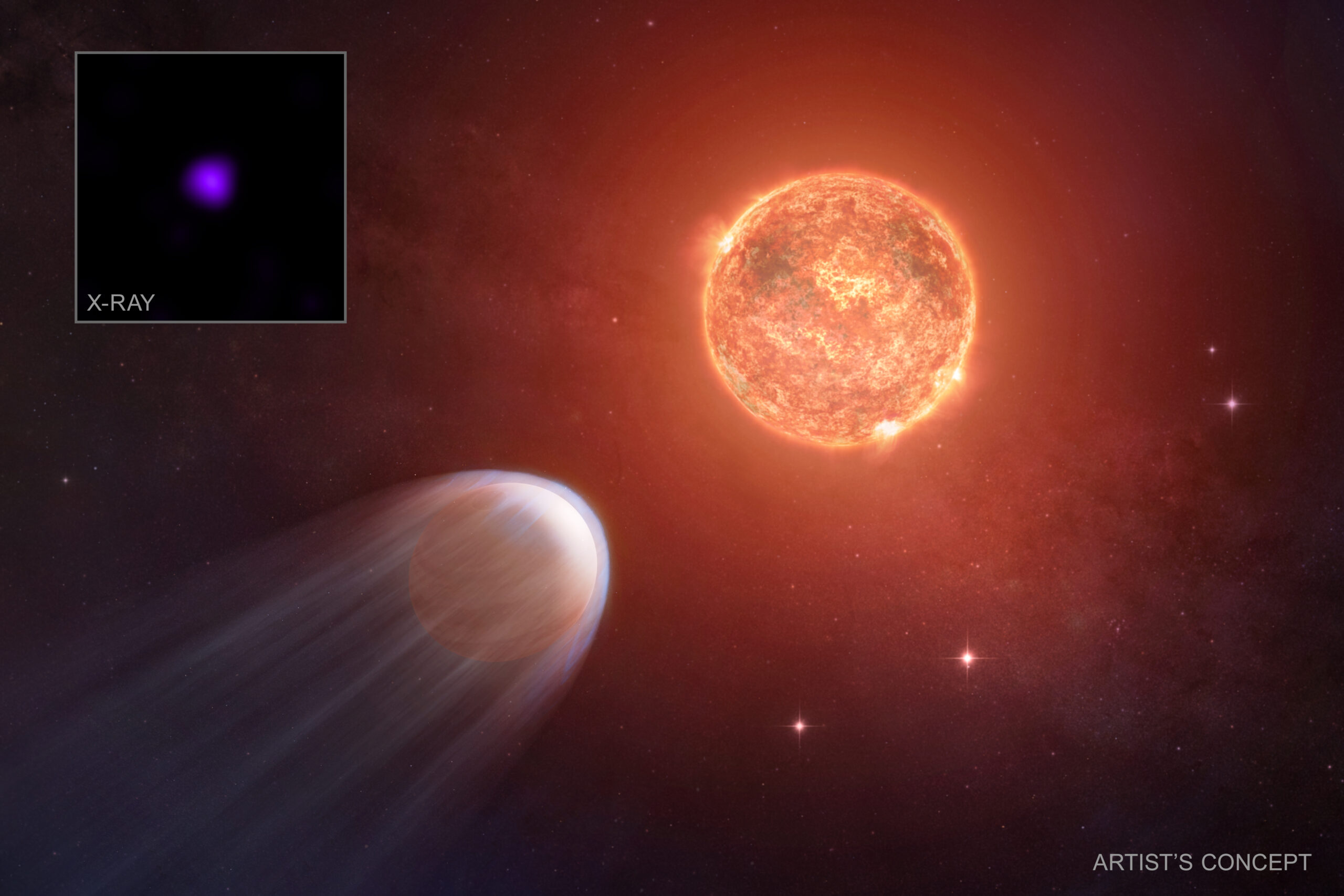
TOI 1227 is a faint red star, relatively young in cosmic terms, around which the planet TOI 1227 b orbits. This exoplanet, comparable in size to Jupiter, is situated incredibly close to its star—much closer than Mercury is to our Sun. Due to this proximity, it is exposed to intense X-ray radiation from its host star, a situation that is proving catastrophic for its atmospheric integrity.
An artist’s rendering of the system offers a striking visual narrative: the planet appears with a tail-like feature, reminiscent of a comet, as its atmosphere is being steadily stripped away by the star’s relentless X-rays. This dramatic scene provides a unique opportunity for scientists to study the effects of high-energy radiation on planetary atmospheres.
The Erosion of TOI 1227 b: A Planetary Transformation
Using the latest data from Chandra, researchers have been able to measure the intensity of the X-rays impacting TOI 1227 b. Through sophisticated computer models, they have predicted that the planet’s atmosphere is being eroded at a rate equivalent to the mass of Earth’s atmosphere every 200 years. This rapid loss suggests that the planet, which once resembled Jupiter, will eventually shrink into a barren, rocky world—essentially a shadow of its former self.
Determining the Age and Future of TOI 1227 b
To ascertain the age of TOI 1227 b, scientists employed several methods. One technique involved analyzing the motion of the star TOI 1227 in relation to nearby star clusters with known ages. Another method compared the star’s brightness and surface temperature against theoretical models of stellar evolution. These analyses indicate that TOI 1227 b is a mere 8 million years old, making it one of the youngest exoplanets ever observed transiting its star. This is a significant finding, as earlier estimates had placed the planet’s age at approximately 11 million years.
Among the population of exoplanets younger than 50 million years, TOI 1227 b is notable for its unique combination of a lengthy orbital period and a host star with minimal mass. Its exposure to such high levels of X-ray radiation, coupled with these characteristics, makes it an ideal candidate for ongoing observation and study.
Broader Implications and Future Observations
The research detailing these findings has been accepted for publication in The Astrophysical Journal, and a preprint is available for further reading. This study, conducted by a team of scientists from institutions including the Rochester Institute of Technology and the Massachusetts Institute of Technology, underscores the transformative effects of stellar radiation on young planets.
The Chandra X-ray Observatory, managed by NASA’s Marshall Space Flight Center, plays a crucial role in these discoveries. The observatory, operated by the Smithsonian Astrophysical Observatory, continues to provide invaluable insights into cosmic phenomena, advancing our understanding of the universe.
Conclusion: The Cosmic Ballet of Star and Planet
The unfolding story of TOI 1227 and its beleaguered planet, TOI 1227 b, is a testament to the dynamic and often harsh realities of planetary systems. As scientists continue to monitor and study this celestial interaction, they gather critical data that enriches our comprehension of planetary development and the forces that shape celestial bodies.
For those interested in delving deeper, further information about the Chandra X-ray Observatory and its mission can be found through the following resources:
- NASA’s Chandra X-ray Observatory
- Chandra X-ray Center
As we look to the stars, the saga of TOI 1227 serves as a powerful reminder of the complex and interconnected nature of our universe, where stars and planets engage in a timeless dance, each influencing the other in profound and often unexpected ways.
For more Information, Refer to this article.