
























NASA’s Curiosity Rover Continues Its Exploration on Mount Sharp’s Slopes
Earth planning date: Monday, July 21, 2025
NASA’s Curiosity rover is diligently continuing its mission to explore the intricate geological formations on the slopes of Mount Sharp, a central peak within the Gale Crater on Mars. This region, known for its unique "boxwork" terrain, has captured the interest of scientists for its potential to reveal the planet’s past environmental conditions. After a steady 5-meter (approximately 16 feet) drive, Curiosity now rests in a shallow depression as it prepares to move toward a ridge to gain a better vantage point of this fascinating landscape.
Over the weekend, Curiosity embarked on a critical atmospheric study using the Sample Analysis at Mars (SAM) instrument. This sophisticated tool is designed to analyze the composition of the Martian atmosphere, providing valuable data that could help scientists understand the planet’s climate history and potential for habitability. However, the SAM instrument requires a significant amount of energy to operate, causing what mission engineers refer to as a "deep dip" in the rover’s battery charge. Consequently, after completing its atmospheric analysis, Curiosity must pause to recharge its batteries before it can proceed with other scientific observations or movements. As a result, the current plan does not include driving, and the team has scheduled contact science for the second sol (Martian day) of the plan.
Daily Operations and Scientific Endeavors
On Sol 4607, the mission team has planned for the SAM instrument to conduct an atmospheric composition activity that will span several hours. Following this, Curiosity will utilize its navigation camera, or Navcam, to observe cloud altitudes, seeking shadows cast by clouds on the upper slopes of Mount Sharp and tracking clouds passing directly overhead.
As Curiosity’s battery recharges overnight, the rover will be ready for a new round of scientific investigations on the morning of Sol 4608. The day will begin with Navcam capturing images to assess dust opacity across the Gale Crater floor. This is followed by a Mastcam measurement of airborne dust in the direction of the Sun. The Mastcam, a critical imaging tool on Curiosity, will then focus on creating a detailed 15×1 mosaic of a target named "Cueva De Los Vencejos Y Murcielagos," translating to "Cave of Swifts and Bats." This mosaic aims to provide high-resolution images that can help scientists analyze surface features and geological formations.
Mastcam will also look back along the rover’s path, searching for freshly exposed rocks and evaluating the texture of the disturbed ground. This retrospective examination is crucial for understanding the mechanical properties of Martian soil and rock, which can inform future exploration missions.
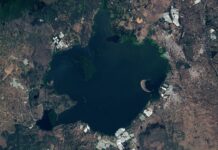
The ChemCam, another vital instrument on Curiosity, will conduct its own set of experiments. It uses a laser-induced breakdown spectroscopy technique to analyze the composition of Martian rocks and soil. For this plan, ChemCam will target a nodular rock pillar named "Lake Titicaca," after the famous high-altitude lake located on the border of Bolivia and Peru. The instrument’s laser will zap the rock, and its spectrometer will analyze the resulting plasma to determine the rock’s elemental composition. Additionally, a second ChemCam observation will utilize the Remote Micro-Imager (RMI) to study the stratigraphy of the "Mishe Mokwa" butte, capturing a 5×2 image mosaic. Mastcam will conclude this series of observations by examining the pits left by the ChemCam laser on the "Lake Titicaca" target, offering insights into the rock’s surface and subsurface properties.
Arm Operations and Close-Up Investigations
In the afternoon, Curiosity’s robotic arm will play a pivotal role in further scientific investigations. It will extend to brush away dust from a bedrock target named "La Tranquita," allowing for a clearer view and analysis of the rock’s surface. The Mars Hand Lens Imager (MAHLI), a microscopic camera on the arm, will then capture high-resolution images of the target. Accompanying this, the Alpha Particle X-ray Spectrometer (APXS) will analyze the elemental composition of "La Tranquita."
MAHLI and APXS will also examine plate-like rock formations at another target called "Aqua Dulce." These formations may hold clues to past geological processes on Mars. A third target, known as "Paposo," which features more complex rock structures, will be imaged solely by MAHLI. This target is named after a natural monument along the Pacific Coast of northern Chile, reflecting the ongoing tradition of naming Martian features after notable Earth locations.
The following morning, another targeted science block is scheduled before Curiosity drives away to its next viewpoint within the boxwork terrain. This continuous movement and observation cycle are essential for piecing together the environmental history of Mars and assessing its past habitability.
The Broader Implications of Curiosity’s Mission
Curiosity’s ongoing exploration of Mount Sharp’s slopes is not just about understanding Martian geology; it’s a part of a larger effort to uncover the planet’s history and assess its potential for supporting life. The rover’s findings contribute to our knowledge of Mars’ climate evolution, helping scientists to draw parallels between the Red Planet and Earth.
As researchers analyze the data sent back by Curiosity, they gain insights into the processes that have shaped Mars over billions of years. This knowledge is crucial for future missions, including the search for past microbial life and the long-term goal of human exploration. The rover’s ability to conduct complex scientific experiments on another planet showcases the remarkable achievements of robotic exploration and sets the stage for even more ambitious missions in the future.
For more detailed information on Curiosity’s mission and its discoveries, readers can visit NASA’s official Mars mission website.
For more Information, Refer to this article.