Unveiling the Sun’s Surprises: Insights from Recent Solar Radio Emissions
As our Sun gears up to enter the most dynamic phase of its eleven-year magnetic cycle, a fascinating phenomenon has captured the attention of both seasoned scientists and enthusiastic volunteers. This summer, NASA volunteers have been diligently monitoring the Sun, and their keen observations have unveiled a new trend in solar behavior that might just have you reaching for your sunscreen. The crux of the matter revolves around something known as a “Type II” solar radio burst.
Understanding Type II Solar Radio Bursts
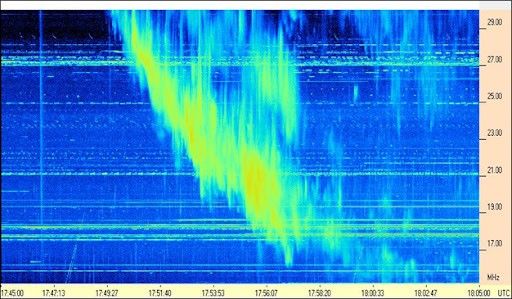
To comprehend the significance of this discovery, let’s first break down what a Type II solar radio burst entails. Our Sun, a colossal ball of gas and plasma, frequently emits powerful blasts of radio waves into the vastness of space. These radio emissions are classified by heliophysicists into five distinct types, determined by how the frequency of the radio waves drifts over time. Among these, Type II solar radio bursts are particularly intriguing as they appear to originate from solar flares and massive expulsions of hot plasma, known as coronal mass ejections.
A Shift in Frequency: The New Trend
Recently, an interesting development has been observed by Thomas Freeman, an undergraduate student at Middle Tennessee State University, along with other dedicated volunteers participating in NASA’s Radio JOVE project. They have detected a noticeable shift in these Type II bursts, which are now appearing at lower frequencies—specifically in the range that lies between FM and AM radio. This shift in frequency is a significant departure from the norm and suggests that our Sun is still full of surprises.
Implications of the Observed Shift
So, what does this shift in frequency mean for us? Essentially, it indicates that our understanding of solar emissions is evolving. The Radio JOVE project, which captures and analyzes the Sun’s radio emissions during the solar maximum, provides invaluable data that can extend our knowledge of these emissions to lower frequencies. This, in turn, allows scientists to study the Sun’s behavior at greater distances from its surface. The implications of such studies are vast, potentially enhancing our understanding of solar activity and its impact on space weather.
The Role of Radio JOVE
The Radio JOVE project, a collaborative citizen science initiative partnered with NASA, plays a pivotal role in these groundbreaking observations. Participants in this project assemble and operate radio astronomy telescopes to gather critical data that supports scientific research. Recently, Radio JOVE joined forces with the SunRISE Ground Radio Lab, which organized teams of high school students to observe the Sun. Their collaborative effort culminated in the publication of a research paper on these newly observed Type II solar radio bursts. For those interested in delving into this fascinating field, further information and opportunities to get involved are readily available.
Broader Implications and Future Prospects
The insights gained from these observations have far-reaching implications, not only for the scientific community but also for our day-to-day lives. Understanding the Sun’s behavior is crucial as solar activity can significantly impact Earth’s space environment, affecting satellite operations, communication systems, and even power grids. By extending our knowledge of solar emissions to lower frequencies, scientists can better predict and mitigate the effects of solar storms, ensuring the continued functionality of our technological infrastructure.
Moreover, these findings open up new avenues for research. As we continue to probe the mysteries of our closest star, the data collected by projects like Radio JOVE provide a foundation for future discoveries. The involvement of citizen scientists, students, and volunteers in such projects underscores the importance of collaborative efforts in advancing our understanding of the universe.
Conclusion
In conclusion, the recent observations of Type II solar radio bursts at lower frequencies mark a significant milestone in our understanding of the Sun’s behavior. As the Sun approaches the peak of its magnetic cycle, the dedicated efforts of NASA volunteers and the Radio JOVE project have shed light on new aspects of solar emissions. These discoveries not only enrich our scientific knowledge but also underscore the dynamic and ever-changing nature of our solar system’s central star.
For those eager to explore this fascinating field further, the Radio JOVE project offers an excellent opportunity to engage with cutting-edge research and contribute to our understanding of the cosmos. As we continue to unravel the mysteries of the Sun, one thing remains certain: our journey of discovery is far from over.
For more Information, Refer to this article.