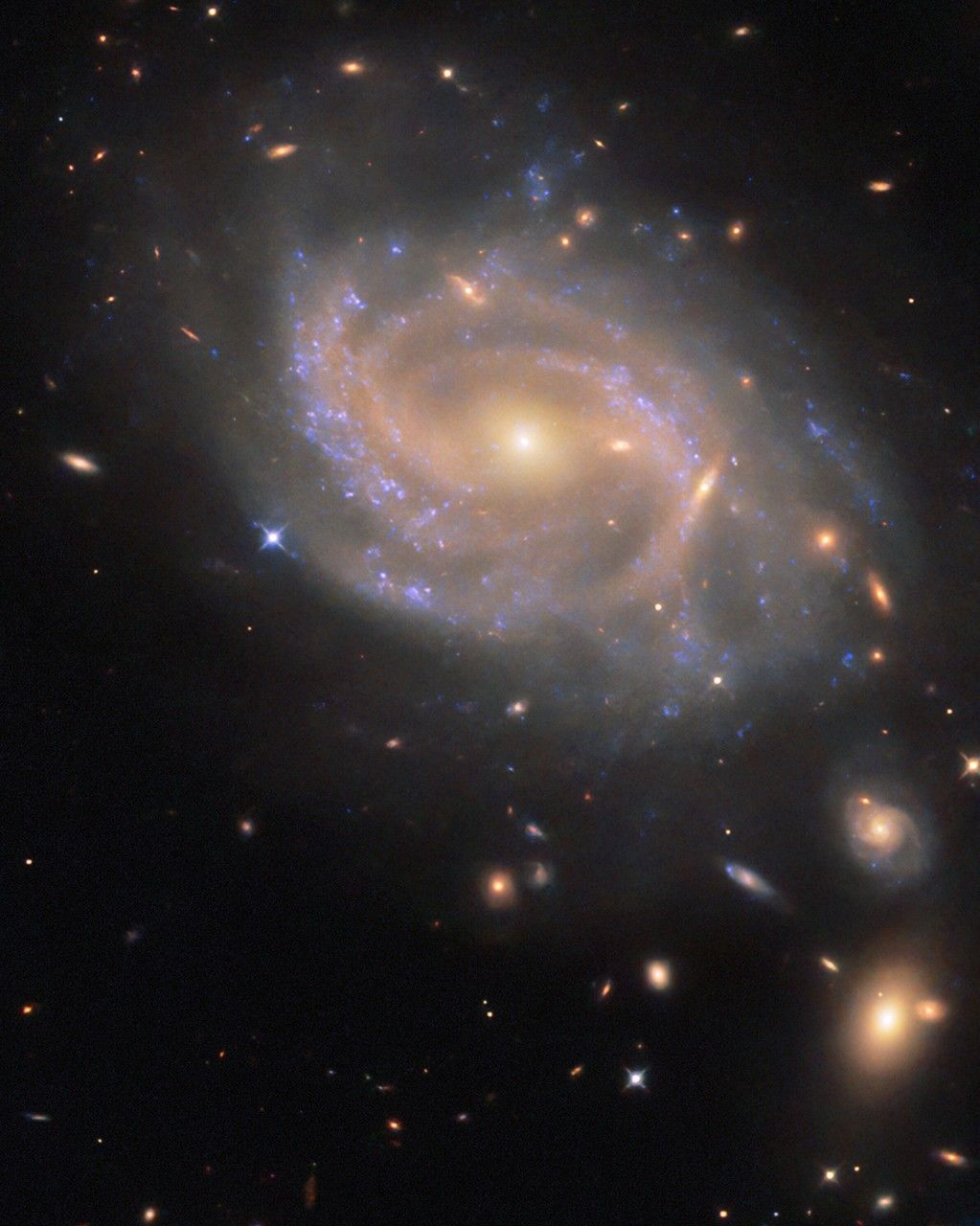
Exploring the Wonders of NGC 3285B: A Distant Spiral Galaxy
The vast expanse of our universe never ceases to amaze with its intricate and awe-inspiring celestial structures. One such marvel is the spiral galaxy NGC 3285B, beautifully captured in an image by the Hubble Space Telescope, a joint mission of NASA and the European Space Agency (ESA). This galaxy is located approximately 137 million light-years from Earth, residing in the Hydra constellation. Known as the Water Snake, Hydra is a prominent constellation, famed for being the most extensive of the 88 constellations mapped across the night sky. To put its size into perspective, Hydra stretches across a 100-degree arc in the sky, a span that would require about 200 full moons placed side by side to cover.
The Galactic Neighborhood: Hydra I Cluster
NGC 3285B is not alone in its cosmic neighborhood. It is part of the Hydra I cluster, one of the largest galaxy clusters in our nearby universe. Galaxy clusters are fascinating celestial formations, consisting of hundreds to thousands of galaxies bound together by the force of gravity. At the heart of the Hydra I cluster are two massive elliptical galaxies, each measuring about 150,000 light-years across. This makes them approximately 50% larger than our Milky Way galaxy, which is already enormous by our earthly standards.
While NGC 3285B is positioned on the outskirts of the Hydra I cluster, far from these central giants, it garnered significant attention from the Hubble Space Telescope due to a remarkable event it hosted in 2023: a Type Ia supernova. For those unfamiliar with the term, a supernova is a powerful and luminous explosion marking the end of a star’s life cycle. A Type Ia supernova specifically occurs when a white dwarf—a dense stellar remnant—accumulates enough material from a companion star or merges with another white dwarf, leading to a cataclysmic explosion. This explosion results in a burst of nuclear fusion, causing the supernova to briefly shine up to 5 billion times brighter than our Sun. In the case of NGC 3285B, the supernova, named SN 2023xqm, appears as a bluish dot on the galaxy’s disk’s left edge.
The Hubble Observation Program
The observation of NGC 3285B was part of a broader Hubble Space Telescope program aimed at studying 100 Type Ia supernovae. The goal of this research is to analyze these supernovae in various wavelengths of light, including ultraviolet, optical, and near-infrared. By doing so, scientists hope to address challenges in cosmic distance measurements, such as the effects of distance and interstellar dust, both of which can cause a supernova to appear redder than it truly is. This program is crucial for refining our understanding of cosmic distances, which is fundamental to cosmology and our knowledge of the universe’s expansion.
Type Ia supernovae are particularly valuable to astronomers because they serve as "standard candles" for measuring astronomical distances. This means their intrinsic brightness is well-understood, allowing researchers to determine how far away they are based on how bright they appear from Earth. However, factors like cosmic dust can alter their observed brightness and color, complicating distance calculations. By closely analyzing these supernovae in multiple light spectra, scientists aim to improve the accuracy of these measurements, enhancing our comprehension of the universe’s scale and structure.
Additional Insights and Reactions
The study of NGC 3285B and other galaxies within the Hydra I cluster offers a glimpse into the dynamic and interconnected nature of the universe. It underscores the critical role that advanced telescopes and international collaborations play in expanding our understanding of cosmic phenomena. The Hubble Space Telescope, for instance, has been instrumental in providing high-resolution images and data that have transformed our knowledge of the universe since its launch in 1990.
Moreover, the study of supernovae like SN 2023xqm contributes to our understanding of stellar evolution and the life cycle of stars. By examining these explosive events, scientists gain insights into the processes that lead to star formation and destruction, as well as the elements dispersed into space during these cataclysmic occurrences. These elements eventually contribute to the formation of new stars and planets, highlighting the interconnected nature of cosmic events.
Conclusion
The exploration of NGC 3285B and its surroundings is a testament to the ongoing quest to unravel the mysteries of the universe. Through the collaborative efforts of space agencies and the use of cutting-edge technology, we continue to push the boundaries of our understanding, unveiling the wonders of distant galaxies and the phenomena that shape them. The insights gained from studying such celestial objects not only deepen our appreciation for the complexity and beauty of the universe but also pave the way for future discoveries that may one day answer some of humanity’s most profound questions about the cosmos.
For those interested in further exploration and detailed images, the Hubble Space Telescope’s findings can be accessed through NASA’s dedicated science mission website. These resources offer a treasure trove of information for both amateur astronomers and seasoned scientists eager to explore the universe’s many wonders.
For more Information, Refer to this article.