























In the rapidly advancing world of technology, discussions about Artificial Intelligence (AI) often revolve around its capabilities for automation and increasing efficiency. However, the potential role of AI in the collaborative domain of open source projects is a topic that is gaining traction. Can AI truly blend with the collective and community-driven essence that characterizes open source initiatives like Apache Airflow? The answer is an emphatic "yes," as demonstrated by our recent endeavor to translate the Airflow user interface (UI) into multiple languages. This narrative is not about AI replacing human contributions, but rather about AI supporting and enhancing human effort, thereby fortifying the very foundation of our open source community.
The Challenge of Internationalization: Bridging a Global Audience
Apache Airflow is a widely-used open source platform designed for programmatically authoring, scheduling, and monitoring workflows. It’s a tool leveraged by individuals and organizations all over the globe. Since its inception over a decade ago, the user interface of Airflow has been exclusively in English. This posed a considerable challenge for many users who prefer interacting with software in their native languages.
The task at hand was a classic internationalization (i18n) challenge: how to translate over 560 phrases in the Airflow UI into various languages, given that only a few contributors might be adept in each language and able to maintain these translations over time. The vast amount of text, along with the subtleties of different languages, the Airflow-specific context, and the open source collaborative nature, made this a formidable task. Moreover, any new feature introduced would necessitate additional translations across multiple languages, meaning existing translations needed to remain current.
The solution needed to provide accurate translations while also fostering community engagement and establishing a sustainable process for future updates.
Navigating Forward: Balancing Efficiency with the Open Source Ethos
Several options were considered when devising a solution. Fully automated machine translation was an obvious choice, promising quick results. However, directly integrating the UI with a translation API seemed contrary to the ethos of open source. The risk was losing the human touch, cultural context, and the invaluable feedback loop provided by active contributor involvement. Moreover, skilled human oversight was still necessary to ensure translations were clear for native speakers, accurately conveyed the original intent, and fit within the UI constraints, something that AI alone cannot yet fully achieve.
The challenge was to harness the power of AI while maintaining community engagement, encouraging collaboration, and upholding the high-quality standards that come from human expertise. The goal was not just to complete translations, but to do so in a manner that empowered contributors and strengthened the project. Building relationships, not just translating strings, was paramount.
The AI-Powered Process and Community-Driven Tooling
Our solution was centered around a "people-first, AI-assisted" methodology. Rather than relying solely on AI for translation, we developed a process that empowered individual contributors, using AI as a supportive tool rather than a full replacement.
Here is how we approached the task:
- Contributor Ownership: We invited community members to "adopt" a language. Each volunteer became the primary owner and reviewer for their chosen language, fostering a sense of responsibility and commitment. Often, we had multiple people proficient in their native language who could collaborate and agree on accurate translations.
- Purpose-Built Tooling: We developed custom tools to facilitate the integration of standard coding tools like Large Language Models (LLM) to support translation efforts.
- Iterative Review and Refinement: After a contributor worked through the AI-generated suggestions, their translations were subject to peer review within the community. This human-to-human interaction was crucial for capturing nuances, ensuring cultural relevance, and maintaining consistency.
- Simplified Contribution Process: We streamlined the process for submitting translations, making it easy for contributors, including those new to open source contributions, to get involved.
This methodology allowed us to rapidly produce initial translations while keeping human intelligence and collaboration at the forefront.
People and Collaboration: The Core of Sustainable Translation
The success of this initiative was rooted not just in technology, but in human collaboration. By centering on community and individual ownership, we achieved remarkable results.
Here’s why this community-centric approach, augmented by AI, was so effective:
- Empowering Contributors: Contributors could leverage AI to initiate their work, making the task seem less daunting and more achievable. This significantly increased efficiency, particularly for repetitive parts of the translation process.
- Strengthening Bonds: The shared objective of translating Airflow fostered direct interaction and collaboration among contributors. We witnessed lively discussions, useful suggestions, and a real sense of camaraderie as individuals worked together on their languages, sometimes even assisting each other across languages due to linguistic similarities.
- Quality Through Collaboration: While AI provided a solid starting point, the human element was crucial for quality. There were numerous instances where AI-generated translations, though grammatically correct, missed the specific context or tone needed for the Airflow UI. Collaborative review processes ensured these nuances were captured.
- Sustainable Engagement: By making contributors responsible for their languages, we established a sustainable model for ongoing translation efforts. As Airflow evolves, these dedicated language owners will play a critical role in maintaining up-to-date translations, preventing bottlenecks, and ensuring the long-term viability of the internationalization effort.
- Human-Driven, AI-Friendly Tooling: The tools designed for this task made it easy to identify when new translations were necessary and to generate incremental updates. Once automated translations were reviewed, they were accepted, ensuring that the translations were accurate and consistent.
Interestingly, the tooling itself was developed using AI, similar to how the first draft of this article was created. We described our requirements to AI, which then generated the tool scripts in Python for us. We iterated heavily on both the tools and the article with manual review and AI, saving time that was then used to refine our approach.
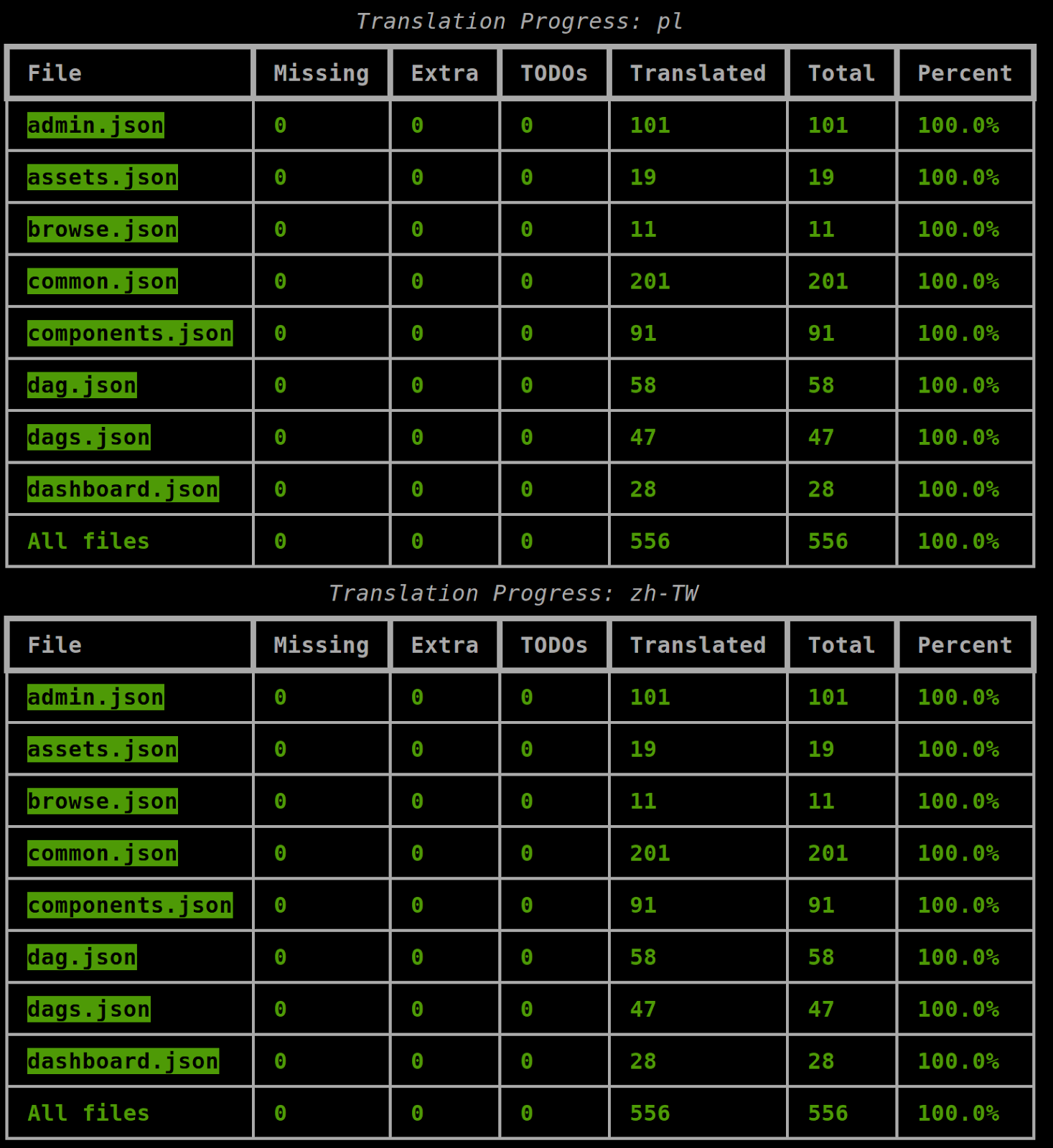
In just a few weeks, we successfully translated over 560 UI phrases into eight languages. This rapid progress was a direct result of smart tooling combined with an empowered, collaborative community.
Responsible AI in Open Source: A Model for the Future
Our experience with translating Apache Airflow’s UI provides a compelling answer to the question: "How can we leverage AI while preserving the open source spirit and collaboration?" Instead of adopting a "top-down" AI approach that might automate everything, we chose a model where AI enables open source maintainers and collaborators to enhance their efficiency while fiercely protecting and fostering the core principles of open source collaboration.
This endeavor underscores an important distinction: AI in open source shouldn’t merely focus on efficiency gains, as is often the case in corporate AI adoption. While efficiency is a welcome byproduct, the true strength of AI in open source lies in its potential to improve collaboration, build relationships, and empower individuals.
The Apache Software Foundation, with its guiding principle of "community over code," is an ideal environment for this responsible and human-centric application of AI. It offers a place where newcomers can genuinely interact with and learn from experienced contributors—a valuable opportunity that is becoming increasingly rare in a corporate world where entry-level roles and hands-on experience are diminishing as junior positions are often replaced by AI.
Our Airflow translation project exemplifies how AI, when used thoughtfully and with a commitment to community, can not only accelerate progress but also strengthen the bonds that make open source truly unique. Beyond Airflow, this example is applicable to many other open source projects, demonstrating that the future of open source, augmented by AI, is not one where automation replaces people, but one where AI empowers people to build, collaborate, and innovate together.
We firmly believe that a similar approach, along with the patterns and philosophy of integrating AI workflows into open-source projects, is widely applicable—not only to numerous open-source initiatives but also to a variety of tasks such as refactoring and applying new code patterns. These approaches can also enhance collaboration, build relationships, and empower individuals.
This people-first, AI-assisted model for internationalization offers a valuable blueprint for other open source projects facing similar challenges. By prioritizing human collaboration and ownership, and strategically applying AI to accelerate repetitive tasks, projects can achieve widespread translation without sacrificing community engagement or quality. This approach emphasizes building purpose-built tools that support human review and iteration, fostering a sense of shared responsibility among contributors, and streamlining the contribution process to make it accessible for newcomers. Ultimately, the success lies in viewing AI not as a replacement for human effort, but as a powerful enabler that amplifies the impact of a dedicated and collaborative community.
For more Information, Refer to this article.