Captivating Cosmic Scenes: A Closer Look at Galaxy NGC 1309
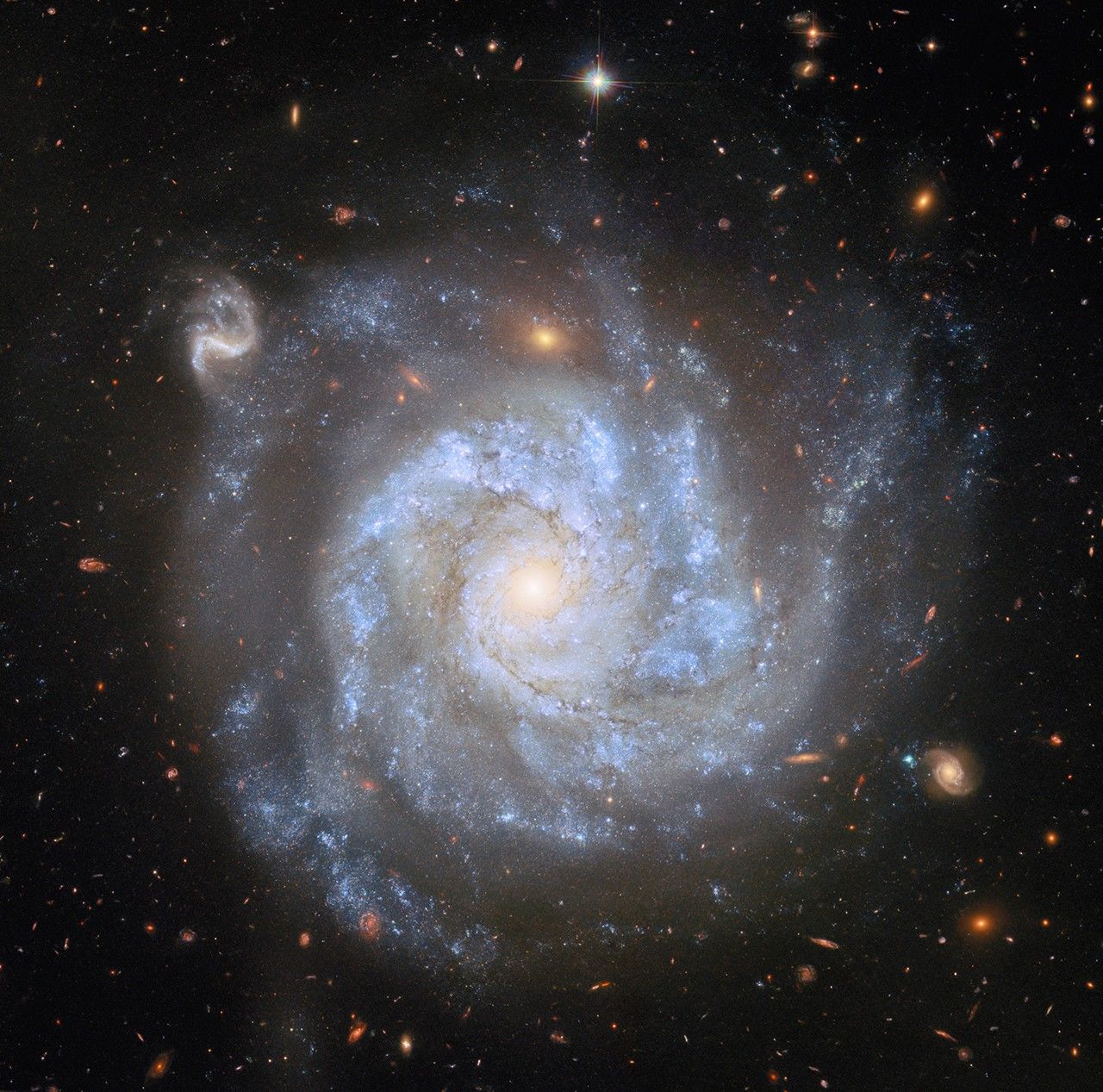
Nestled in the vastness of space, the spiral galaxy NGC 1309 presents a mesmerizing view as captured by the renowned Hubble Space Telescope, a joint venture between NASA and the European Space Agency (ESA). Located approximately 100 million light-years away from Earth, this celestial wonder is part of the constellation Eridanus. The image of NGC 1309 is not merely a snapshot; it is a window into the past, offering insights into cosmic events that unfolded millions of years ago.
A Stellar Portrait of NGC 1309
The latest image of NGC 1309 reveals a breathtaking spectacle. The galaxy’s spiraling arms are adorned with bluish stars, dark brown gas clouds, and a luminous pearly-white core. What makes this image even more spectacular are the myriad distant galaxies visible in the background. Each smudge, streak, and blob of light is an individual galaxy, many of which are shining through the less dense regions of NGC 1309 itself. This creates a cosmic tapestry that extends far beyond the boundaries of the galaxy.
Amidst this galactic ensemble, a solitary star can be seen near the top of the frame. Identified by its diffraction spikes—a pattern created by the telescope’s optics—this star is one of our cosmic neighbors, residing within the Milky Way galaxy, only a few thousand light-years away from Earth.
Hubble’s Continued Exploration of NGC 1309
Hubble’s fascination with NGC 1309 has prompted numerous observations over the years. The telescope first captured images of this galaxy in 2006 and again in 2014. The scientific intrigue surrounding NGC 1309 largely stems from two supernovae—SN 2002fk and SN 2012Z—that occurred within this galaxy.
The supernova SN 2002fk, observed in 2002, is a textbook example of a Type Ia supernova. This type of supernova occurs when a white dwarf, the remnant core of a dead star, accumulates enough material from a companion star to reach a critical mass, leading to a catastrophic explosion. Type Ia supernovae are vital to astronomers as they serve as "standard candles" for measuring cosmic distances due to their consistent brightness.
The Enigma of SN 2012Z
In 2012, another noteworthy supernova, SN 2012Z, was detected in NGC 1309. Unlike its predecessor, SN 2012Z did not conform to the typical Type Ia supernova profile. Instead, it was classified as a Type Iax supernova. While its spectral characteristics bore a resemblance to a Type Ia supernova, its explosion was notably less luminous.
Hubble’s meticulous observations revealed a fascinating twist in the tale of SN 2012Z. Unlike the typical fate of a white dwarf in a supernova, which is usually obliterated, this explosion did not completely destroy the white dwarf. Instead, it left behind what astronomers have dubbed a "zombie star." Remarkably, this surviving remnant shone even brighter than it did before the explosion. This discovery marked the first time that astronomers identified a star system that later produced such an unusual supernova event involving a white dwarf.
The Broader Implications of These Discoveries
The discoveries associated with NGC 1309 and its supernovae have significant implications for our understanding of stellar evolution and the dynamics of galaxies. The study of Type Ia and Type Iax supernovae not only enhances our comprehension of stellar lifecycles but also aids in the measurement of vast cosmic distances, playing a crucial role in mapping the universe.
Furthermore, the identification of a "zombie star" challenges existing theories about the end stages of a white dwarf’s life. It opens up new avenues of inquiry into the behavior of these remnants and the conditions that lead to different types of supernovae. This, in turn, can provide insights into the processes that contribute to the chemical enrichment of galaxies, as supernovae are key drivers of element formation and distribution in the universe.
The Continued Legacy of the Hubble Space Telescope
The Hubble Space Telescope has been instrumental in advancing our understanding of the universe since its launch in 1990. Its ability to capture detailed images of distant galaxies, stars, and cosmic phenomena has transformed our knowledge of the cosmos. The observations of NGC 1309 are just one example of the wealth of information Hubble has provided to scientists and astronomers worldwide.
As Hubble continues to orbit Earth and capture the mysteries of the universe, it remains a vital tool for exploring the frontiers of space. Its legacy endures as it inspires new generations of astronomers and space enthusiasts, fueling curiosity and the quest for knowledge about our place in the cosmos.
Conclusion
The captivating images of NGC 1309 and the intriguing discoveries of supernovae SN 2002fk and SN 2012Z underscore the dynamic and ever-evolving nature of the universe. These findings not only enrich our understanding of galaxies and stellar phenomena but also highlight the invaluable contributions of space observatories like the Hubble Space Telescope in unraveling the mysteries of the cosmos.
For further details on Hubble’s mission and discoveries, interested readers can explore the NASA Hubble website here.
By delving into the cosmic dance of galaxies, stars, and supernovae, we gain a deeper appreciation of the intricate tapestry of the universe and our own place within it. As we continue to explore the heavens, each discovery serves as a reminder of the boundless wonders that await us in the vast expanse of space.
For more Information, Refer to this article.