























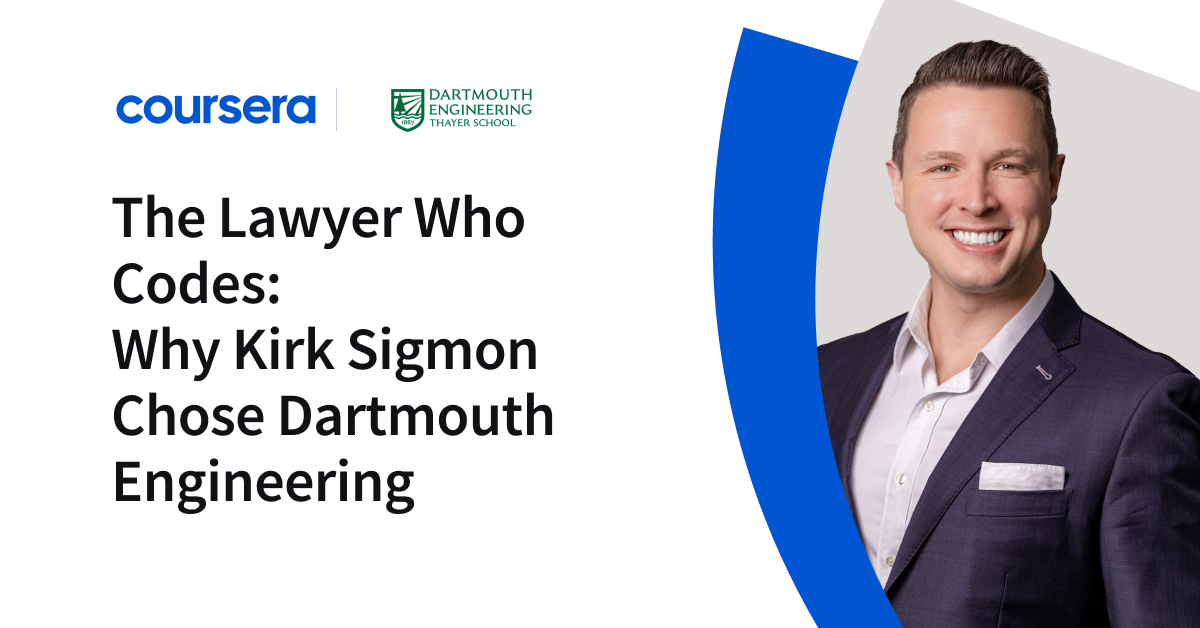
Expanding Horizons: Kirk Sigmon’s Journey from Law to Engineering
Kirk Sigmon, an unusual figure in the legal field, is redefining the traditional path of a lawyer through his unique approach to intellectual property (IP) law. As a partner and attorney specializing in artificial intelligence (AI) law, he is not content with a surface-level understanding of technology. Instead, Sigmon has embarked on a journey to delve deeper into the engineering realm, a decision that sets him apart in his profession. To achieve this, he enrolled in the Master’s of Engineering in Computer Engineering (MEng-CE) program at Dartmouth College. This program, he believes, will bring immense value to his career, far beyond traditional expectations.
A Diverse Background Leading to Expertise
Sigmon’s educational and professional trajectory is a testament to his relentless pursuit of knowledge. Beginning with an undergraduate degree in English Literature and Japanese, he proceeded to law school at Cornell. His career took an international turn when he moved to Japan, where he worked as a self-taught programmer before shifting his focus entirely to intellectual property law.
Realizing the limits of his self-taught engineering knowledge, Sigmon returned to academia, earning a Bachelor of Science in Electrical Engineering from Arizona State University. He furthered his education with an MBA from Temple University—all while continuing his professional work. This electrical engineering degree opened doors for him to the patent bar, allowing him to fully embrace his passion for patent law. However, as he gained seniority, Sigmon felt the urge to deepen his understanding of AI.
The Growing Role of AI in the Legal Field
While AI might not be the first thing that comes to mind when considering the legal industry, it plays an increasingly significant role, especially in IP law. Sigmon’s clients frequently inquire about data privacy and intellectual property protection in the context of AI. This has led him to explore complex questions, such as the reversibility of machine learning models.
Although we have not yet reached a point where AI commits crimes, Sigmon focuses on exciting projects involving AI components in technologies like self-driving cars and machine learning models that enhance business operations. To elevate his existing engineering and programming expertise, Sigmon sought a deeper understanding of these technologies.
"We’re not at the stage where robots are taking over the world," Sigmon quips, "so until then, I’m specializing in the actual nuts and bolts."
Choosing Dartmouth for Continued Education
Sigmon discovered Dartmouth’s online Master of Engineering in Computer Engineering program while researching AI courses on Coursera. Having previously completed an IBM data engineering certificate on the platform, the Dartmouth program seemed like a natural progression. The curriculum, which includes machine learning, deep learning, FPGA courses, and embedded systems, perfectly aligns with his professional needs.
The program’s comprehensive nature and immediate applicability to his work convinced Sigmon of its value. "The combination of AI knowledge and engineering fundamentals is where the rubber hits the road," he explains. Additionally, Dartmouth’s esteemed reputation and the online format suited his busy lifestyle.
"I’ve heard nothing but positive feedback about Dartmouth and its engineering department," Sigmon notes. "One of the engineers I work closely with is a Dartmouth graduate. The decision was easy."
Real-Time Application of Learning
Even while still enrolled in the program, Sigmon experiences tangible benefits in his career. Collaborating with autonomous vehicle companies, his coursework in machine vision enables him to converse intelligently with engineers about cutting-edge technology. "Most attorneys claiming to specialize in AI have never programmed anything," he observes. "But having done the coding myself opens doors and lends me credibility."
Sigmon’s coursework often intersects with real-world legal scenarios. One project involves utilizing language models to explore copyright boundaries, directly relating to ongoing cases in AI law. "The transferability of skills has been fantastic. Everything I’m learning is immediately relevant to my career."
Engaging Online Learning Experience
Despite being fully online, Dartmouth’s program fosters a sense of community and engagement that Sigmon finds invaluable. Professors like Peter Chin (machine learning) and Kendall Farnham (FPGAs and machine vision) go to great lengths to ensure students feel connected and supported. "The professors actually care. They know us by name, they know our work, and it feels like we’re actively part of the program," Sigmon says.
The small cohort size, approximately 20 students, allows for a more personalized experience compared to larger programs. With hands-on courses that send kits directly to students’ homes, learning extends beyond theory to practical application. Sigmon eagerly anticipates an upcoming campus visit and continues to immerse himself in the Dartmouth community.
Carving Out a Professional Niche
Looking ahead to his anticipated graduation in Spring 2026, Sigmon will hold five degrees, demonstrating his commitment to self-improvement. These credentials have enabled him to find a niche within his profession that benefits both him and his firm. "Most attorneys aren’t well-versed in AI. Many have just skimmed Wikipedia summaries and hypothesize about AI taking over the world. But my experience from Dartmouth has already opened doors because I’ve actually done the coding."
Guidance for Future Applicants
Sigmon acknowledges the workload and difficulty of the coursework, emphasizing that Dartmouth’s rigorous curriculum and prestige are not for everyone. However, he takes pride in his progress. "I’m very pleased with the coursework, and I enjoy showing that this isn’t just a feather in my cap. This is real, challenging coursework, and I’m proud to excel in it."
His advice for prospective Dartmouth students is to build a strong foundation. "Coursera offers a lead-up program that helps you get up to speed. The C Programming with Linux Specialization is a great way to assess your readiness to dedicate 20-30 hours a week to learning while balancing work, family, and social life."
A Commitment to Lifelong Learning
Based in Washington, D.C., Sigmon plans to visit Dartmouth’s campus in the fall to engage further with the community and gain firsthand insight into the engineering department. Even from afar, he is already reaping the rewards of the program, applying new skills to his legal practice and lecturing engagements worldwide. "Understanding AI at a technical level isn’t just interesting; it’s immediately relevant to my work and gives me authority in a space where most lawyers have none."
Kirk Sigmon’s journey serves as a reminder that education and expertise need not follow a linear path. By blending law, engineering, and AI, he has carved out a unique niche that allows him to influence both technological and legal landscapes. His story demonstrates that with curiosity and dedication, the boundaries between disciplines can be bridged and championed, creating new opportunities for growth and innovation. For more details on the program, you can visit Coursera’s blog.
For more Information, Refer to this article.