
























Exploring Mars: Perseverance Rover’s Latest Discoveries in Jezero Crater
In recent developments on Mars, NASA’s Perseverance rover has achieved a significant milestone by analyzing two distinctly different rock samples in quick succession, providing valuable insights into the planet’s geological history. This exploration took place in the Vernodden area along the rim of Jezero Crater, a site of immense interest due to its potential to harbor clues about Mars’ ancient past.
Analyzing "Peachflya": Uncovering Ancient Breccia
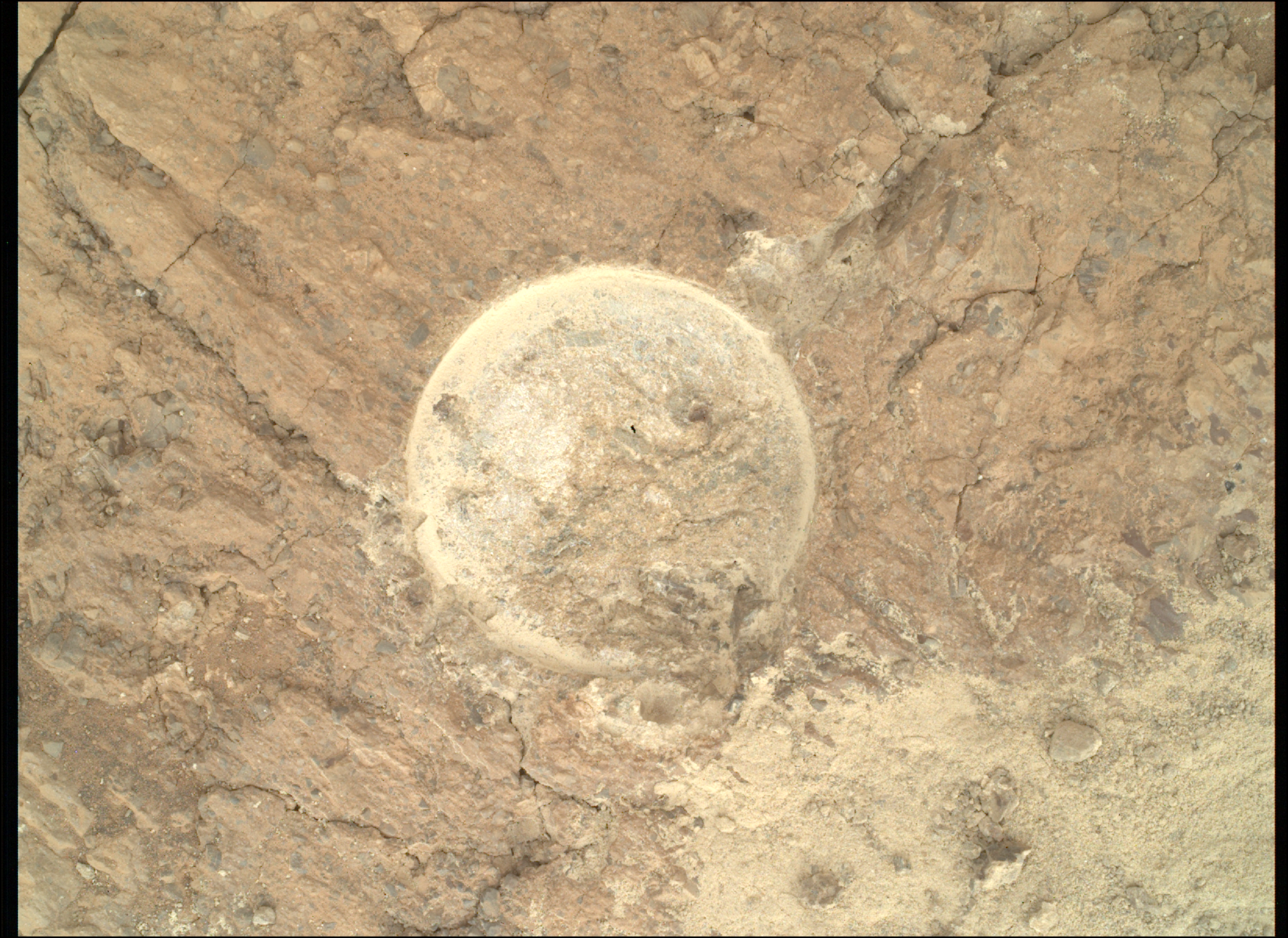
On Sol 1618, Perseverance focused its attention on a rock target named "Peachflya." The abrasion of this rock revealed clasts, or fragments, of varying mineral compositions. This discovery suggests that the rock might be a breccia. In geological terms, breccia is a type of rock formed from broken fragments of minerals or rock cemented together by a fine-grained matrix. The presence of such a formation on Mars indicates a history of dynamic geological processes, possibly including impacts that shattered older materials, which were then transported and cemented together over time. This finding is crucial as it offers a glimpse into the tumultuous events that shaped Mars’ surface in its early history.
Unveiling "Klorne": Evidence of Chemical Alteration
Just a short distance from "Peachflya," Perseverance explored another rock, "Klorne," on Sol 1623. This rock presented a strikingly different appearance, with a greenish surface interspersed with dark spots and white veins. These features suggest significant chemical alteration, a process that occurs when minerals within a rock undergo changes due to chemical reactions, often involving water. The green hue observed in "Klorne" is consistent with the mineral serpentine. Serpentine is a group of minerals that are typically formed in the presence of water, hinting at past aqueous activity on Mars. This discovery is reminiscent of an earlier observation made by Perseverance at a site dubbed "Serpentine Lake" on Sol 1404, where similar greenish rocks were identified.
The "Monacofjellet" Megablock: A New Focus
Following these intriguing findings, Perseverance is set to examine another rock formation known as the "Monacofjellet" megablock. This rock promises to offer yet another unique spectral signature, further diversifying the geological narrative of the Jezero Crater region. Each of these ancient rock fragments plays a crucial role in helping scientists reconstruct the complex geological processes that influenced early Mars. By studying variations in mineral composition, texture, and chemical alterations, researchers aim to piece together the planet’s history and better understand the environmental conditions that once prevailed.
Understanding Mars’ Geological History
The discoveries made by Perseverance underscore the dynamic and multifaceted nature of Mars’ geological history. The presence of breccia-like formations and chemically altered rocks indicates a planet that has experienced significant geological transformations. These processes include impacts, volcanic activity, and the possible presence of water, all of which have contributed to shaping the Martian landscape over billions of years.
The Importance of Serpentine
The identification of serpentine in Martian rocks is particularly noteworthy. On Earth, serpentine is often associated with hydrothermal activity, where heated water interacts with rock, leading to the formation of new minerals. Such environments are considered potential habitats for microbial life, making the presence of serpentine on Mars an exciting prospect for astrobiology. While there is currently no direct evidence of life on Mars, understanding the planet’s past environmental conditions is a critical step in assessing its habitability.
Perseverance’s Mission: A Broader Context
Perseverance’s mission on Mars is part of NASA’s broader effort to explore the Red Planet and seek signs of ancient life. The rover is equipped with a suite of scientific instruments designed to conduct detailed analyses of the Martian surface and atmosphere. By collecting and studying rock samples, Perseverance aims to shed light on the planet’s geological and climatic history, ultimately paving the way for future human exploration.
Conclusion: A Step Forward in Mars Exploration
The recent findings by Perseverance highlight the rover’s pivotal role in advancing our understanding of Mars. By uncovering the stories told by rocks like "Peachflya" and "Klorne," scientists can piece together a more comprehensive picture of the planet’s past. These discoveries not only enhance our knowledge of Mars’ geological processes but also raise intriguing questions about the possibility of past life on the planet.
As Perseverance continues its journey across the Martian surface, each new discovery brings us closer to unraveling the mysteries of Mars. The rover’s ongoing exploration efforts are a testament to human curiosity and ingenuity, driving us to explore the unknown and expand our understanding of the universe.
For more detailed insights and updates on Perseverance’s mission, you can refer to NASA’s official website and their scientific publications.
For more Information, Refer to this article.