























October’s Night Sky Notes: The Exciting World of Gravitational Waves
As we find ourselves in September 2025, it is an opportune moment to celebrate a significant milestone in the field of astrophysics. This year marks the tenth anniversary of a groundbreaking achievement that confirmed one of Albert Einstein’s most intriguing predictions from his 1916 theory of General Relativity: the direct detection of gravitational waves. These elusive ripples in the very fabric of space-time were first observed by the Laser Interferometer Gravitational-Wave Observatory (LIGO), an achievement that has opened new avenues in the understanding of the universe.
Understanding Gravitational Waves
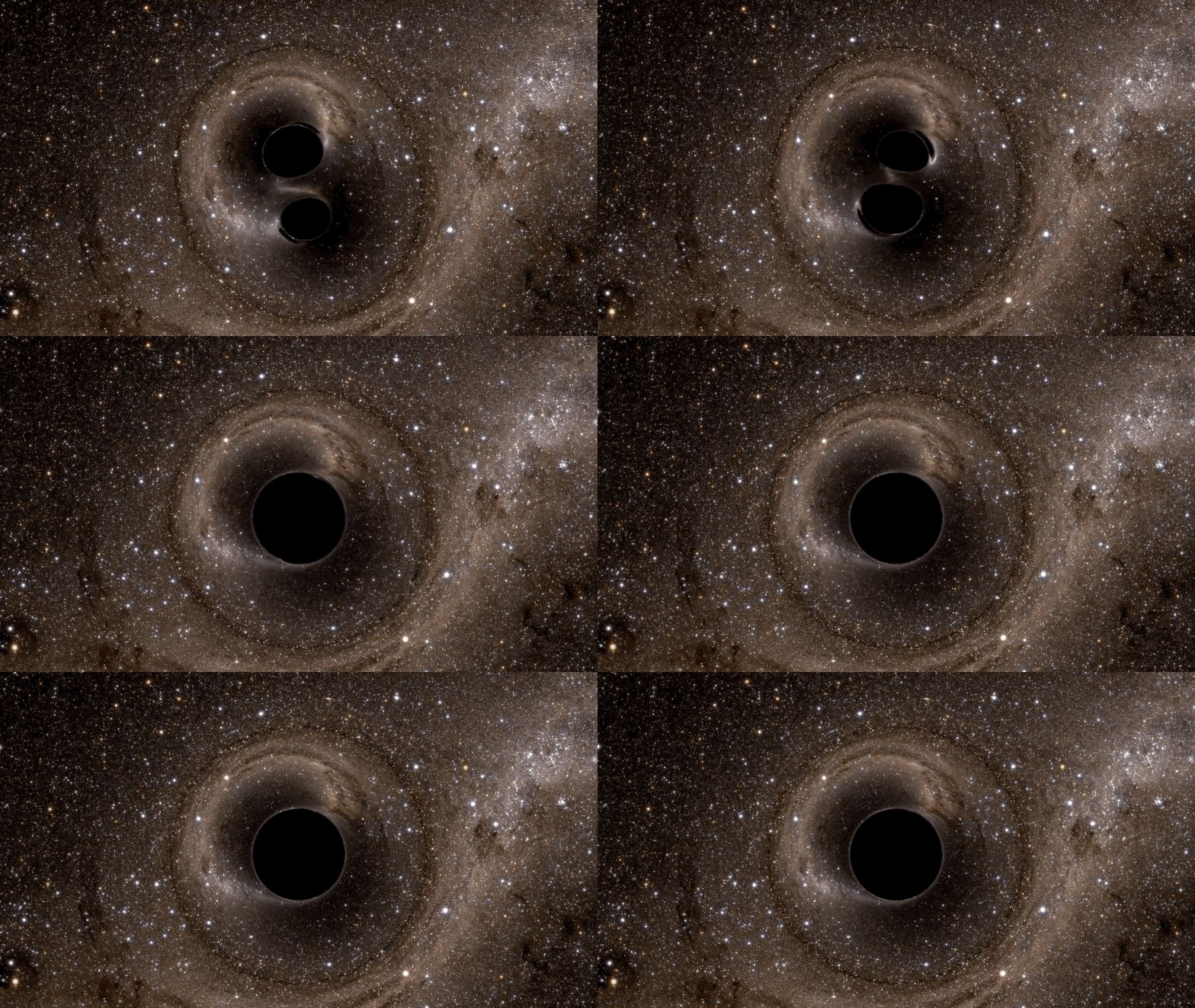
Gravitational waves are fascinating phenomena generated by the acceleration of massive celestial objects. Imagine two gigantic black holes spiraling towards each other and eventually colliding. This cosmic dance creates ripples in space-time, akin to the ripples you see when a stone is thrown into a pond. However, gravitational waves are not only the result of black hole mergers. They can also be created by other dramatic cosmic events, such as the explosion of a star in a supernova or the collision of neutron stars. While these waves are imperceptible to the human eye, they are a profound testament to the dynamic nature of the universe.
The first detection of gravitational waves by LIGO occurred when two black holes, in a cosmic ballet, merged into one, sending ripples through the universe. The detection of these waves was a monumental event, opening up a new way to observe and understand the cosmos.
How Gravitational Wave Observatories Work
Gravitational wave observatories like LIGO operate on an ingenious principle. They consist of two long tunnels arranged in an “L” shape, each stretching approximately 2.5 miles. At the end of each tunnel, there is a highly polished mirror designed to reflect laser beams. A laser is split into two beams, sent down each tunnel, and then recombined. If the tunnels are of equal length, the returning light waves cancel each other out perfectly, resulting in darkness at the detector. However, if a gravitational wave passes through, it causes one tunnel to stretch slightly and the other to compress, altering the time it takes for the beams to return. This change results in a detectable flicker of light, revealing the passage of a gravitational wave.
The detection process is precise. Even the tiniest difference in the beams’ return time can indicate the presence of a gravitational wave. The observatories in Washington State (LIGO Hanford) and Louisiana (LIGO Livingston) work in tandem to ensure accuracy. Both must record the same signal within milliseconds to confirm that it is a gravitational wave and not local interference. This meticulous process allows scientists to detect these cosmic ripples, providing invaluable insights into the universe’s workings.
Expanding the Search for Gravitational Waves
LIGO is not alone in the quest to explore gravitational waves. The network has expanded to include additional observatories like VIRGO in Italy and KAGRA in Japan. With their help, scientists have detected over 300 black hole mergers in the past decade. Some of these detections have been confirmed, while others await further analysis. This burgeoning field of study is revolutionizing our understanding of the universe and inspiring a new generation of astrophysicists.
Although most people don’t have access to sophisticated instruments like laser interferometers, there are ways to contribute to gravitational wave research. Two notable citizen science projects offer intriguing opportunities for public participation:
- Black Hole Hunters: This project utilizes data from NASA’s Transiting Exoplanet Survey Satellite (TESS). Volunteers analyze graphs showing changes in star brightness over time, searching for gravitational microlensing effects. This phenomenon occurs when a massive object, such as a black hole, passes in front of a star, temporarily magnifying its light. By participating, you can help identify potential black holes lurking in space.
- Gravity Spy: This project involves assisting LIGO scientists by identifying glitches in the data that may mimic gravitational waves. By sorting through these mimics, participants help in refining algorithms that distinguish genuine gravitational wave signals. This collaborative effort is crucial in improving the accuracy of gravitational wave detection.
For those interested in a more hands-on approach, NASA’s Jet Propulsion Laboratory offers an educational activity called "Dropping In With Gravitational Waves." Using simple materials like gelatin, magnetic marbles, and a small mirror, participants can simulate how gravitational waves ripple through space-time. It’s an engaging way to grasp the fundamental principles behind these cosmic phenomena.
The Future of Gravitational Wave Astronomy
The detection of gravitational waves has opened a new window into the universe, allowing scientists to observe events that were previously inaccessible. This field has already led to remarkable discoveries, such as the observation of a neutron star collision that produced both gravitational waves and electromagnetic radiation. This event, observed in 2017, gave rise to the emerging field of multi-messenger astronomy, where different types of signals (such as light and gravitational waves) are used together to study cosmic phenomena.
As technology advances, the sensitivity of gravitational wave detectors will continue to improve, enabling the detection of even fainter signals from deeper in the universe. This progress promises to reveal more about the mysterious events that shape our cosmos, from the formation of black holes to the dynamics of neutron stars.
In conclusion, the tenth anniversary of gravitational wave detection is a testament to human ingenuity and the relentless pursuit of knowledge. As we continue to explore the universe through this new lens, we are sure to encounter surprises that will challenge our understanding and inspire future generations of scientists. The journey into the cosmos is far from over, and gravitational waves are leading the way into uncharted territories of space and time.
For those interested in delving deeper into the world of gravitational waves, resources and further reading can be found on NASA’s website. This incredible journey is just beginning, and there is much more to discover in the vast expanse of the universe.
For more Information, Refer to this article.