
























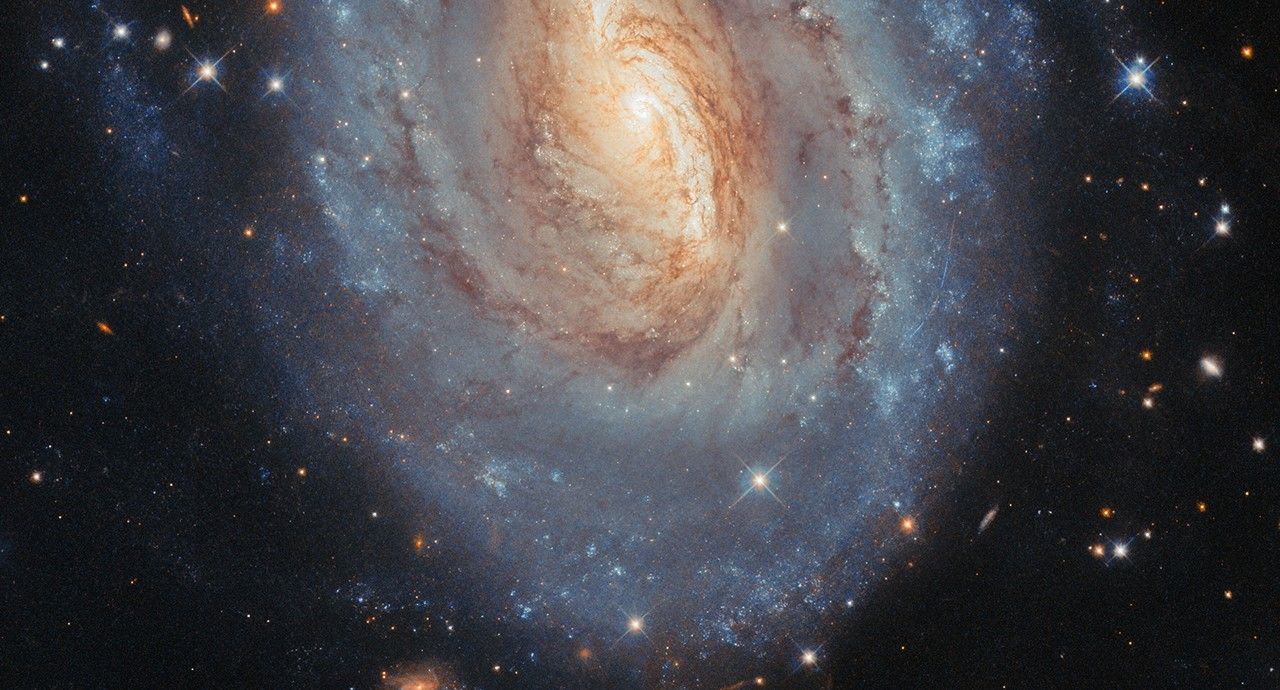
Stars of All Ages Illuminate the NGC 6000 Galaxy
The universe never ceases to amaze us with its vastness and the myriad wonders it holds. One such marvel is the spiral galaxy known as NGC 6000, located an incredible 102 million light-years away in the constellation Scorpius. This galaxy, captured in a stunning image by the Hubble Space Telescope, showcases stars of various ages, sizes, and temperatures, each contributing to the galaxy’s distinct and colorful appearance.
A Kaleidoscope of Stellar Colors
NGC 6000 is a vibrant tapestry of colors, with a glowing yellow core and gleaming blue edges. This color variation is not random but rather a reflection of the differences in the ages, masses, and temperatures of the stars within the galaxy. At the center, we find stars that are generally older and smaller. These less massive stars are cooler, which may seem counterintuitive, but cooler stars emit a redder hue. Conversely, the outskirts of the galaxy, along its spiral arms, are home to clusters of young, massive stars that shine in bright blue.
Insights from Supernova Observations
The Hubble Telescope gathered data for this remarkable image while conducting a survey of recent supernova explosions in nearby galaxies. NGC 6000 was the site of two such cosmic events: SN 2007ch in 2007 and SN 2010as in 2010. Hubble’s advanced detectors can still perceive the faint glow of these supernovae years after their initial explosions. These observations are crucial for scientists as they help determine the masses of the stars that went supernova and whether these stars had any stellar companions.
Asteroids in the Galactic Portrait
An interesting feature of this Hubble image is the presence of a series of four thin yellow and blue lines on the right side of the galaxy’s disk. These lines were caused by an asteroid from our solar system drifting across Hubble’s field of view during the observation of NGC 6000. The four lines are the result of four separate exposures taken consecutively, with brief intervals between each. Image processors combined these exposures to produce the final image. The dashed appearance, with alternating colors, is due to each exposure being taken through a filter that collected specific wavelengths of light, primarily in the red and blue spectrum. This method not only highlights the colors of the stars, aiding in their study, but also makes any asteroids passing by quite noticeable.
The Importance of Wavelength Filters
Using different filters to capture specific wavelengths of light is a common technique in astronomical observations. It allows scientists to examine and compare stars based on their colors, which provides insights into their properties such as temperature and composition. In the case of NGC 6000, the use of red and blue filters helped paint a detailed picture of the galaxy, revealing its diverse stellar population and the ongoing stellar formation in its spiral arms.
Understanding Stellar Evolution
The study of galaxies like NGC 6000 is essential for understanding stellar evolution. By observing the distribution of stars and their properties, astronomers can infer the processes that govern their birth, life, and eventual death. The presence of young, massive stars in the spiral arms suggests active star formation, while the older, cooler stars in the center indicate a more mature stellar population. These observations provide a snapshot of the galaxy’s history and evolution over millions of years.
The Role of the Hubble Space Telescope
The Hubble Space Telescope, a joint project by NASA and the European Space Agency (ESA), has been instrumental in expanding our knowledge of the universe. Launched in 1990, Hubble has provided breathtaking images and invaluable data that have led to numerous scientific breakthroughs. Its ability to observe distant galaxies like NGC 6000 has allowed astronomers to study the cosmos in unprecedented detail, enhancing our understanding of the complex dynamics of galaxies.
Conclusion
The image of NGC 6000 captured by the Hubble Space Telescope is more than just a beautiful picture; it is a window into the universe’s history and the life cycle of stars. By studying galaxies like NGC 6000, scientists continue to unravel the mysteries of stellar evolution, supernovae, and the intricate dance of celestial bodies in the vast expanse of space. As our technological capabilities advance, we can only imagine what new discoveries await us in the depths of the cosmos.
For more detailed insights and imagery from the Hubble Space Telescope, you can visit NASA’s official Hubble website.
For more Information, Refer to this article.