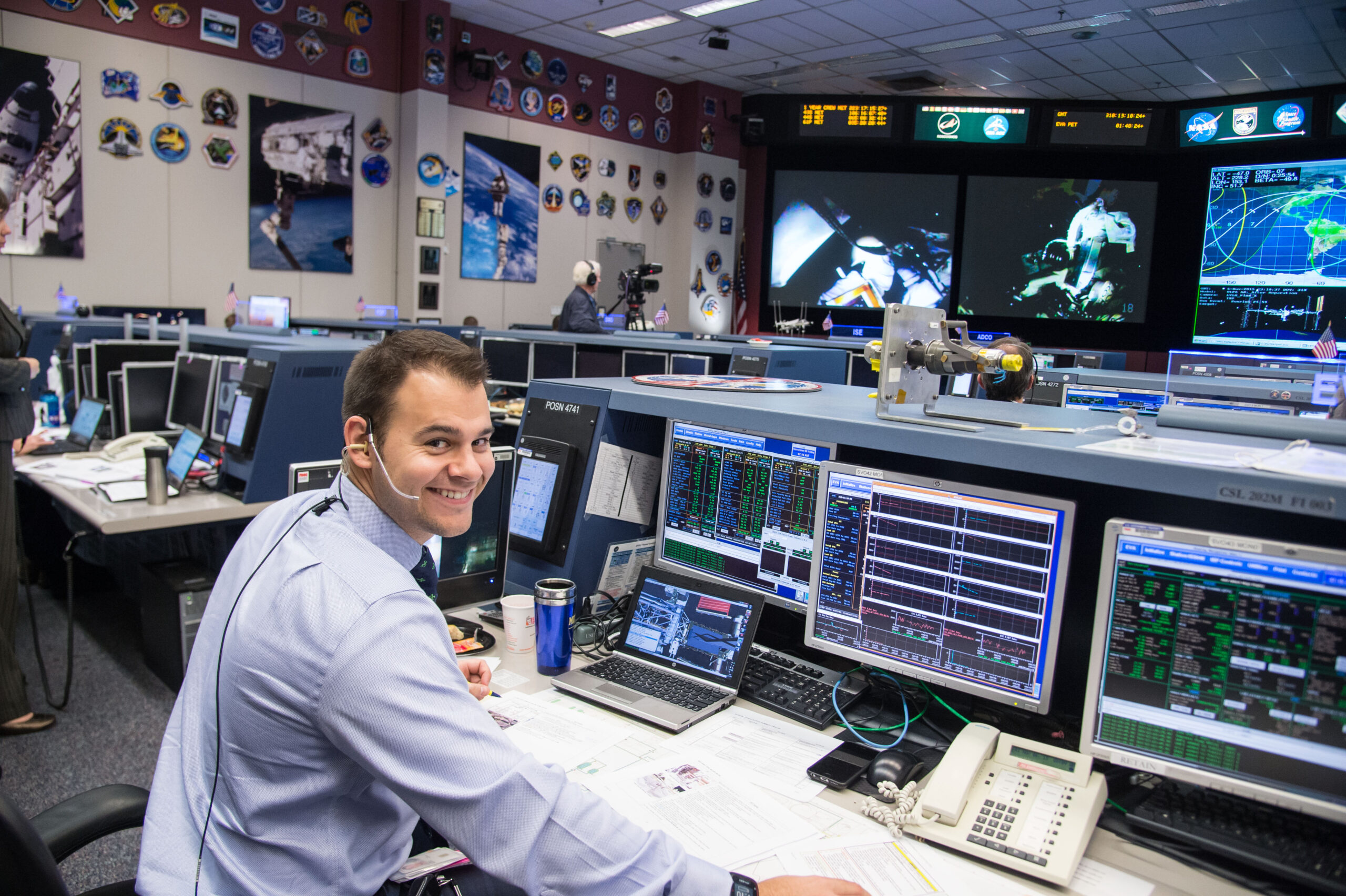
From College Seminar to NASA: Brian Alpert’s Exciting Journey
In the world of aerospace, Brian Alpert’s career trajectory has been as impressive as a high-flying spacecraft. His path was almost predestined to intersect with the aerospace industry, but the pivotal moment came during his sophomore year in college. It was then that he attended a particularly inspiring seminar led by Tricia Mack, a professional working at NASA’s Transportation Integration Office within the International Space Station Program. Mack spoke to Alpert’s class about the intricacies of planning spacewalks, training astronauts, and supporting operations from NASA’s Mission Control Center located in Houston. This encounter sparked a passion in Alpert that would steer him towards a career with NASA.
After being motivated by Mack’s presentation, Alpert found his way into NASA, securing a position as an engineering co-op student at the Johnson Space Center. Reflecting on his early days, Alpert fondly recalls, “My first stop after new employee orientation was Tricia’s office.” This marked the beginning of an illustrious career in aerospace engineering.
Fast forward eighteen years, and Brian Alpert now holds the position of cross-program integration deputy for NASA’s Human Landing System (HLS). This system is a vital component of NASA’s ambitious Artemis campaign, intended to transport astronauts to the lunar surface. In his current role, Alpert manages coordination efforts with other Artemis programs, such as the Orion Program. His responsibilities include resolving issues, drafting joint agreements, facilitating data exchanges, integrating hardware, and overseeing reviews. Additionally, he co-leads the Exploration Atmospheres Issue Resolution Team, which evaluates risks and impacts on space vehicle atmospheres, spacesuit pressure, and operational timelines for Artemis missions.
Alpert’s journey with NASA has also included participating in numerous proposal reviews for Artemis program contracts. He finds NASA’s model of forming public-private partnerships to achieve strategic objectives both exciting and promising for the future. “NASA’s model of embracing public-private partnerships to achieve its strategic goals and objectives is exciting and will continue to expand opportunities in space,” he noted.
Drawing on his extensive background, Alpert applies the lessons and skills he acquired in previous roles as a spacewalk crew instructor, flight controller, and systems engineer to his current work with the HLS. His diverse experiences have equipped him with a broad perspective and a robust skill set. He emphasizes the importance of continued learning and growth, saying, “I hope to pass on to the next generation that skills and lessons you learn as a student or a young employee can and will help you in your future work.”
During his tenure at NASA, Alpert has encountered numerous memorable experiences. One such highlight was addressing spacesuit and vehicle failures during a spacewalk on the International Space Station’s Expedition 32. As the lead spacewalk systems flight controller in the Mission Control Center, he played a crucial role in ensuring the safe return of NASA astronaut Suni Williams and JAXA astronaut Aki Hoshide to the space station. Although the primary objective of replacing a Main Bus Switching Unit wasn’t completed during the initial spacewalk, Alpert was on console for the backup spacewalk scheduled later, demonstrating his commitment and expertise.
Reflecting on his career, Alpert shared insights on the supportive culture at NASA. “One important lesson that I have learned through my career to date is how exceptionally talented, passionate, and hard-working everyone is here at NASA,” he remarked. He appreciates the collaborative atmosphere, noting that when work becomes stressful or challenges arise, there is always a team ready to offer support and new perspectives. “Whenever work gets stressful or problems get hard, there are teams of people that have your back, are willing to problem-solve with you, and can bring another perspective to finding a solution that you may not have considered,” Alpert said. He attributes his job satisfaction to the outstanding colleagues he works with daily. “As much as I love what we do at NASA, what really gets me excited to come to work is all the outstanding people I get to work with every day.”
Adapting to change has been another crucial lesson for Alpert throughout his career. Since becoming a full-time NASA employee in 2009, he has witnessed significant transitions. He emphasizes the importance of setting clear goals for himself, his work, and his team to stay focused on the mission. “NASA has been through a lot of change since I became a full-time employee in 2009,” he said. “Making sure that I have clear goals for myself, my work, and my team helps us all stay focused on the mission and the work at hand and helps us prioritize projects and tasks as questions or challenges inevitably arise.”
Outside of his professional life, Alpert finds joy in participating in Johnson’s annual Chili Cookoff. As part of the Cosmic Chili team, he embraces the festive spirit by donning a Wolverine costume and relishing the camaraderie and competition of the event. Alpert is also an enthusiast of space trivia, often challenging himself and expanding his collection of trivia trophies.
The Bigger Picture: NASA’s Future and Alpert’s Role
Alpert’s story is just one example of the dedicated professionals contributing to NASA’s future endeavors. The Artemis campaign, which aims to return humans to the moon and eventually send astronauts to Mars, relies heavily on the hard work and innovation of individuals like Alpert. The collaboration between NASA and private companies under the public-private partnership model serves as a driving force for advancements in space exploration, creating new opportunities and technologies that benefit humanity as a whole.
As NASA continues its mission to explore the cosmos, the role of experts like Alpert in integrating systems, resolving issues, and fostering collaboration becomes ever more critical. Through their efforts, NASA not only advances its own goals but also inspires future generations to dream big and reach for the stars.
For more information, you can visit the NASA website to learn about their ongoing projects and initiatives.
In conclusion, Brian Alpert’s journey from a college seminar to a key role in NASA’s Artemis program exemplifies the passion, dedication, and expertise that drive the agency’s success. His story serves as an inspiration to aspiring engineers and scientists, highlighting the exciting opportunities in aerospace and the impact of collaborative efforts in achieving ambitious goals in space exploration.
For more Information, Refer to this article.