























State of the Word 2025: A Celebration and Vision for the Future of WordPress
The annual "State of the Word" address for 2025 was a notable event that gathered the WordPress community for a session that was both reflective of the past and visionary for the future. This year’s address was significant, marking the twentieth such event since its inception in 2006. In the WordPress history book "Milestones: The Story of WordPress," this annual gathering is highlighted as a tradition that allows the project to share its journey and future directions.
The keynote address was driven by the collective efforts of thousands of contributors, educators, students, and creators who have continually shaped the open web. It underscored the fact that WordPress is not just a piece of software but a community that collaboratively writes its story and future.
Mary Hubbard, the Executive Director of WordPress, began the event by reflecting on her first year in this role. Her experiences over the year involved listening and observing how people from different regions contribute, learn, and lead within the community. Her insights emphasized the importance of mutual investment, open teaching, and trust-building through contributions.
Mary shared stories of individuals who have used WordPress to pivot their careers, contributors who started small and now lead significant parts of the project, and students who have swiftly picked up WordPress tools, showcasing the power of learning and community collaboration. This reflection was a testament to the resilience of WordPress, driven by a culture that values participation, learning through doing, and supporting one another. This culture is what has sustained WordPress for over two decades and will continue to propel it forward.
WordPress by the Numbers
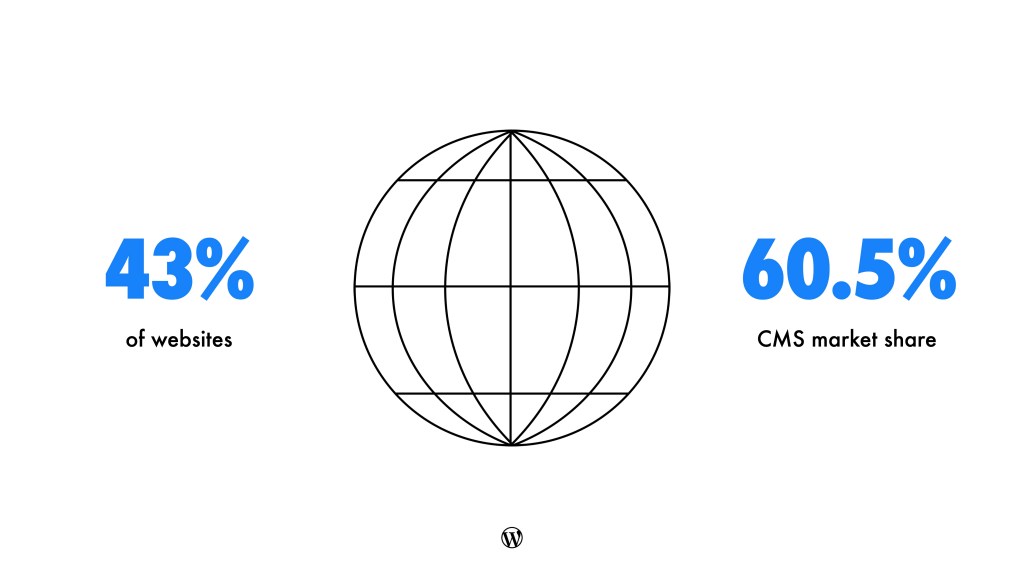
Matt Mullenweg, Co-founder of WordPress, provided a broad view of the platform’s growth. WordPress now powers over 43% of websites globally, accounting for 60.5% of the CMS (Content Management System) market. Its nearest competitor, Shopify, holds a 6.8% share. Among the top 1,000 websites, WordPress’s share increased to 49.4%, a 2.3% rise from the previous year.
The growth of multilingual usage was also highlighted, with over 56% of WordPress sites operating in languages other than English. Notably, in Japan, WordPress powers 58.5% of all websites and 83% of the CMS market, making Japanese the second most-used language on WordPress at 5.82%. Spanish, German, French, and Brazilian Portuguese followed in usage.
The plugin ecosystem has also experienced remarkable growth. The directory has surpassed 60,000 plugins, with plugin downloads expected to reach 2.1 billion by the end of the year. Additionally, over 1,500 themes were released this year.
Contributors reached new milestones, with the 6.8 release involving 921 contributors, the largest group to date. WordPress 6.8 achieved 79.5 million downloads, a 13% increase, and WordPress 6.9 featured contributions from 230 first-time contributors and over 340 enhancements and fixes.
A Release Moment to Remember
This year’s keynote featured a live, on-stage release of WordPress 6.9, a first for the platform. Mary Hubbard described WordPress 6.9 as "fast, polished, and built for collaboration," highlighting a year of deliberate iteration, improved workflows, and increased cross-team participation.
Matt Mullenweg, along with some release leads, initiated the release. As the room counted down, WordPress 6.9 was shipped live, instantly updating millions of sites worldwide. This live release was both a celebration and a testament to the trust and reliability embedded in WordPress’s release processes. Such a feat would have been unimaginable to the early contributors of WordPress.
Matt reflected on WordPress’s origins, recounting his discovery of the B2 forums, where he transitioned from a learner to a contributor. This transition is still central to the project today. Two decades later, WordPress has evolved from these initial interactions to a platform capable of live major releases, with the support of thousands of contributors.
WordPress and the Future of AI
Looking to the future, Matt acknowledged the significant role of AI in shaping the next chapter of WordPress. He recalled encouraging the community in 2022 to delve into AI, long before ChatGPT became a global conversation point. The pace of AI advancement since then has surpassed expectations, and WordPress has been preparing for this shift both visibly and behind the scenes.
Matt introduced a key architectural development: the Abilities API and the MCP adapter. The Abilities API defines WordPress’s capabilities in a way that AI systems can interpret, while the MCP adapter exposes these abilities through a shared protocol. This allows AI agents, whether from individuals, companies, or larger platforms, to understand and interact with WordPress safely and predictably. Instead of relying on one-off integrations or fragile interfaces, WordPress is now part of a broader ecosystem of tools that can query its capabilities and perform tasks using a standardized approach.
He highlighted how developers are already incorporating AI into their work with tools like Cursor, Claude Code, and next-generation CLIs. These tools can explore codebases, generate documentation, create tests, refactor components, and coordinate WP-CLI commands, amplifying what a single developer can achieve.
Matt then introduced Telex, an experimental environment that transforms natural-language prompts into Gutenberg Blocks. Telex has moved beyond experimentation and is being used practically. For instance, community creator Nick Hamze uses Telex to power micro-business tools that were previously complex and required custom engineering.
Across the ecosystem, companies are building with AI. Hostinger’s Kodee can generate a complete WordPress site from a single description. Elementor AI can rapidly create full sections and layouts within its editor. WordPress.com uses AI tools to help users draft, revise, and refine content, maintaining consistency with the site’s voice. Yoast utilizes AI to enhance SEO workflows by generating structured suggestions and improving readability. These examples demonstrate that AI is becoming ubiquitous rather than confined to a single area.
Experimental browsers can autonomously navigate WP Admin, performing tasks such as clicking buttons, opening menus, and executing multi-step tasks without custom plugins or APIs. This raises an important question: Which AI capabilities should be integrated into WordPress, and which should remain external, operated through the browser or operating system?
Matt concluded this section by discussing WordPress-specific AI benchmarks and evaluation suites. These tests will assess how well AI systems understand and execute WordPress tasks, such as enabling plugins or navigating WP Admin. The aim is to establish a foundation where AI tools operate predictably across the ecosystem, instilling confidence in creators that intelligent tools comprehend the platform.
A Global Community Growing Together
Mary returned to the stage to celebrate the ecosystem supporting WordPress’s growth. Across continents, diverse groups have hosted WordPress events, training new contributors and embracing newcomers. In 2025, more than 81 WordCamps were held in 39 countries, supported by over 5,000 volunteers and attended by nearly 100,000 people, with sixteen more events yet to occur.
Education has been pivotal in this community expansion. Learn.WordPress.org served over 1.5 million learners this year, with clearer pathways to structured programs like Campus Connect and WordPress Credits. This deliberate effort aims to guide learners from tutorials or workshops into deeper skill development.
She highlighted Costa Rica’s Universidad Fidélitas, where WordPress has been integrated into formal academics. Even before formal agreements with the WordPress Foundation, students were hosting WordCamp San José, forming clubs, and recognizing WordPress as critical to digital literacy and professional growth.
Wapuu, a mascot character, appeared at various events, representing creativity and playfulness, essential to open-source culture.
Matt shared the story of Youth Day in Managua, Nicaragua, where seventy-five young individuals spent a day building their first WordPress sites. Sessions were taught by teenagers for teenagers, covering theme selection, layout customization, contact form creation, and content publishing. Such moments of confidence can spark entire careers.
These instances illustrate a project expanding not just in numbers but in diversity and global reach. WordPress is growing because communities are embracing it in their unique ways.
What’s New in WordPress 6.9
WordPress Lead Architect, Matías Ventura, joined virtually to discuss the details of WordPress 6.9, highlighting its refinement and collaboration. He focused on the evolution of writing, designing, building, and developing in this release.
One of the most anticipated features is Notes in the Block Editor, allowing collaborators to comment directly on individual blocks. This integration aids focus and communication. The development of Notes exemplified collaboration, with contributors from various companies working together.
Matías also discussed improvements in writing and design. Editor interactions are now smoother, patterns behave more predictably, and spacing and typography controls are more intuitive. These enhancements make writing and designing within WordPress more reliable and empowering.
Block bindings now offer a more visual way to connect blocks to dynamic data sources, laying the foundation for richer, code-free interfaces.
On the developer front, Matías highlighted three significant upgrades:
- The Abilities API: A unified registry describing WordPress’s capabilities across various interactions.
- The HTML API: Enhances server-side HTML handling, making it safer and more reliable.
- The Interactivity API: Enables smoother interactions without heavy JavaScript frameworks, promoting modern interfaces while adhering to WordPress’s principles.
Matt further elaborated on developments that build on 6.9’s foundations. The Plugin Check Plugin helps developers align with current standards and catch early issues, ensuring plugin reliability. The Data Liberation initiative improves the WordPress importer, facilitating seamless content migration and supporting the open web’s portability. Advances in the Playground ecosystem, including WordPress Studio, Playground CLI, and Blueprints, allow developers and learners to quickly create WordPress environments, test ideas, and experiment without complex setups.
Matt emphasized that WordPress 6.9 is defined by its broad spectrum of refinements, enhancing reliability and capability, setting the stage for future innovations.
Insights from the AI Panel
The keynote transitioned to a live AI panel moderated by Mary Hubbard. The panel included James LePage (Automattic), Felix Arntz (Google), Jeff Paul (Fueled), and Matt Mullenweg. They discussed AI’s role in WordPress’s evolution, emphasizing its potential to amplify human creativity.
James LePage stated that AI is not about adding superficial enhancements but about empowering users to create content and express themselves digitally. Jeff Paul highlighted AI’s ability to improve developer productivity by handling repetitive tasks, while Felix Arntz described Google’s vision of AI as a tool to make the web more accessible and intuitive.
Looking ahead, the panelists predicted more contextual integrations, AI-assisted debugging, and workflows where agents handle tasks while guided by human decisions. They emphasized the importance of standards, shared protocols, and privacy-focused design as essential for WordPress’s long-term strategy.
The panel concluded with a forward-looking message: AI is accelerating, but WordPress remains committed to openness, agency, and creative freedom.
Questions That Push Us Forward
The Q&A session revealed what people are curious about, struggling with, or eager to build. A participant asked about the impact of major provider outages, like Cloudflare. Matt acknowledged the visibility of such outages but argued that each failure strengthens the system through learning and adaptation.
Another question focused on web content longevity. Matt pointed to the Internet Archive as a stabilizing force and mentioned a new plugin that replaces dead links with archived versions, preserving web history.
The next question addressed real-time collaboration in WordPress. Matt emphasized that collaboration tools can support early-stage creators, enabling them to work confidently and effectively.
The final question considered long-term decision-making. Matt noted that while predicting changes is challenging, identifying constants is easier. WordPress values agency, openness, and independent publishing, guiding its future direction.
TBPN Podcast Appearance
Following the Q&A, the keynote included a segment with the Technology Business Programming Network (TBPN), a tech podcast. When asked about the "word of the year," Matt chose "freedom," linking it to open-source philosophy. He described open-source licenses as a software "bill of rights," ensuring user freedoms in a software-driven world.
The conversation touched on Beeper, a multi-network messaging client. Matt likened Beeper to bringing disparate gardens together, unifying messages from various platforms into a single interface.
The discussion returned to publishing, with Matt reaffirming the importance of freedom, agency, and independent publishing as guiding principles for WordPress, even as AI and platforms evolve.
Building the Web We Believe In
As the keynote concluded, Matt emphasized that WordPress’s future is shaped by its community. Contributors, students, educators, and creators all play vital roles in developing the platform.
He discussed upcoming opportunities: new tools enabling creators to build more, collaborative features enhancing teamwork, and AI systems that support creativity. WordPress offers a path to learning, empowerment, and expression across generations and skill levels.
The values that have carried WordPress this far—freedom, participation, learning, and community—remain central to its future. These are not abstract concepts but are actively practiced in daily decisions and contributions.
Future Events
For those interested in revisiting past moments from WordPress’s annual address, the State of the Word YouTube playlist provides a look back at community milestones and product progress. Looking ahead to 2026, major WordPress events like WordCamp Asia in Mumbai, India, WordCamp Europe in Kraków, Poland, and WordCamp US in Phoenix are already planned. The community eagerly anticipates these events as it continues to build the future together.
For more Information, Refer to this article.