

















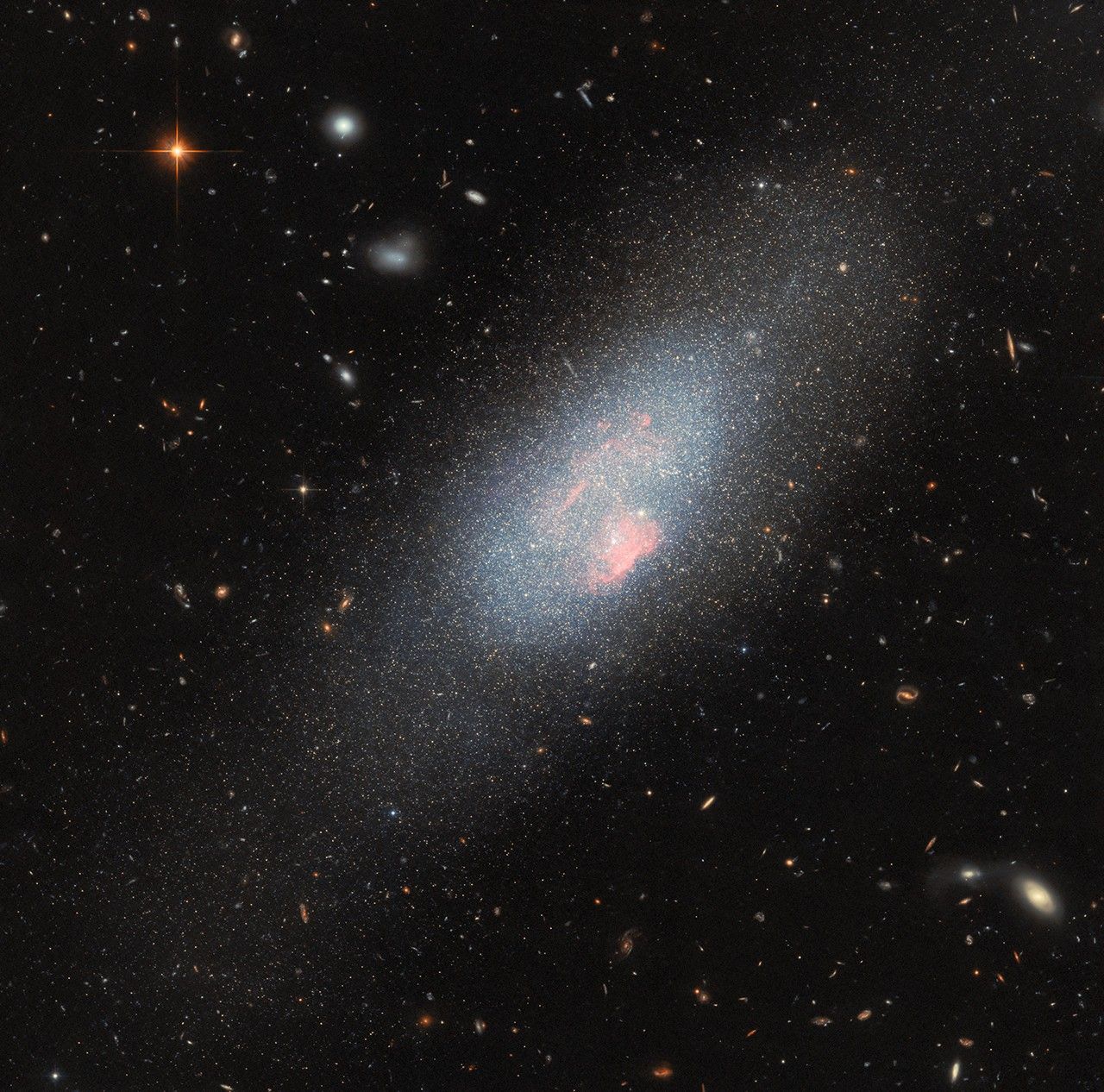
In the vast expanse of the universe, galaxies of various shapes and sizes continue to fascinate astronomers and space enthusiasts alike. One such intriguing celestial body is the blue dwarf galaxy known as Markarian 178, or Mrk 178. Captured in stunning detail by the Hubble Space Telescope, this galaxy offers a glimpse into the complex and dynamic processes that govern star formation and evolution.
Located approximately 13 million light-years away in the constellation Ursa Major, Mrk 178 is a relatively diminutive galaxy when compared to our own Milky Way. Despite its smaller size, Mrk 178 is a part of a larger family of galaxies known as Markarian galaxies. This group, named after the Armenian astrophysicist Benjamin Markarian, is distinguished by its members’ unusual brightness in ultraviolet light. This trait has made them a subject of interest and study within the astronomical community.
Mrk 178’s appearance is dominated by a striking blue color, indicative of the presence of young, hot stars. These stars are abundant in the galaxy and are relatively free from the obscuring effects of cosmic dust. However, the galaxy also features a distinct reddish hue, particularly prominent near its edge. This red coloration is attributed to a cluster of rare, massive stars known as Wolf–Rayet stars. These stars are in a unique evolutionary phase characterized by the shedding of their outer layers through powerful stellar winds, a process that leaves bright emission lines in the galaxy’s spectrum. These emission lines, particularly those of ionized hydrogen and oxygen, contribute to the red appearance in the Hubble image.
Wolf–Rayet stars are noteworthy for their short-lived presence; they exist for only a few million years before undergoing dramatic transformations into black holes or neutron stars. The presence of these stars in Mrk 178 indicates a recent surge in star formation activity within the galaxy. The catalyst for this burst of star formation remains a subject of investigation. Unlike some galaxies, Mrk 178 does not have any nearby galactic companions that might have influenced its gas dynamics to spark new star creation. Instead, researchers hypothesize that the galaxy may have encountered an external force, such as an intergalactic gas cloud or disturbances from the intergalactic medium, which could have triggered the formation of new stars.
The study of galaxies like Mrk 178 is crucial for understanding the diverse mechanisms that drive star formation and evolution in the universe. By examining these processes, scientists can gain insights into the lifecycle of stars and the evolution of galaxies over cosmic timescales. The Hubble Space Telescope, a collaborative project between NASA and the European Space Agency (ESA), plays a pivotal role in capturing detailed images of distant galaxies, thereby providing valuable data for these scientific endeavors.
In addition to its scientific significance, the observation of Mrk 178 and other Markarian galaxies offers a visual feast for stargazers and space enthusiasts. The Hubble images reveal the breathtaking beauty of the cosmos, showcasing the intricate structures and vibrant colors that define these celestial phenomena. For those interested in exploring further, NASA’s Hubble Space Telescope website provides a wealth of information and resources related to its missions and discoveries.
As we continue to explore the universe, galaxies like Mrk 178 remind us of the complex and ever-changing nature of the cosmos. They serve as a testament to the power of scientific collaboration and technological advancement in expanding our understanding of the universe. Through the lens of the Hubble Space Telescope, we can witness the dynamic processes that shape galaxies and the stars within them, gaining a deeper appreciation for the wonders of the universe.
For more information on the Hubble Space Telescope and its discoveries, you can visit their official website at NASA’s Hubble Space Telescope.
For more Information, Refer to this article.