
















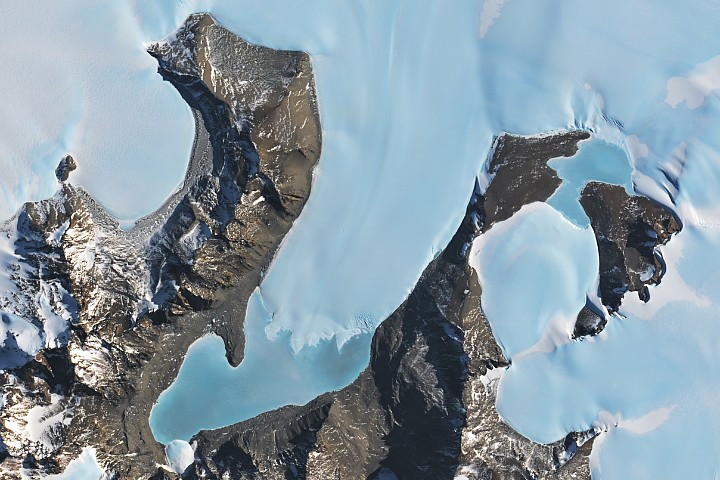
Lake Unter-See, one of Antarctica’s largest and deepest surface lakes, stands out among the more than 100 million lakes on Earth due to its unique water chemistry. The lake’s ice-covered waters have significantly high levels of dissolved oxygen, low dissolved carbon dioxide, and a strongly alkaline pH. This distinctive composition sets Lake Unter-See apart from other bodies of water on the planet.
In a recent image captured by the Operational Land Imager (OLI) on Landsat 9, the lake’s features were highlighted during the Antarctic summer. Lake Unter-See primarily receives water from seasonal meltwater flowing from the nearby Anuchin Glacier, sourced from the Gruber Mountains in Queen Maud Land. Despite mean annual temperatures hovering around minus 10 degrees Celsius, the lake remains frozen year-round, with sunlight penetrating the ice to warm the waters below. However, cold surface temperatures and strong winds prevent significant surface melting, maintaining the lake’s icy environment. With a maximum depth estimated to reach nearly 170 meters, Lake Unter-See boasts a unique ecosystem beneath its frozen surface.
One of the most fascinating aspects of Lake Unter-See is the presence of large, conical stromatolites within its waters. Stromatolites are layered microbial reef structures that grow slowly upwards, primarily composed of cyanobacteria that trap sediment and form calcium carbonate mineral crusts. These microbial communities release oxygen that becomes trapped under the ice, contributing to the lake’s high oxygen levels. Discovered in 2011 by SETI geobiologist Dale Andersen and colleagues, the stromatolites in Lake Unter-See provide insight into ancient microbial life forms that existed over 3 billion years ago on Earth.
While other Antarctic lakes, such as Lake Joyce in the McMurdo Dry Valleys, also contain stromatolites, the formations in Lake Unter-See are notably larger, reaching heights of up to half a meter. Scientists attribute the unusual height of Unter-See’s stromatolites to various factors, including their sheltered location beneath permanent ice, clear waters with minimal sediment, limited light exposure, and minimal grazing pressure. The lake’s inhabitants primarily consist of microscopic tardigrades, known for their resilience in extreme environments.
Astrobiologists see Lake Unter-See as a potential analog for environments on icy moons like Europa and Enceladus, as well as early Mars with its icy caps and glaciers. These icy bodies in our solar system share similarities with Lake Unter-See, raising questions about the potential for life to exist in such extreme conditions.
Despite its seemingly stable environment, Lake Unter-See experiences occasional changes, as observed during a fieldwork expedition in 2019. Researchers noted an increase in the lake’s water levels, which was later confirmed to be caused by a glacial lake outburst flood from nearby Lake Ober-See. The outburst flood released significant amounts of meltwater into Lake Unter-See, altering its pH and replenishing it with carbon dioxide-rich waters that likely enhanced microbial productivity. This event underscores the dynamic nature of Antarctica’s ecosystems and their potential implications for understanding life in extreme environments.
In conclusion, Lake Unter-See stands as a remarkable example of the diverse and unique ecosystems that exist on our planet, offering valuable insights into ancient microbial life forms and the potential for life in extreme environments beyond Earth. This hidden gem in Antarctica continues to captivate scientists and researchers, shedding light on the mysteries of our planet’s past and the possibilities for life beyond our world.
For more Information, Refer to this article.