







NASA Successfully Launches Northrop Grumman CRS-24 Mission
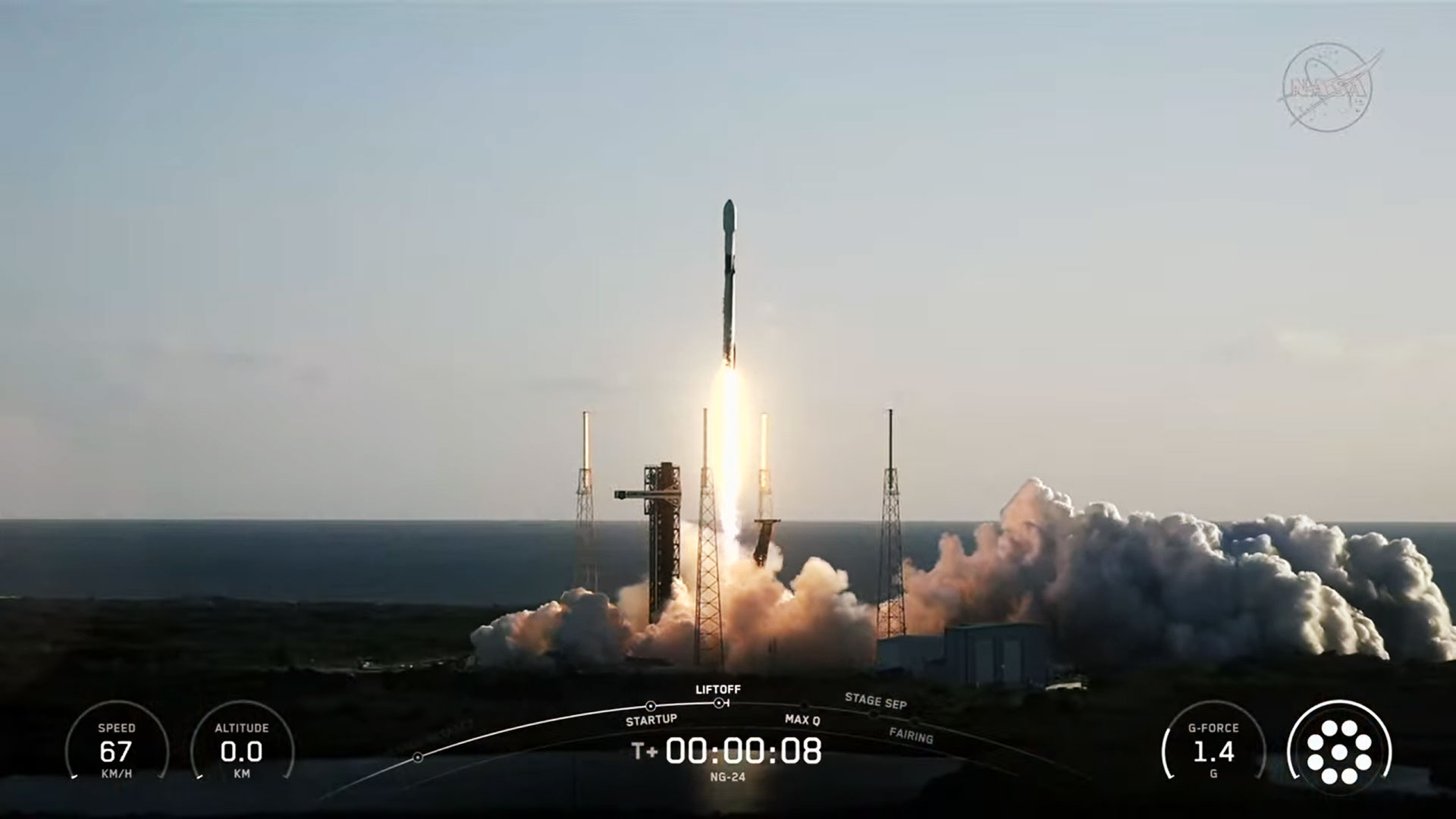
NASA has successfully launched its Northrop Grumman Commercial Resupply Services 24 mission, known as CRS-24, to deliver critical science and technology supplies to the International Space Station (ISS). The Cygnus XL spacecraft lifted off at 7:41 a.m. EDT on Saturday from Cape Canaveral Space Force Station in Florida, carrying approximately 11,000 pounds of cargo.
Launch Details and Coverage
The Cygnus XL spacecraft was launched aboard a SpaceX Falcon 9 rocket from Space Launch Complex 40. Following its successful ascent, the spacecraft is scheduled to arrive at the ISS on Monday, April 13. Live coverage of the spacecraft’s docking will begin at 12 p.m. on NASA+, Amazon Prime Video, and YouTube.
The capture of Cygnus XL by the ISS’s Canadarm2 robotic arm is set for 12:50 p.m., operated by NASA astronauts Jack Hathaway and Chris Williams. After capture, the spacecraft will be attached to the Earth-facing port of the Unity module for unloading.
Scientific Cargo and Research Initiatives
This resupply mission is packed with scientific experiments and technology demonstrations that will support research during Expedition 74/75 aboard the ISS. Notable items include:
- A new module aimed at advancing quantum science, which could enhance computing technologies and assist in dark matter research.
- Hardware designed to produce therapeutic stem cells that may aid in treating blood diseases and cancer.
- Model organisms intended for studying the gut microbiome.
- A receiver that could improve space weather models to safeguard critical infrastructure like GPS and radar systems.
These experiments represent just a fraction of the hundreds of scientific investigations conducted on the ISS across various fields such as biology, biotechnology, Earth and space science, physical sciences, and technology development.
Future Plans for Cygnus XL
The Cygnus XL spacecraft is expected to remain docked at the ISS until October. Upon its departure, it will dispose of thousands of pounds of waste by re-entering Earth’s atmosphere, where it will safely burn up upon descent. The spacecraft has been named S.S. Steven R. Nagel in honor of the former NASA astronaut who flew four space shuttle missions and commanded the deployment of the Gamma Ray Observatory.
What This Means for Future Research
The successful launch and upcoming arrival of Northrop Grumman CRS-24 signify a continued commitment to advancing scientific research in microgravity environments. With its diverse array of experiments, this mission not only supports ongoing research but also lays groundwork for future technological advancements that could have far-reaching implications on Earth and beyond. As NASA continues to collaborate with commercial partners like Northrop Grumman, the potential for innovation in space exploration remains robust.
For more information, read the original report here.