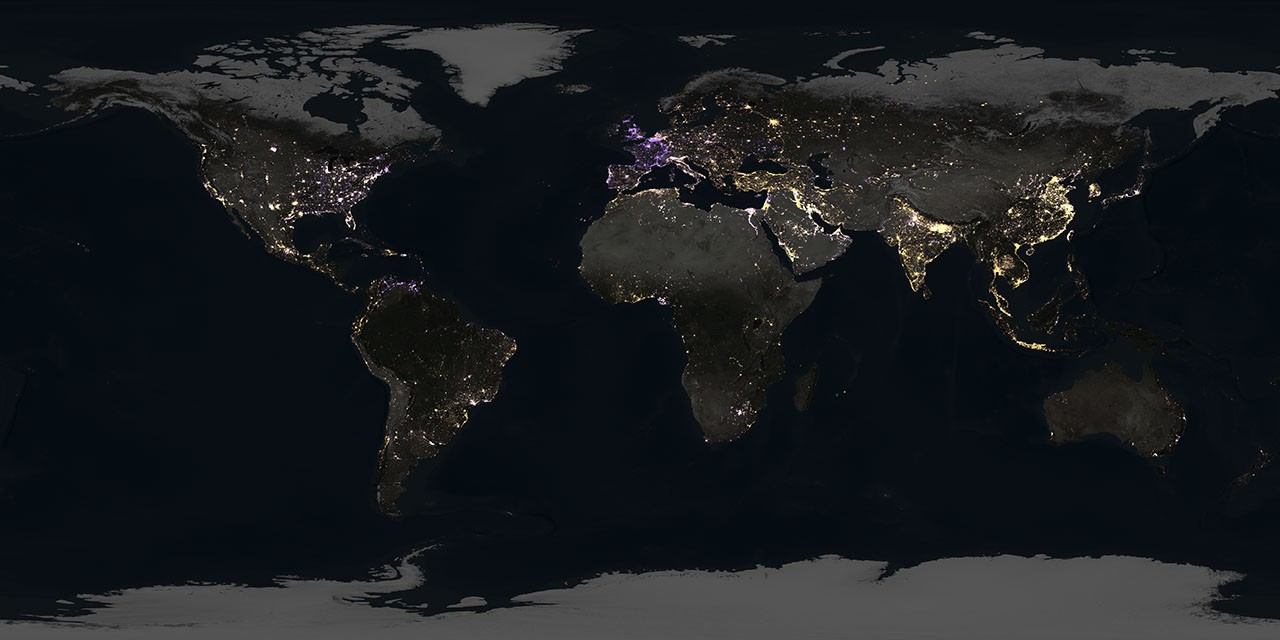
NASA’s Nighttime Maps Reveal New Insights into Global Brightness Trends
Recent findings from NASA’s satellite imagery have challenged long-held beliefs about nighttime illumination patterns across the globe. A study led by researchers from the University of Connecticut indicates that artificial brightening and dimming have intensified over the past decade, particularly highlighting significant gas flaring in major oil and gas fields in the United States. This research, published on April 8 in the journal Nature, sheds light on how energy production and conservation practices are reshaping the way billions experience nighttime.
Innovative Analysis Using Satellite Imagery
The research team, headed by Tian Li and Zhe Zhu, employed a novel algorithm to analyze over 1.16 million satellite images captured daily at around 1:30 a.m. local time over a nine-year period from 2014 to 2022. Utilizing data from the Visible Infrared Imaging Radiometer Suite (VIIRS), which consists of refrigerator-sized sensors orbiting Earth at speeds exceeding 16,000 mph, the team could detect light sources with remarkable precision—down to the scale of a toll booth on a dark highway. These sensors are part of Earth science satellites operated by NASA and the National Oceanic and Atmospheric Administration (NOAA).
The study encompassed most of the inhabited world, focusing on latitudes between 60 degrees south and 70 degrees north. During this timeframe, domestic oil and natural gas production in the U.S. reached unprecedented levels, driven by advancements in technology and horizontal drilling techniques. The satellite imagery revealed notable cycles of gas flaring—where excess natural gas is burned off at oil wellheads—particularly concentrated in regions like Texas’s Permian Basin and North Dakota’s Bakken Formation. This process not only wastes valuable resources but also contributes to environmental pollution through carbon dioxide and soot emissions.
Implications for Energy Sector Insights
Experts in energy analysis are recognizing the significance of these findings. Deborah Gordon, a methane expert at the Rocky Mountain Institute (RMI), emphasized that understanding where gas is being wasted globally can provide critical insights for energy management and environmental security. She noted that making this data publicly available allows operators, investors, and insurers to better understand operational inefficiencies within the sector.
Nasa’s night-light data is accessible through its Black Marble product suite, enabling scientists and analysts across various industries to monitor energy flows through grids, pipelines, and supply chains in near real-time. Gordon remarked on the value of having openly validated flaring data as essential components for tools used by organizations like RMI.
Challenging Conventional Assumptions
The latest nighttime maps challenge previous assumptions about global illumination trends. Historically, researchers believed that urban development simply resulted in brighter nights; however, this new analysis reveals a more complex landscape characterized by both industrial booms and busts alongside gradual shifts such as energy-efficient retrofits.
The researchers developed methods capable of detecting changes in nighttime brightness continuously—pixel by pixel—while filtering out interference caused by moonlight, clouds, or atmospheric conditions. This innovative approach allowed them to effectively give satellites “smart glasses,” enabling them to focus on genuine changes rather than noise.
Overall findings indicated that global radiance increased by 34% during the study period; however, this surge obscured significant areas experiencing dimming. Such “bidirectional changes” often occur simultaneously; for instance, while West Coast cities grew brighter due to population increases, many East Coast areas showed dimming attributed to widespread adoption of energy-efficient LED lighting and economic restructuring.
Global Patterns of Light Variation
The study also highlighted international trends in nighttime illumination. Rapid urban development led to increased light levels in countries like China and northern India. Conversely, regions such as Paris experienced a notable reduction in light pollution due to energy conservation measures—a decrease of approximately 33%. Similar trends were observed across the UK (22% dimming) and the Netherlands (21% dimming), particularly pronounced during 2022 amid an energy crisis linked to geopolitical tensions following Russia’s invasion of Ukraine.
Zhe Zhu described tracking these fluctuations as akin to observing “the heartbeat of the planet,” underscoring their potential relevance for understanding global dynamics related to energy consumption and environmental impact.
The Role of VIIRS Sensors
The VIIRS sensors have been operational since 2011 aboard three satellite platforms: Suomi NPP, NOAA-20, and NOAA-21. These instruments are capable of detecting light across visible to thermal infrared wavelengths with exceptional sensitivity under low-light conditions. Their unique day-night band enables finer resolution compared to earlier night-light imagery provided by other satellite programs.
What This Means
This research underscores a pivotal moment for understanding global energy dynamics through advanced satellite technology. By revealing intricate patterns of brightening and dimming across various regions, it provides valuable insights into how economic activities impact environmental health. As nations grapple with energy efficiency challenges amid climate change concerns, such data will be crucial for policymakers aiming for sustainable development while addressing national security interests related to energy resources.
For more information, read the original report here.