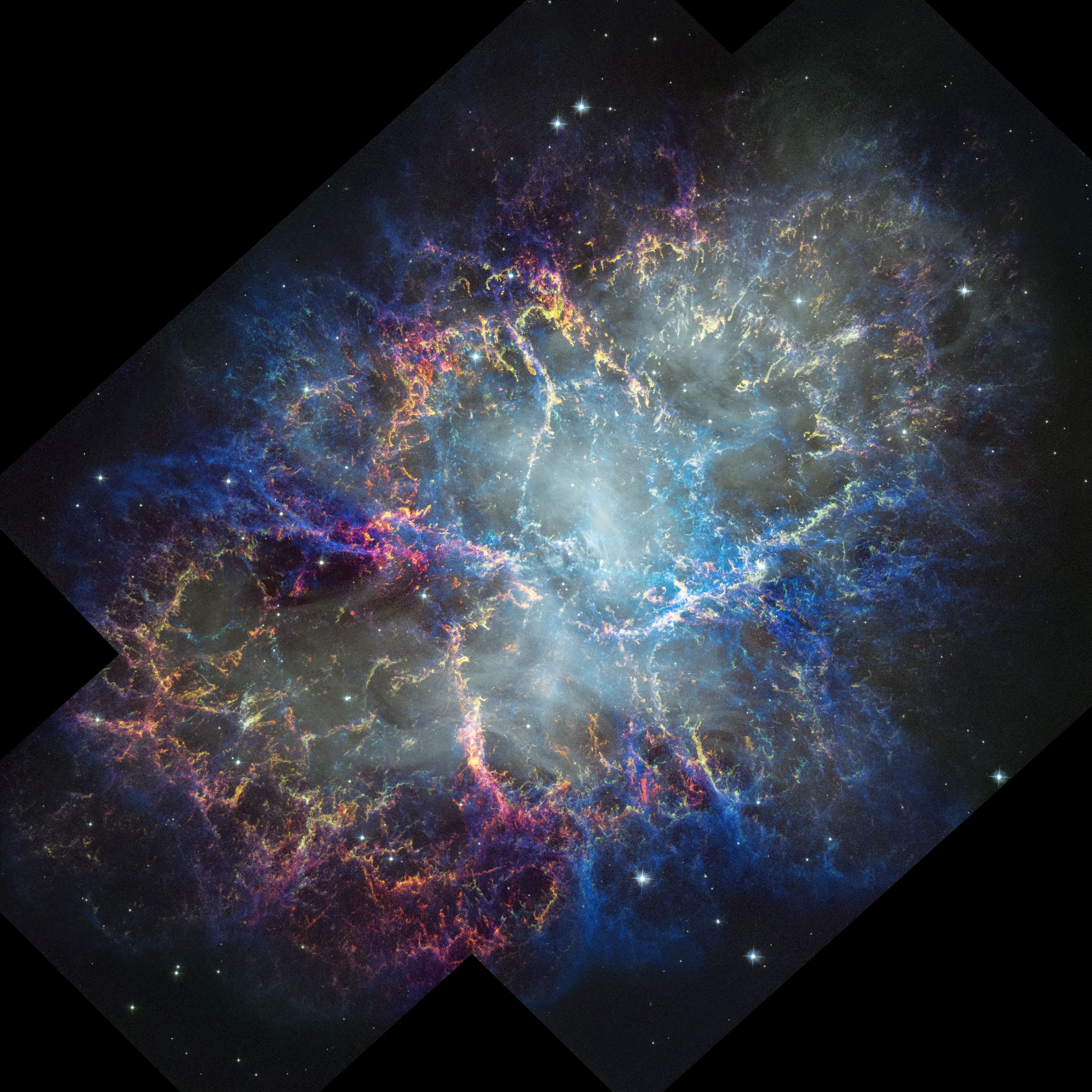
NASA’s Hubble Telescope Reveals 25 Years of Crab Nebula Expansion
On March 23, 2026, NASA unveiled a stunning observation from the Hubble Space Telescope that captures the evolution of the Crab Nebula over a quarter-century. This detailed imagery highlights the intricate filamentary structure of the nebula and documents its remarkable expansion, showcasing filaments moving outward at an astonishing speed of 3.4 million miles per hour.
Understanding the Crab Nebula
The Crab Nebula is a well-studied remnant of a supernova explosion that occurred in 1054 AD. Located approximately 6,500 light-years away in the constellation Taurus, it is one of the most famous astronomical objects. The nebula was formed from the debris of a massive star that ended its life in a spectacular explosion, leaving behind a neutron star at its core. This neutron star is known as a pulsar, which emits beams of radiation detectable from Earth.
The Hubble Space Telescope has been observing this celestial phenomenon for decades, providing invaluable data that helps scientists understand not only the nebula itself but also supernova remnants in general. The latest images reveal how the structure and composition of the Crab Nebula have changed over time, offering insights into the dynamics of such explosive events.
Details from Hubble’s Latest Observations
The recent observations highlight several key features of the Crab Nebula’s expansion. The intricate filamentary structure captured by Hubble showcases delicate strands of gas and dust that have been ejected during the supernova event. These filaments are not static; they are continuously moving outward, driven by shock waves produced by the explosion.
Over the past 25 years, these filaments have been observed to expand significantly. The speed at which they are moving—3.4 million miles per hour—illustrates not only the violent nature of supernova explosions but also provides a unique opportunity to study how such remnants evolve over time. By comparing images taken over decades, astronomers can track changes in brightness and structure, gaining insights into the physical processes at work within these cosmic phenomena.
The Importance of Long-Term Observations
Long-term observations like those conducted by Hubble are crucial for understanding astronomical phenomena such as supernova remnants. They allow scientists to build comprehensive models that explain how these structures change over time and interact with their surrounding environments.
In addition to studying the Crab Nebula specifically, this research contributes to broader astrophysical knowledge about stellar evolution and death. The data gathered can help refine models predicting how different types of stars will end their lives and what remnants they will leave behind.
Future Implications for Astronomical Research
The findings from Hubble’s observations could pave the way for future research initiatives aimed at understanding other supernova remnants throughout the universe. As telescopes become more advanced and capable of capturing higher-resolution images across various wavelengths, astronomers will be able to conduct even more detailed studies.
Moreover, ongoing missions like Hubble continue to inspire new generations of scientists and enthusiasts alike. By revealing complex cosmic phenomena in unprecedented detail, these observations foster curiosity and drive innovation in astronomical research methodologies.
What This Means
The detailed observations of the Crab Nebula not only enhance our understanding of this specific astronomical object but also underscore the significance of long-term observational studies in astrophysics. As researchers continue to analyze data collected over decades, they gain critical insights into stellar life cycles and supernova mechanics. This knowledge is vital not just for academic inquiry but also for advancing technologies related to space exploration and observation techniques.
For more information, read the original report here.