






























New X-ray Discovery Sheds Light on Mysterious Cosmic Objects
A newly identified cosmic object, dubbed an “X-ray dot,” may hold the key to understanding a perplexing class of astronomical sources known as “little red dots” (LRDs). This discovery was made by NASA’s Chandra X-ray Observatory and detailed in a recent publication in The Astrophysical Journal Letters. The findings could illuminate the nature of these enigmatic objects, which are believed to exist in the early universe.
The Mystery of Little Red Dots
Since the James Webb Space Telescope commenced its scientific observations, astronomers have reported the existence of LRDs—small, red objects located approximately 12 billion light-years from Earth. These celestial bodies have sparked considerable interest due to their unusual properties and potential implications for our understanding of supermassive black holes.
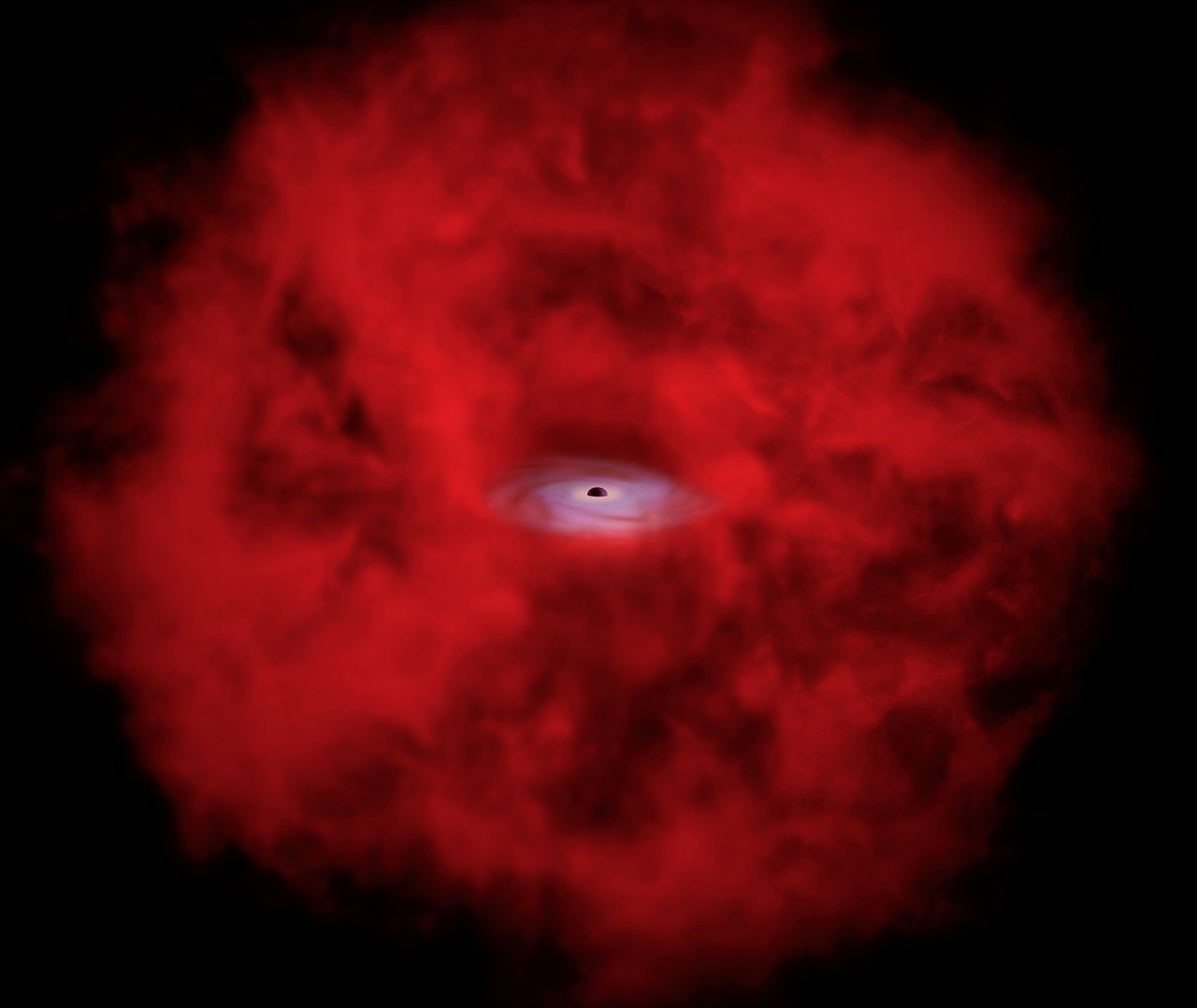
Many scientists hypothesize that LRDs are supermassive black holes obscured by dense gas clouds. This gas masks typical signatures seen in various wavelengths of light, including X-rays, which are crucial for identifying such black holes. Unlike typical growing supermassive black holes, which emit bright ultraviolet light and X-rays from surrounding material, LRDs appear muted due to their gaseous surroundings. This has led researchers to propose a new scenario referred to as the “black hole star” theory.
The Significance of the X-ray Dot
The newly discovered X-ray dot, officially named 3DHST-AEGIS-12014, is located about 11.8 billion light-years away from Earth. It stands out among LRDs because it emits X-rays—a feature not observed in other similar objects. Lead author Raphael Hviding from the Max Planck Institute for Astronomy remarked on the significance of this discovery: “This single X-ray object may be— to use a phrase—what lets us connect all of the dots.”
The identification of this unique object was made possible by comparing new data from Webb with previous deep survey data collected by Chandra. Co-author Anna de Graaff from the Center for Astrophysics | Harvard & Smithsonian raised an important question regarding LRDs: “If little red dots are rapidly growing supermassive black holes, why do they not give off X-rays like other such black holes?” The presence of an X-ray emitting dot provides critical insights into what might be driving these mysterious objects.
Transition Phase Between Black Hole Types
Researchers suggest that this X-ray dot represents a transitional phase between an LRD and a typical growing supermassive black hole. As a black hole star consumes surrounding gas, it creates openings in the dense gas clouds that allow X-rays from infalling material to escape and be detected by observatories like Chandra. Over time, as more gas is consumed, these clouds dissipate entirely, leading to the eventual disappearance of the black hole star.
Chandra’s data also hints at variations in the brightness of the X-ray emissions from this dot, supporting the idea that it is partially obscured by gas clouds. As these clouds rotate, areas of differing density can intermittently cover or uncover the black hole, resulting in fluctuations in observed brightness.
Future Investigations and Implications
If confirmed as a transitioning LRD, this object would mark a significant milestone in astronomical research. Co-author Hanpu Liu from Princeton University stated that such a finding would provide unprecedented insight into LRDs: “We may be seeing into the heart of a little red dot for the first time.” This could offer compelling evidence that links supermassive black hole growth with some or all members of the little red dot population.
An alternative explanation for this X-ray dot posits that it could represent a more conventional type of growing supermassive black hole shrouded in an exotic form of dust not previously observed by astronomers. Future observations will be crucial in determining its true nature and resolving ongoing debates within the scientific community.
What This Means
The discovery of this X-ray dot not only enhances understanding of LRDs but also underscores the importance of collaborative efforts between major observatories like Chandra and Webb. As astronomers continue to unravel these cosmic mysteries, findings like these could reshape current models regarding supermassive black holes and their formation processes in the early universe.
For more information, read the original report here.







