














![[Video] Samsung Color E-Paper: A Smarter Alternative to Traditional Posters](https://www.hawkdive.com/media/samsung-tvs-and-displays-samsung-color-e-paper-samsung-vxt-digital-signage_thumb932-218x150.jpg "Samsung introduces Color E-Paper as innovative poster alternative.")







Apple’s Foundation Models Framework: Revolutionizing Intelligent App Experiences
In September 2025, Apple announced the release of the Foundation Models framework, a cutting-edge technology poised to redefine how developers create intelligent features in mobile and desktop applications. With the integration of this framework in iOS 26, iPadOS 26, and macOS 26, developers now have access to a robust on-device large language model that is central to Apple’s advanced artificial intelligence capabilities. This development marks a significant step forward in delivering personalized, privacy-focused app experiences that can operate offline and free of charge.
This article delves into the potential of Apple’s Foundation Models framework and highlights its impact across various app categories, including health and fitness, education, and productivity. The framework empowers developers to innovate, offering users unique and intelligent experiences while maintaining their privacy.
Transforming Health and Fitness Applications
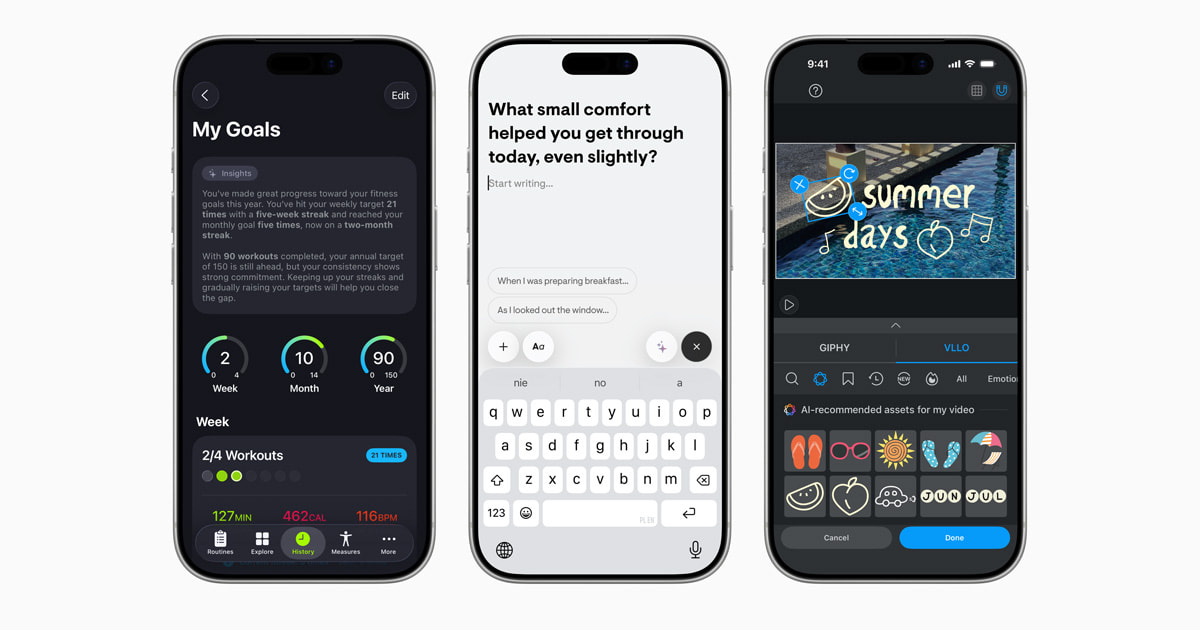
The health and fitness sector is among the first to harness the potential of the Foundation Models framework. Apps like SmartGym have significantly enhanced their user experience by employing this new technology. SmartGym allows users to design and track workouts seamlessly. By leveraging the framework, users can describe their workout routines, which the app then translates into structured plans, complete with sets, reps, rest intervals, and equipment adaptations. The app’s "Smart Trainer" feature learns from users’ workout habits, offering personalized recommendations such as adjusting weights or reps. Each suggestion is accompanied by clear explanations, providing users with insights into the reasoning behind adjustments.
Moreover, SmartGym generates comprehensive summaries of workout data, presenting users with monthly progress overviews, routine breakdowns, and individual exercise performance in an easily digestible format. Users also receive motivational messages tailored to their preferences, with options to add personal notes or generate automatic notes based on workout data. Every time the app is opened, users are greeted with a personalized message, created in real-time using current fitness data. Matt Abras, SmartGym’s CEO, describes the Foundation Models framework as "simple to implement yet incredibly powerful in its capabilities."
Similarly, the journaling app Stoic leverages the framework to provide users with hyper-personal journaling prompts based on their recent entries. If a user logs negative emotions or poor sleep, Stoic delivers encouraging messages. Notifications are context-aware, reminding users of past entries or moods. The prompts are generated entirely on-device, ensuring users’ privacy. Stoic also offers contextual journaling prompts that encourage reflection, along with tailored starting phrases to facilitate writing. Users can revisit past entries through enhanced views, including summaries, organization of related entries, and improved natural language search. Maciej Lobodzinski, Stoic’s founder, emphasizes that the framework allows prompts and reflections to adapt to users’ changing states of mind. The simplicity of the framework enabled Stoic’s small team to deliver immense value quickly while ensuring data privacy.
Other health and fitness apps have also embraced the Foundation Models framework. SwingVision, for instance, offers advice for tennis and pickleball players by analyzing gameplay videos and providing specific feedback. The 7 Minute Workout app enables users to create dynamic workouts using natural language, catering to individual needs such as injury prevention or event preparation. Gratitude, a journaling app, generates weekly summaries and personalized affirmations based on journal entries.
Enhancing Educational Experiences
The education sector is also benefiting from the Foundation Models framework. The immersive biology app CellWalk lets users explore 3D cells down to the molecular level. It provides explanations for unfamiliar terms using the framework, tailoring responses to learners’ knowledge levels. Tim Davison, the developer of CellWalk, highlights how the framework’s on-device model enhances the app’s interactivity, transforming scientific data into a dynamic learning experience.
Education apps covering diverse topics have integrated the framework to enhance their offerings. Grammo, an AI tutor, provides explanations for incorrect answers in English grammar exercises and generates new questions for deeper learning. Lil Artist combines the framework’s capabilities with the ImageCreator API to create illustrated stories for children, making the experience more engaging. Vocabulary uses natural language understanding to categorize words into custom themes, aiding memorization. Platzi, an education platform for Spanish speakers, allows users to ask questions about video content and receive quick responses.
Inspiring Creativity and Productivity
The Foundation Models framework is making waves in creativity and productivity applications as well. Stuff, an app for managing to-do lists, utilizes the framework to understand dates, tags, and lists as users type. It also features Listen Mode, allowing users to speak their tasks, and Scan Mode, which captures handwritten tasks for digital organization. Austin Blake, the developer behind Stuff, praises the framework for enabling the rapid development of new features.
For content creators, VLLO revolutionizes video editing by integrating the Foundation Models framework with Apple’s Vision framework. The app analyzes video previews and suggests background music and dynamic stickers tailored to each scene. Kyunghyun Lee, Vimosoft’s CEO, notes that the framework simplifies advanced recommendation features, lowering barriers for new creators.
Other creativity and productivity apps have embraced the framework. Signeasy generates document summaries, highlights key points, and supports conversational interfaces for quick responses to document-specific questions. Agenda’s "Ask Agenda" feature allows users to query their notes library and receive plain language responses. Detail: AI Video Editor uses the framework to transform drafts into teleprompter scripts and generate social media content elements automatically. Essayist extracts information from PDFs and creates structured references and citations. OmniFocus 4 helps users generate projects and next steps automatically, suggesting tags and content based on captured information.
Building with the Foundation Models Framework
The Foundation Models framework is seamlessly integrated with Swift, Apple’s programming language, making it accessible for developers to send requests to the on-device model. It offers guided generation, ensuring consistent responses, and allows developers to provide tools for additional information when needed. The framework is available with iOS 26, iPadOS 26, and macOS 26, compatible with Apple Intelligence-enabled devices.
Apple Intelligence, still in beta, supports multiple languages, including English, French, German, Italian, Portuguese (Brazil), Spanish, Chinese (simplified), Japanese, and Korean. However, some features may not be available in all regions or languages. For more information on feature availability and system requirements, visit support.apple.com.
The Foundation Models framework represents a significant leap forward in app development, enabling developers to create intelligent, privacy-focused features without extensive infrastructure. As more developers embrace this technology, users can expect increasingly personalized and innovative app experiences across various domains.
For more information, visit the official Apple newsroom at Apple Newsroom.
For more Information, Refer to this article.