






















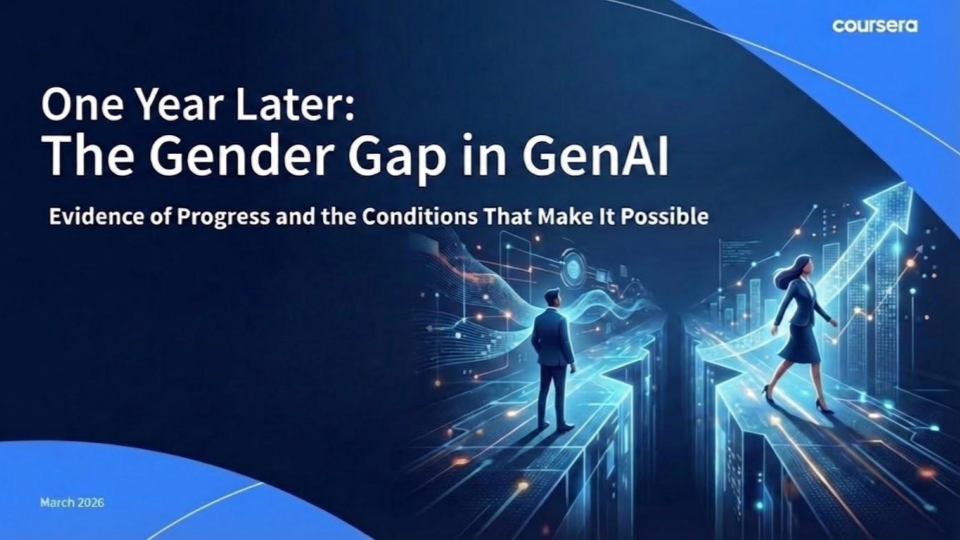
As International Women’s Day approaches, it serves as an opportune moment to reflect on the strides made in bridging the gender gap within critical skill domains, particularly in Generative AI (GenAI) and vital human competencies such as Critical Thinking. Recent research conducted by Coursera unveils promising advancements in this area, marking a significant step forward in gender inclusivity. This report, titled "One Year Later: The Gender Gap in GenAI," offers a comprehensive analysis of where progress has been made and highlights areas that still require attention.
GenAI, a rapidly evolving field, is poised to revolutionize the global economy. According to research by IDC, it has the potential to boost the world’s wealth by an astounding USD 22.3 trillion by 2030. To ensure that these economic benefits are equitably distributed, it is crucial for institutions to equip individuals with the necessary skills to embrace these emerging technologies.
Key Findings from the Coursera Report
Progress in Female Enrollment
One of the most encouraging findings from the report is the notable increase in female enrollment in GenAI courses over the past year. While women have historically been underrepresented in this domain, the gender gap is gradually narrowing. Data reveals that women’s share of total GenAI enrollments on Coursera rose from 32% in 2024 to 36% in 2025. This increase is even more pronounced among enterprise learners, with women accounting for 36% of enrollments in 2024 and 42% in 2025. This indicates a faster rate of engagement with GenAI technologies among women compared to their male counterparts.
Regional Variations in Gender Gap
Despite the global trend of narrowing gender gaps, there are significant regional discrepancies in the uptake of GenAI skills. In Latin America, countries like Peru, Mexico, and Colombia have witnessed a doubling of female enrollments in GenAI courses year-over-year. Similarly, Asia Pacific countries, notably Uzbekistan, India, Vietnam, Indonesia, Thailand, and the Philippines, have made substantial progress in increasing female participation.
However, the situation is different in many English-speaking and economically developed nations. In countries such as the United States, Canada, the United Kingdom, Spain, and Germany, the share of female enrollments in 2025 has decreased compared to 2024. This suggests that more efforts are needed to encourage women’s participation in these regions.
Persistence and Completion Rates
Once women overcome the initial barriers to enrollment, they often demonstrate high levels of persistence in GenAI learning. Across a significant number of countries, women are more likely than men to complete GenAI courses once they enroll. This trend is particularly pronounced in the top five countries for GenAI enrollments, where women are 1.5 times more likely to complete courses compared to their male peers. These findings underscore that the primary challenge for women is often entry into the field rather than capability or motivation. Once engaged, women frequently persist at equal or higher rates than men, emphasizing the importance of removing initial barriers to participation.
Courses and Recommendations for Institutions
Coursera’s data indicates that courses emphasizing GenAI as a practical tool for productivity and problem-solving receive higher enrollments from female learners. To build on this momentum, institutions are encouraged to design GenAI courses for beginners with real-world applications. Additionally, ensuring visible representation and inclusive pedagogy across educational modalities is essential. Expanding access through policies, partnerships, and localization, as well as reinforcing participation through social validation and diverse role models, are crucial steps to foster greater inclusivity.
Furthermore, pairing GenAI skills with durable human capabilities like Critical Thinking is vital. This combination equips learners, especially women, with a comprehensive skill set that enhances their ability to navigate the evolving technological landscape.
The Path Forward
The insights and strategies outlined in the report aim to pave the way for more inclusive and equitable learning experiences. Educators, businesses, and governments all play a pivotal role in creating an environment where women from diverse backgrounds, experiences, and geographies can upskill, persist, and thrive in the GenAI economy. By designing educational programs with the audience in mind, we can ensure that women have the opportunity to fully participate in and contribute to the advancements in GenAI.
For those interested in exploring the detailed findings and recommendations, the full report "One Year Later: The Gender Gap in GenAI" is accessible on Coursera’s website.
For more Information, Refer to this article.