





















NASA’s Hubble Space Telescope Captures Stunning Image of Barred Spiral Galaxy IC 486
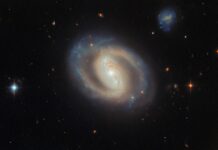
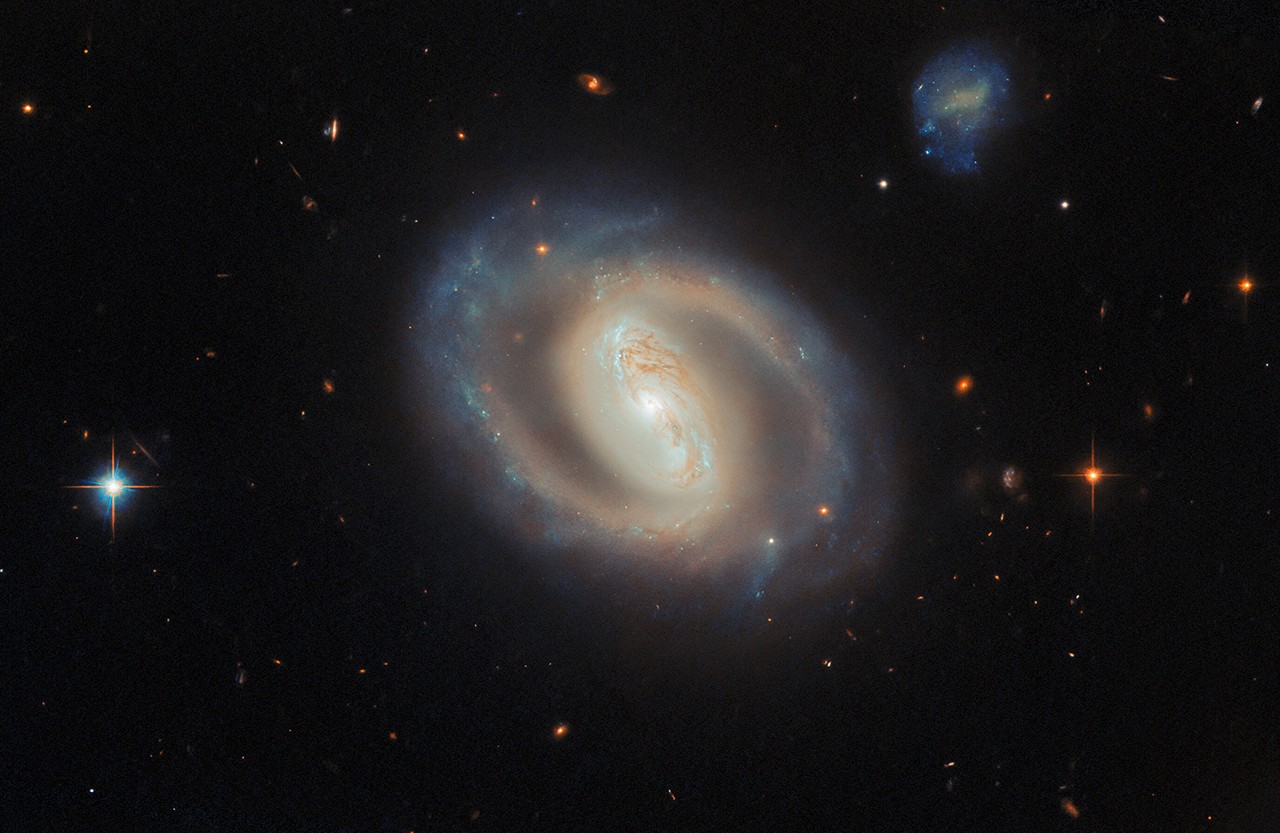
A new image from NASA’s Hubble Space Telescope reveals the barred spiral galaxy IC 486, located approximately 380 million light-years from Earth in the constellation Gemini. This striking visual showcases the galaxy’s luminous structure and highlights its active galactic nucleus, which is powered by a supermassive black hole over 100 million times the mass of our Sun.
The Structure of IC 486
IC 486 is classified as a barred spiral galaxy, characterized by its distinctive central bar-shaped structure from which spiral arms extend outward. These arms wrap around the core in a smooth, almost ring-like fashion. Hubble’s advanced imaging capabilities reveal subtle color variations across the galaxy, with a bright center dominated by older stars, contrasted by faint bluish regions indicating areas of recent star formation. Wisps of dust interlace through the galaxy, obscuring light and marking regions rich in molecular gas where new stars are likely to emerge.
Active Galactic Nucleus and Supermassive Black Hole
At the heart of IC 486 lies an active galactic nucleus (AGN), emitting a noticeable white glow that outshines surrounding starlight. This intense luminosity is attributed to a supermassive black hole that consumes vast amounts of gas and dust, forming an accretion disk around it. The immense gravitational pull of this black hole generates significant heat and radiation, including X-rays, which can dominate the galaxy’s overall brightness. Galaxies with such active nuclei are classified as active galaxies, underscoring the dynamic processes occurring at their cores.
Research Initiatives Behind the Image
The data used to create this stunning image stems from two separate observing programs aimed at surveying nearby active galaxies like IC 486. The first program, led by Principal Investigator M.J. Koss, focuses on capturing high-quality images of central black holes and nearby stars. The second program, led by A.J. Barth, shares similar objectives. By combining Hubble’s sharp imaging capabilities with comprehensive datasets, researchers can conduct detailed comparisons of how stars, gas, dust, and black holes interact within galaxy centers.
A primary goal of this research is to understand how galaxies evolve by linking their large-scale structures—such as bars and spiral arms—to activities occurring in their nuclei. The research teams utilize both expert classifications and citizen science initiatives through platforms like Galaxy Zoo to analyze these galaxies. Ultimately, they plan to release their datasets to the public for further exploration.
Future Implications for Astronomy
In addition to traditional analysis methods, researchers are testing how well large language models and machine learning techniques can replicate or enhance human classifications of galaxy morphology. This innovative approach could significantly scale studies related to galaxy structures for future telescopes such as ESA’s Euclid mission and NASA’s Roman Space Telescope.
The image also features distant background galaxies and foreground stars scattered throughout the cosmos. Some stars exhibit characteristic diffraction spikes while more diffuse reddish smudges represent far-off galaxies that contribute to the vastness of space.
The Dynamic Nature of IC 486
Despite its serene appearance in this image, IC 486 is a dynamic system shaped by gravitational forces and stellar evolution. Over millions of years, its structure will continue to change as stars are born, age, and eventually fade away—contributing to an ongoing narrative about galactic life in the universe.
What This Means
The detailed observations made possible by Hubble not only enhance our understanding of individual galaxies like IC 486 but also contribute to broader insights into galaxy formation and evolution across the universe. As researchers continue to analyze these images and develop new methodologies for studying cosmic structures, they pave the way for future discoveries that could reshape our understanding of astrophysics.
For more information, read the original report here.