























Advancements in Quantum Computing: IBM’s Leap Towards Quantum Advantage
On November 12, 2025, at the Quantum Developer Conference in Yorktown Heights, New York, IBM made a series of groundbreaking announcements that have the potential to revolutionize the field of quantum computing. The tech giant, renowned for its innovation, unveiled significant strides toward achieving quantum advantage by 2026 and fault-tolerant quantum computing by 2029. This announcement marks a pivotal moment in the evolution of computing, promising to bring unprecedented capabilities to the world.
IBM Quantum Nighthawk: A New Era in Quantum Processing
IBM introduced the IBM Quantum Nighthawk, its most advanced quantum processor to date. This processor is meticulously designed to work in synergy with high-performance quantum software, setting the stage for quantum advantage. Quantum advantage refers to the point where a quantum computer can solve a problem more efficiently than any classical computer.
The Nighthawk processor is expected to be available to IBM users by the end of 2025. It boasts 120 qubits, which are the fundamental units of quantum information. These qubits are interconnected by 218 next-generation tunable couplers, forming a square lattice. This architecture represents a 20% increase in couplers compared to its predecessor, IBM Quantum Heron. This enhanced connectivity allows the execution of circuits with 30% more complexity while maintaining low error rates.
This advancement means that users will be able to tackle more computationally demanding problems, requiring up to 5,000 two-qubit gates. Gates are the building blocks of quantum circuits, and two-qubit gates are essential for entangling qubits, a crucial process in quantum computing.
IBM has ambitious plans for the future iterations of the Nighthawk processor. By 2026, the processor is expected to handle up to 7,500 gates, with further expansions to 10,000 gates by 2027. By 2028, Nighthawk-based systems could support up to 15,000 two-qubit gates, thanks to over 1,000 connected qubits extended through long-range couplers tested in IBM’s experimental processors last year.
IBM anticipates that the first instances of verified quantum advantage will be confirmed by the broader scientific community by the end of 2026. To facilitate this validation process, IBM, in collaboration with Algorithmiq, the Flatiron Institute, and BlueQubit, is contributing to an open, community-led quantum advantage tracker. This tracker systematically monitors and verifies emerging demonstrations of quantum advantage.
Expanding Qiskit’s Capabilities for Enhanced Quantum Computing
Qiskit, IBM’s renowned quantum software stack, is undergoing significant enhancements. It now offers developers more control over their circuits, enabling a 24% increase in accuracy for systems with over 100 qubits. Additionally, a new execution model in Qiskit allows for fine-grain control and introduces a C-API, unlocking high-performance computing (HPC) accelerated error mitigation capabilities. This innovation reduces the cost of extracting accurate results by over 100 times.
As quantum technology matures, it is increasingly integrating with HPC and scientific communities. IBM is facilitating this integration by delivering a C++ interface to Qiskit, powered by a C-API. This allows users to program quantum operations natively in existing HPC environments.
Looking ahead to 2027, IBM plans to extend Qiskit with computational libraries focused on machine learning and optimization. These libraries aim to tackle fundamental physics and chemistry challenges, including differential equations and Hamiltonian simulations.
Building Blocks of Fault-Tolerant Quantum Computing
Parallel to its efforts in quantum advantage, IBM is making substantial progress toward building the first large-scale, fault-tolerant quantum computer by 2029. Fault-tolerant computing is essential for practical quantum applications, as it ensures that errors in quantum computations are corrected efficiently.
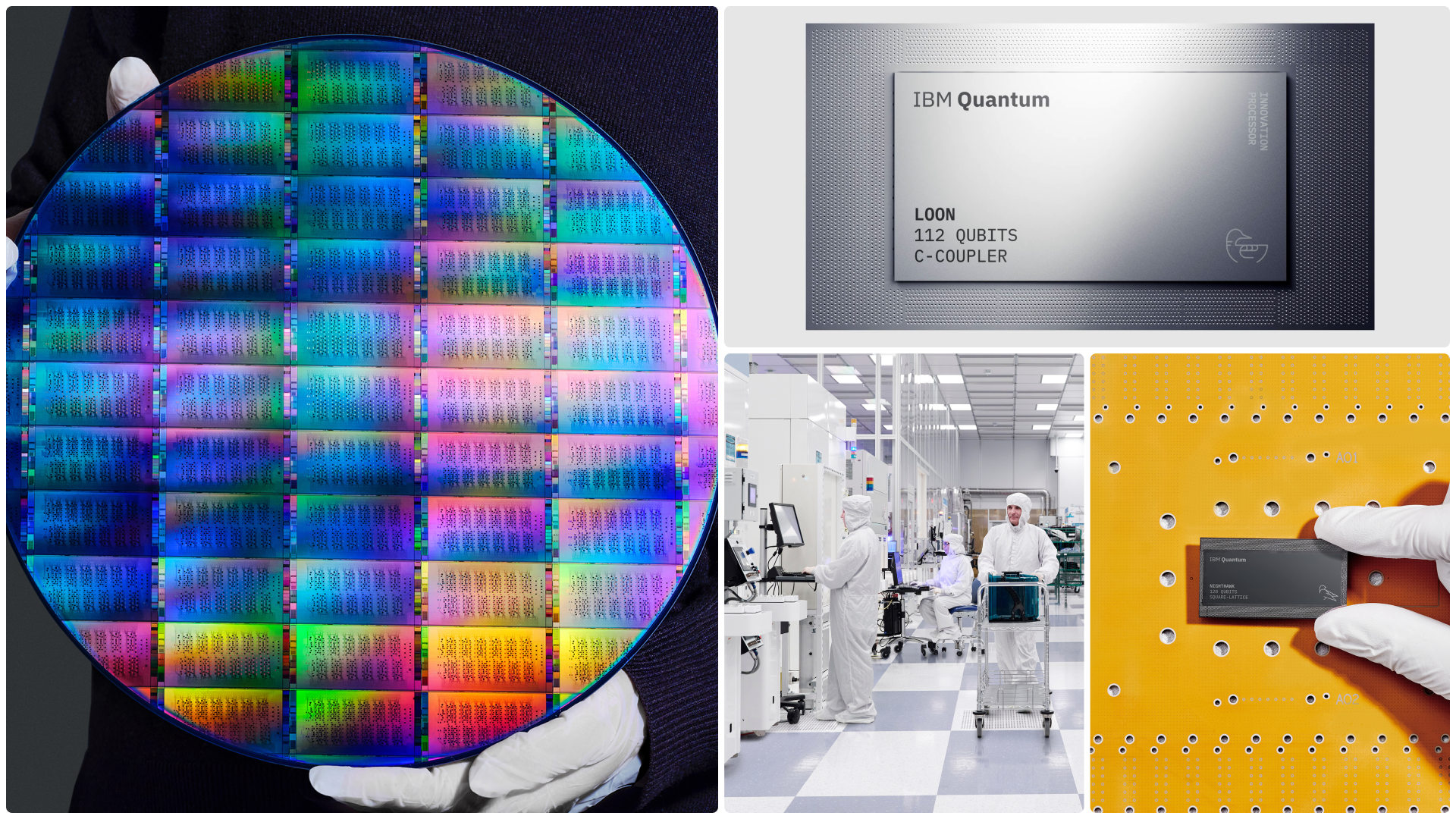
IBM Quantum Loon, an experimental processor, is a testament to IBM’s commitment to fault tolerance. For the first time, IBM has demonstrated all the key components required for fault-tolerant quantum computing. The Loon processor validates a new architecture capable of scaling high-efficiency quantum error correction components.
A pivotal achievement in this regard is IBM’s ability to decode errors in real-time using qLDPC (quantum Low-Density Parity-Check) codes, an engineering feat accomplished a year ahead of schedule. This breakthrough demonstrates the cornerstones needed to scale qLDPC codes on high-speed, high-fidelity superconducting qubits, forming the core of IBM’s quantum computers.
Scaling Quantum Processor Fabrication for Rapid Development
In a strategic move to accelerate quantum processor development, IBM has initiated the primary fabrication of its quantum processor wafers at an advanced 300mm wafer fabrication facility in the Albany NanoTech Complex, New York. This state-of-the-art facility is equipped with cutting-edge semiconductor tooling and operates with always-on capabilities.
The benefits of this advanced fabrication facility are substantial. IBM has doubled the speed of its research and development efforts by reducing the time required to build each new processor by at least half. Moreover, the physical complexity of IBM’s quantum chips has increased tenfold, allowing for multiple design explorations in parallel.
Conclusion
IBM’s latest advancements in quantum computing represent a monumental leap toward realizing the full potential of this transformative technology. With the introduction of the IBM Quantum Nighthawk processor, enhanced Qiskit capabilities, and progress in fault-tolerant computing, IBM is poised to lead the charge in the quantum revolution.
The company’s commitment to open collaboration, as evidenced by the community-led quantum advantage tracker, ensures that the broader scientific community can actively contribute to and validate quantum advancements. By expanding its fabrication capabilities, IBM is accelerating the development of quantum processors, bringing the world closer to realizing the practical benefits of quantum computing.
As IBM continues to push the boundaries of quantum technology, the future promises to be one where quantum computers solve complex problems that are currently beyond the reach of classical computing, ushering in a new era of innovation and discovery.
For more information about IBM’s quantum computing initiatives, visit their official IBM Quantum Blog.
For more Information, Refer to this article.