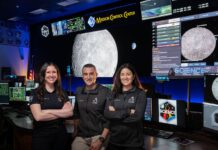





















NASA’s Artemis program has launched its first crewed test flight, known as Artemis II, with four astronauts aboard the Orion spacecraft. The mission aims to test the spacecraft’s systems in a deep space environment as it travels around the Moon and back.
The crew, consisting of NASA astronauts Reid Wiseman, Victor Glover, and Christina Koch, along with Canadian Space Agency astronaut Jeremy Hansen, lifted off from Kennedy Space Center in Florida on April 1. Throughout the mission, real-time coverage can be viewed on NASA’s YouTube channel, providing live streams from inside the Orion spacecraft and the latest mission imagery online.
Daily mission status briefings are held at Johnson Space Center in Houston, except for April 6 due to lunar flyby activities. The crew will participate in live conversations scheduled prior to their departure, with updates available on the Artemis blog.
To track Orion in space, visit nasa.gov/trackartemis. The Artemis II mission is expected to last approximately 10 days, covering a distance of 695,081 miles with a lunar flyby and splashdown off the coast of San Diego.
During the mission, the crew will test various spacecraft systems, conduct manual and automated operations, evaluate life support and navigation systems, and participate in science activities such as lunar surface observations and human health studies. The crew will also practice critical activities like trajectory adjustments and piloting Orion during key flight phases.
The lunar flyby is a significant aspect of the mission, with scheduled activities including crew conversations, lunar observations, and communication loss as Orion passes behind the Moon. The crew will make observations of the Moon’s surface, providing unique insights that complement robotic observations.
Artemis II aims to confirm the systems necessary for deep space exploration and establish a sustained presence on the Moon. The crew will demonstrate the ability of systems to support astronauts, retrieve hardware and data, and validate emergency operations and subsystems.
As part of the mission, a zero-gravity indicator named Rise was selected by the crew as a tribute to the Earthrise moment from Apollo 8. Orion is equipped with 32 cameras for engineering, navigation, crew monitoring, and science activities. Following the mission, imagery and data will be made available on the Artemis II Multimedia website.
Overall, the Artemis II test flight is crucial for validating spacecraft systems with crew aboard in deep space, paving the way for future Artemis missions and establishing a sustained presence on the Moon. NASA’s Artemis program aligns with the National Space Policy to advance American leadership in space through a series of ambitious initiatives.
For more Information, Refer to this article.