























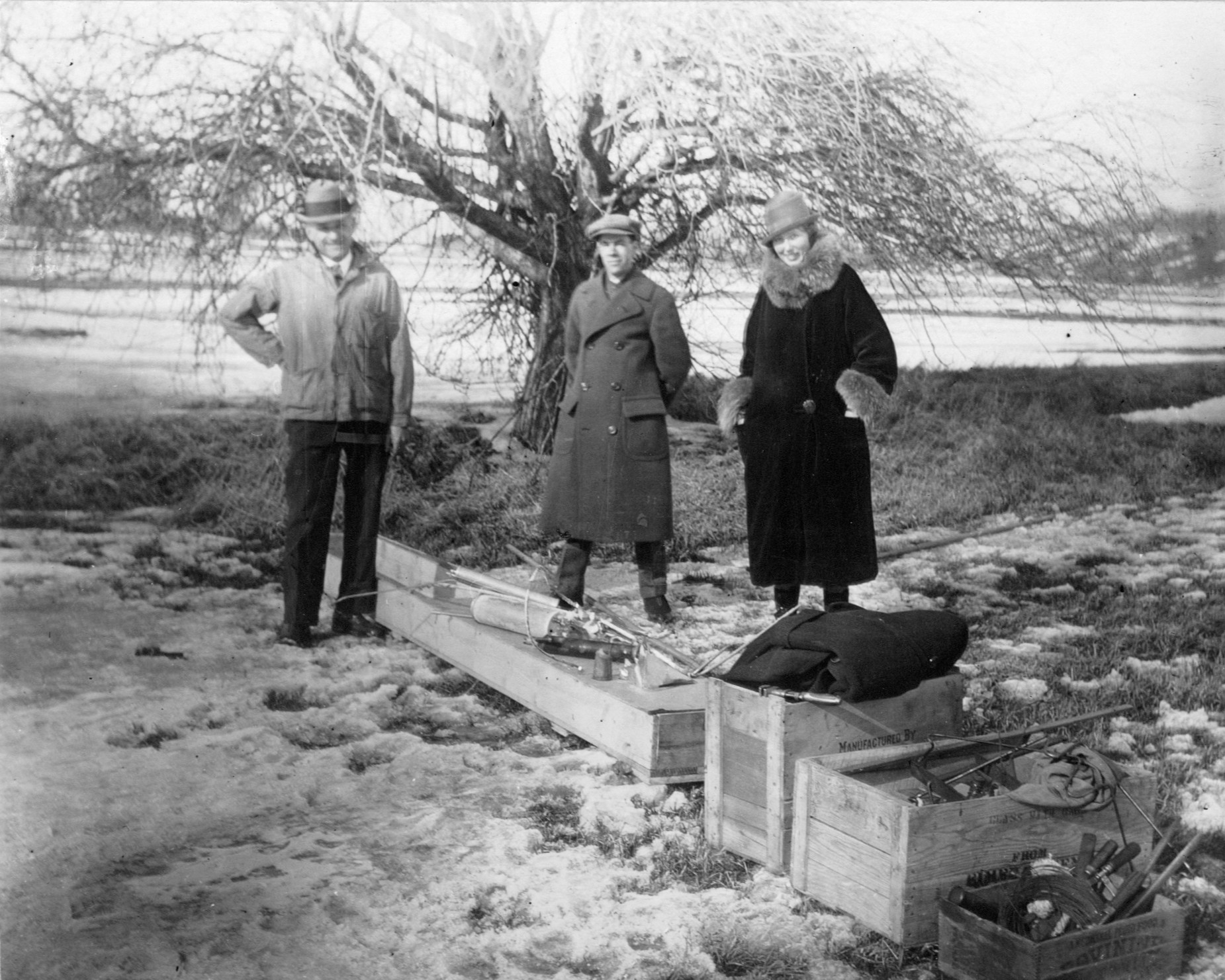
On a snowy morning a century ago, an event took place that would forever change the landscape of modern technology and exploration. It was March 16, 1926, when Dr. Robert Goddard, a professor at Clark University, alongside his wife and two colleagues, embarked on a short drive from their home to a family farm in Auburn, Massachusetts. This ordinary trip was about to witness an extraordinary milestone in human history, thanks to an ingenious invention they called "Nell."
Nell was not just any device; it was a pioneering contraption designed by Dr. Goddard himself. Standing eleven feet tall but weighing a mere ten pounds, Nell was the culmination of years of meticulous research, testing, and incremental improvements. Dr. Goddard’s invention was about to make history as the first liquid-fueled rocket ever launched.
As they reached Aunt Effie’s farm, the professor’s assistant used a blowtorch to ignite Nell. In a matter of moments, the rocket took off, reaching a height of 41 feet and landing 60 yards away in a cabbage patch. Although the flight lasted less than three seconds, it marked the dawn of a new era in rocketry. Dr. Robert Goddard, through this modest yet groundbreaking endeavor, earned his place as a true pioneer of modern rocketry.
Reflecting on the event, Goddard noted in his journal that the rocket’s ascent appeared almost magical, as if it had its own will to explore beyond its terrestrial confines. This seemingly simple occurrence was, in fact, a monumental leap for mankind, demonstrating the potential of liquid-fueled rockets.
The concept of using liquid fuel in rockets was not entirely new at the time. Scientists around the world had theorized about its advantages, including greater thrust control compared to the solid fuels used previously. However, the challenges were significant, particularly in pressurizing the fuel and regulating its mixture. Dr. Goddard, by using a combination of gasoline and liquid oxygen, became the first to overcome these challenges, achieving a successful launch.
Despite this remarkable achievement, recognition for Goddard’s work was not immediate. In 1920, The New York Times published a skeptical editorial, questioning the feasibility of Goddard’s ideas and his assertion that rockets could one day reach the Moon. The publication doubted the functionality of rockets in a vacuum, dismissing Goddard’s work as lacking the basic principles taught in high schools.
Nevertheless, Goddard remained undeterred, continuing to refine and enhance his rocket designs. It wasn’t until the advent of the Space Age and the tireless advocacy of his wife, Esther Goddard, that his contributions were fully acknowledged. After Goddard’s passing in 1945, his legacy was honored by NASA, which named its first new facility the Goddard Space Flight Center in 1959. This recognition came as liquid-fueled rocketry became a foundational technology for space exploration.
Fast forward to today, a hundred years after Goddard’s initial launch, NASA is preparing for the Artemis II mission, set to send astronauts around the Moon for the first time since 1972. The Space Launch System (SLS) rocket, which will carry the mission, stands 30 times taller and is significantly heavier than Nell, yet remarkably, it remains liquid-fueled, embodying Goddard’s early innovations.
Dr. Robert H. Goddard’s journey from a snow-covered field in Massachusetts to the forefront of space exploration is a testament to the power of innovation and perseverance. His work laid the groundwork for countless advancements in rocketry and space technology, proving that even the most ambitious dreams can become reality with dedication and ingenuity.
In reviewing this pivotal moment in history, the world can appreciate the profound impact of Goddard’s work. His legacy is a reminder of the human spirit’s insatiable curiosity and the continuous pursuit of knowledge. As we look to the future, the principles and technologies he pioneered remain integral to our quest to explore the cosmos.
For those keen to delve deeper into the history of Goddard’s achievements, several resources provide invaluable insights:
- Goddard, Esther: A detailed account of Robert Goddard standing next to his rocket at Ward Farm on March 16, 1926, can be found in the archives of Clark University.
- Goddard, Robert H.: Another significant reference includes images and descriptions of key figures such as Henry Sachs, Percy Roope, and Esther Goddard with components of the first liquid-propellant rocket post-flight on that historic day.
- NASA’s Goddard Space Flight Center: Celebrating the 100th anniversary of Dr. Goddard’s birth, this document provides a comprehensive overview of his contributions and the impact of his work on modern rocketry.
- Rosenthal, Alfred: In "Venture Into Space: Early Years of Goddard Space Flight Center," the early developments and milestones of the Goddard Space Flight Center are explored, highlighting how Goddard’s initial successes laid the foundation for future space endeavors.
Dr. Robert H. Goddard’s pioneering spirit and groundbreaking achievements continue to inspire generations of scientists and engineers. His story is a powerful reminder that innovation often begins with a simple idea and the courage to pursue it, regardless of the skepticism it may initially face. As we celebrate the centennial of his first liquid-fueled rocket launch, we honor the enduring legacy of a true visionary in the field of rocketry.
For more Information, Refer to this article.