






















Exploring Mars: Curiosity Rover’s Recent Discoveries and Activities
In an intriguing development from the Martian surface, NASA’s Curiosity Rover has been making significant strides. As of July 25, 2025, the rover successfully completed a 23-meter drive, positioning itself at a strategic location for a comprehensive examination of Mars’ geological features. This article delves into the details of Curiosity’s recent activities, shedding light on the rover’s mission to understand Mars’ past and present environment.
A New Panorama: Documenting Martian Topography
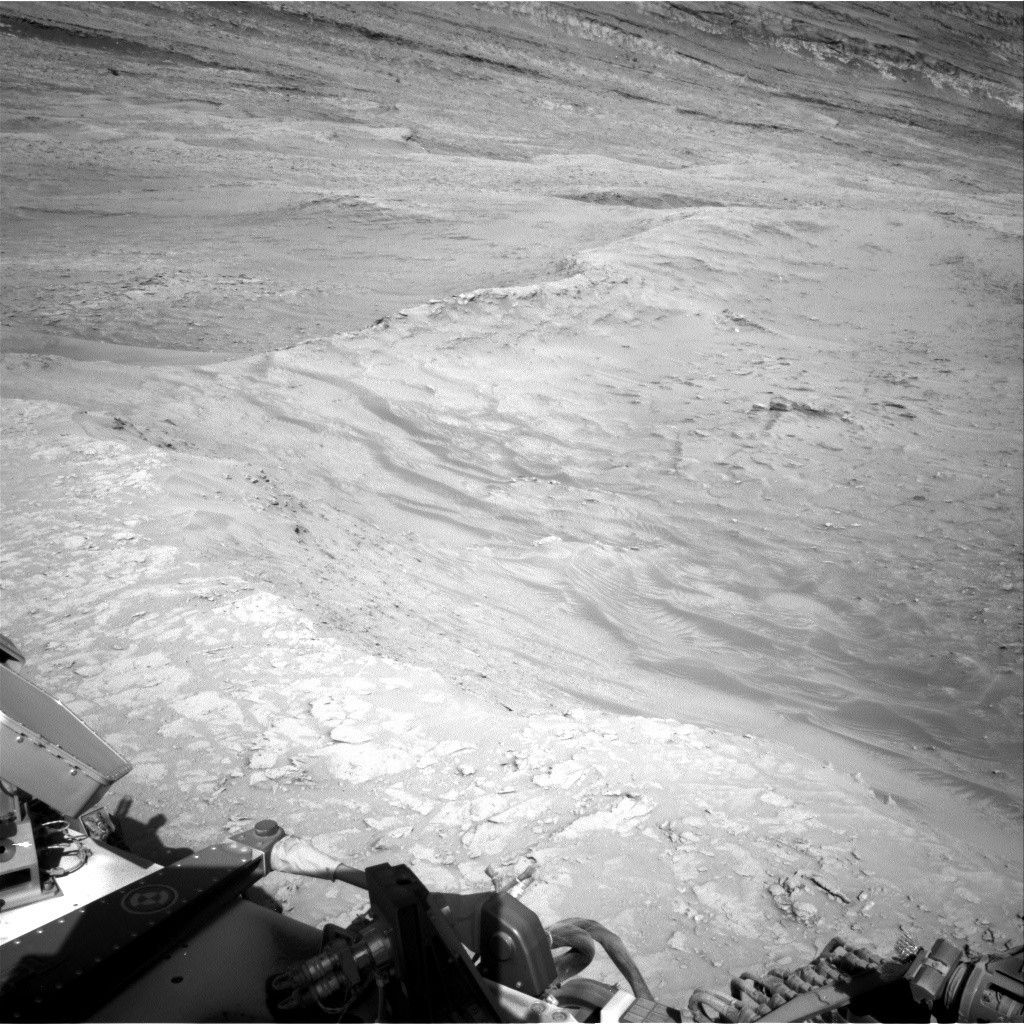
The highlight of Curiosity’s current mission is the creation of a 360-degree Mastcam panorama. This sweeping view will capture the unique ridge-and-hollow topography within the boxwork-forming unit that the rover has been exploring. Additionally, the panorama will document the stratigraphy of nearby buttes. Stratigraphy here refers to the study of rock layers, which can provide valuable insights into the planet’s geological history.
Of particular interest is the right-angle ridge pattern prominently visible in HiRISE (High-Resolution Imaging Science Experiment) orbital images. HiRISE is a powerful camera aboard the Mars Reconnaissance Orbiter, capable of capturing detailed surface features from space. These images helped scientists plan Curiosity’s stop at this location. Remarkably, it has been 70 sols (Martian days) since the rover last captured a panorama, and during this time, it has traveled a considerable distance across the Martian landscape.
Detailed Imaging and Analysis
In addition to the panoramic view, Curiosity is conducting detailed imaging using the ChemCam remote imager (RMI) and Mastcam’s high-resolution M100 camera. The planned imaging will cover various geological features, including the exposed strata beneath the ridge known as "Arequipa Airport." Two notable linear fractures, "Laguna de Salinas" and "Laguna Santa Rosa," will also be examined. These fractures are significant as they could reveal information about the planet’s tectonic or volcanic activity.
The rover will also capture images of troughs surrounding a nearby light-toned float block, dubbed "Arubai," and the Uyuni butte, which stands in the middle distance. These imaging efforts are crucial for understanding the geological processes that have shaped Mars over millions of years.
Observing Changes in Bedrock Texture
Curiosity’s current location exhibits a noticeable change in bedrock texture compared to its previous workspace. The bedrock here has a knobbly texture interspersed with occasional platier exposures. To further investigate these textures, the rover will conduct geochemical measurements using the ChemCam Laser-Induced Breakdown Spectroscopy (LIBS). This technique involves firing a laser at a rock or soil target, creating a plasma, and analyzing the light emitted to determine its composition.
The ChemCam will target two specific areas: "La Coca," a block that appears to exhibit unusual colors, and "El Algodón," a knobbly chunk of bedrock. These analyses will complement the auto-targeted post-drive AEGIS (Autonomous Exploration for Gathering Increased Science) measurements. AEGIS is a software tool that enables Curiosity to autonomously select and analyze rock targets.
Further geochemical analysis will be conducted using the Alpha Particle X-ray Spectrometer (APXS), a tool that determines the elemental composition of rocks and soil. The APXS will analyze the "Yura Tuff" target, which features a knobbly texture, after dust removal, and the "Tipnis" target without dust removal. MAHLI (Mars Hand Lens Imager) will provide close-up images of these APXS targets, offering a detailed view of their surface features.
Studying the Martian Atmosphere
As Curiosity navigates the Martian surface, it continues to monitor the planet’s modern environment. Currently, it is the cloudy season at Gale Crater, prompting the rover’s team to plan several cloud-related activities. A Mastcam sky survey will measure the abundance of atmospheric dust and water ice. This survey is crucial for understanding the current weather patterns on Mars and how they may affect future exploration efforts.
One of the planned observations involves capturing video footage of clouds and their shadows. This data will allow scientists to calculate the altitudes and velocities of the clouds and the winds that drive them. Such measurements are essential for understanding the dynamics of the Martian atmosphere.
Additionally, a short movie will be created to search for dust devil activity. Dust devils are small, swirling columns of dust and are a common occurrence on Mars. Observing these phenomena helps scientists understand the planet’s surface and atmospheric conditions.
Curiosity’s passive environmental monitoring instruments, REMS (Rover Environmental Monitoring Station) and DAN (Dynamic Albedo of Neutrons), will continue to observe temperature, humidity, and the neutron environment at the rover’s current location. These ongoing observations provide valuable data on the planet’s climate and contribute to long-term studies of the Martian environment.
The Road Ahead for Curiosity
Curiosity’s mission on Mars is an ongoing journey of discovery. As the rover continues to explore the Red Planet, each new observation and analysis brings scientists closer to unraveling the mysteries of Mars’ past and present. The data collected not only enhances our understanding of Mars but also informs future missions, including the eventual goal of human exploration.
For those interested in learning more about Curiosity’s mission and its latest findings, NASA’s official website offers a wealth of information and updates. The mission’s success is a testament to the ingenuity and dedication of the scientists and engineers who continue to push the boundaries of space exploration.
In conclusion, Curiosity’s recent activities highlight the rover’s critical role in advancing our knowledge of Mars. As it traverses the Martian landscape, Curiosity continues to uncover the planet’s secrets, paving the way for future exploration and discovery.
For more Information, Refer to this article.