





















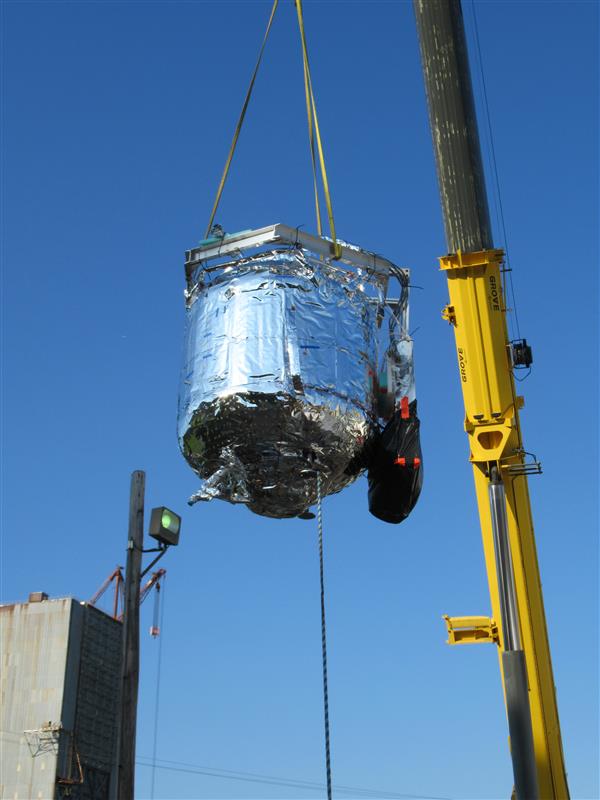
In the vast and frigid expanse of space, where temperatures can drop to an astonishing minus 455 degrees Fahrenheit, one might assume that maintaining cold conditions is a straightforward task. However, the reality is far more intricate, especially when it comes to preserving ultra-cold fluid propellants, also known as fuel, which are susceptible to overheating due to factors such as onboard systems, solar radiation, and spacecraft exhaust. To address this challenge, NASA has developed a sophisticated method known as cryogenic fluid management. This collection of technologies is designed to store, transfer, and measure super-cold fluids, which are crucial for missions to the Moon, Mars, and future long-duration spaceflight endeavors.
Cryogenic fluids, such as liquid hydrogen and liquid oxygen, are commonly used as propellants in space exploration. Despite the seemingly cold environment of space, these propellants face a “hot” threat because of their low boiling points—approximately minus 424 degrees Fahrenheit for liquid hydrogen and minus 298 degrees Fahrenheit for liquid oxygen. This makes them vulnerable to boiloff, where the liquid turns into gas and escapes, potentially leading to significant fuel loss.
In an unprecedented demonstration, NASA’s Marshall Space Flight Center in Huntsville, Alabama, is testing an innovative approach to achieve zero boiloff storage of liquid hydrogen. This involves using two stages of active cooling, which could effectively prevent the loss of valuable propellant. Kathy Henkel, the acting manager of NASA’s Cryogenic Fluid Management Portfolio Project, emphasized the importance of this technology, stating, “Technologies for reducing propellant loss must be implemented for successful long-duration missions to deep space like the Moon and Mars. Two-stage cooling prevents propellant loss and successfully allows for long-term storage of propellants whether in transit or on the surface of a planetary body.”
The new technique, referred to as “tube on tank” cooling, integrates two cryocoolers or cooling devices to maintain the propellant at the necessary low temperatures and counteract multiple heat sources. In this method, helium, chilled to around minus 424 degrees Fahrenheit, circulates through tubes attached to the outer wall of the propellant tank. This design ensures that the propellant remains cold and minimizes the risk of boiloff.
In June, NASA’s team installed the propellant tank in a test stand at the Marshall Space Flight Center, initiating a 90-day test campaign slated to conclude in September. The tank is enveloped in a multi-layer insulation blanket, which includes a thin aluminum heat shield placed between layers. A second set of tubes, carrying helium at about minus 298 degrees Fahrenheit, is integrated into this shield. This intermediate cooling layer intercepts and rejects incoming heat before it can reach the tank, reducing the thermal load on the tube-on-tank system.
A significant challenge in current spaceflight systems is the potential for dangerous pressure buildup in the propellant tank. To manage this, boiloff vapors must be vented, resulting in the loss of valuable fuel. Eliminating such propellant losses is crucial for the success of NASA’s most ambitious missions, including future crewed journeys to Mars, which will require storing large amounts of cryogenic propellant in space for extended periods, potentially months or even years. Until now, cryogenic fuels have only been utilized for missions lasting less than a week.
Henkel highlighted the necessity of preserving cryogenic propellants for sustainable space exploration, explaining, “To go to Mars and have a sustainable presence, you need to preserve cryogens for use as rocket or lander return propellant. Rockets currently control their propellant through margin, where larger tanks are designed to hold more propellant than what is needed for a mission. Propellant loss isn’t an issue with short trips because the loss is factored into this margin. But human exploration missions to Mars or longer stays at the Moon will require a different approach because of the very large tanks that would be needed.”
The Cryogenic Fluid Management Portfolio Project is a collaborative effort involving teams at NASA’s Marshall Space Flight Center and the Glenn Research Center in Cleveland. This project is part of NASA’s Technology Demonstration Missions Program, which falls under the Space Technology Mission Directorate. The cryogenic portfolio encompasses more than 20 individual technology development activities aimed at advancing space exploration capabilities.
For those interested in delving deeper into the world of cryogenic fluid management, detailed information can be found on NASA’s official page dedicated to this groundbreaking technology.
As space exploration continues to push the boundaries of human capability, the development of advanced technologies like cryogenic fluid management is essential. By ensuring the preservation and efficient use of propellants, NASA is paving the way for longer and more sustainable missions beyond Earth’s orbit. The successful implementation of these technologies could mark a significant milestone in humanity’s journey to explore and perhaps even inhabit other celestial bodies.
For more Information, Refer to this article.