





















Unveiling the Red Spider Nebula: A New Perspective with the James Webb Space Telescope
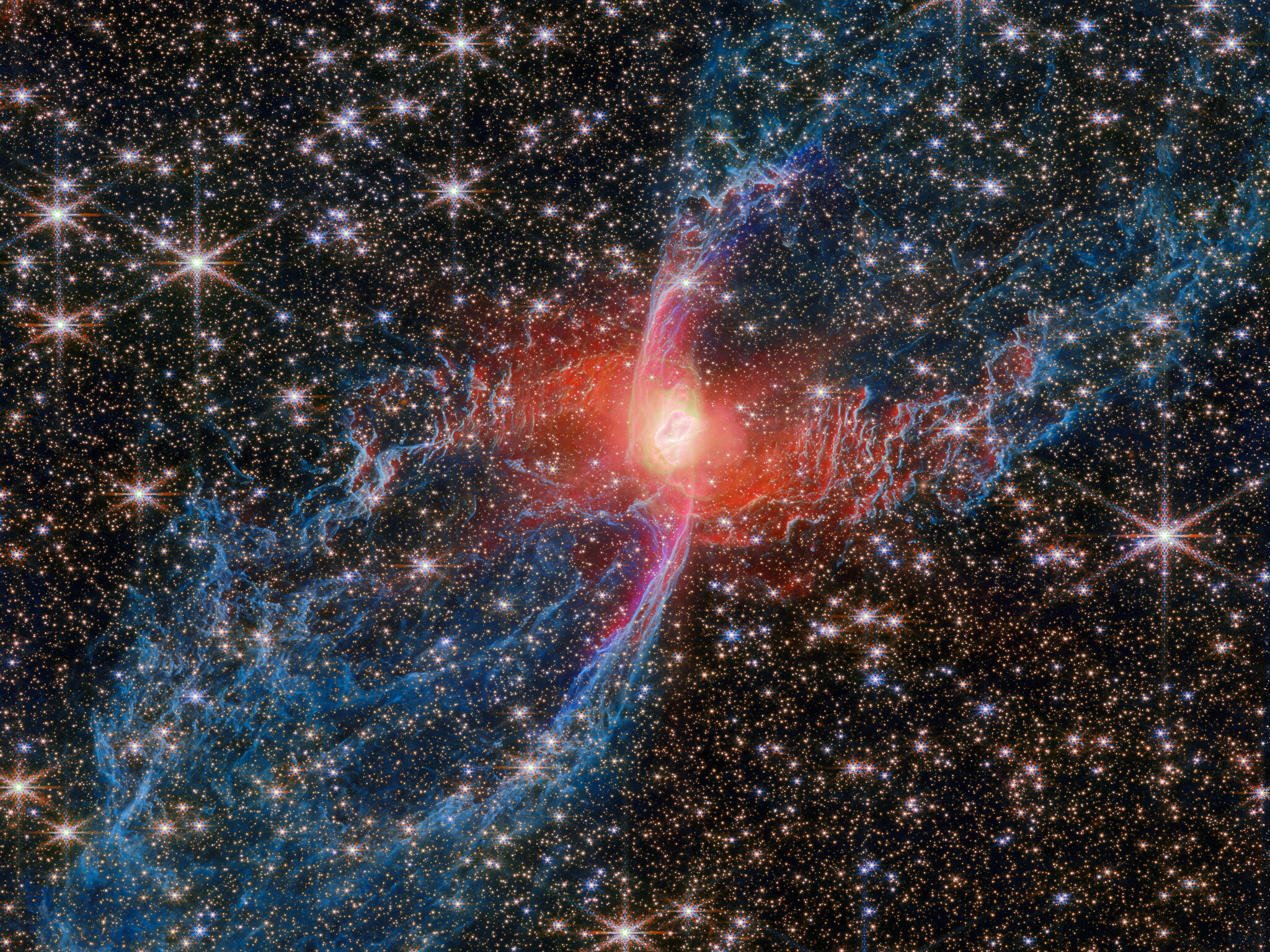
In a remarkable advancement in space observation, NASA’s James Webb Space Telescope has offered an unprecedented view of the Red Spider Nebula. Utilizing the Near-InfraRed Camera (NIRCam), the telescope has captured intricate details of this planetary nebula that were previously unseen. The image, released on October 26, 2025, provides a new understanding of the nebula’s vast and complex structure.
Understanding NIRCam: The Tool Behind the Vision
The Near-InfraRed Camera, commonly referred to as NIRCam, is a pivotal component of the James Webb Space Telescope. As its primary near-infrared imager, NIRCam is designed to capture high-resolution images and conduct spectroscopy across a broad spectrum of astronomical investigations. This camera offers a window into the universe that allows scientists to explore celestial phenomena with unprecedented clarity.
A New Look at the Red Spider Nebula
The latest images from Webb unveil the full scope of the Red Spider Nebula’s expansive lobes—features that resemble the legs of a spider. In these images, the lobes are depicted in a striking blue hue due to the light emitted by H2 molecules, which are formed by two hydrogen atoms bonded together. These structures stretch across the entire field of view captured by NIRCam, revealing closed, bubble-like formations that extend approximately three light-years each.
The origin of these lobes is the outflow of gas from the nebula’s core, which has been expanding these massive bubbles for thousands of years. This process sheds light on the dynamic forces at play within the nebula and highlights the transformative power of stellar winds and radiation.
The Science Behind the Beauty
The Red Spider Nebula is an example of a planetary nebula, a phenomenon that occurs during the late stages of a star’s life. When a star similar to our Sun exhausts its nuclear fuel, it expels its outer layers into space, creating a shell of gas and dust. The remaining core of the star, now a white dwarf, emits ultraviolet radiation that causes the surrounding gas to glow, resulting in the vibrant colors observed in planetary nebulae.
The detailed imagery provided by NIRCam allows scientists to study the composition and structure of these nebulae in great detail. By analyzing the light emitted by the H2 molecules within the lobes, researchers can gain insights into the physical conditions and chemical processes occurring within the nebula.
The Significance of This Discovery
The ability to observe the Red Spider Nebula with such precision marks a significant milestone in the field of astronomy. It not only enhances our understanding of planetary nebulae but also provides a glimpse into the processes that shape the evolution of stars and galaxies. These observations can inform models of stellar dynamics and contribute to our comprehension of the lifecycle of stars.
Moreover, the findings from this study have broader implications for understanding the universe. Planetary nebulae like the Red Spider serve as laboratories for studying the complex interactions between stars and their environments. By examining these intricate systems, scientists can piece together the history of our cosmos and better predict its future.
The Broader Impact of the James Webb Space Telescope
The James Webb Space Telescope represents a new era in space exploration. As the successor to the Hubble Space Telescope, Webb is equipped with cutting-edge technology that enables it to explore the universe in ways that were previously impossible. Its suite of instruments, including NIRCam, allows scientists to probe the mysteries of the cosmos with unprecedented depth and clarity.
The data collected by Webb will support a wide range of scientific endeavors, from studying the formation of stars and galaxies to searching for potentially habitable exoplanets. By providing detailed observations of celestial phenomena, Webb is poised to transform our understanding of the universe and inspire future generations of astronomers.
Reaction from the Scientific Community
The release of these images has generated excitement and intrigue within the scientific community. Researchers and astronomers worldwide have expressed their enthusiasm for the insights provided by Webb’s observations. The ability to visualize the Red Spider Nebula in such detail opens new avenues for research and sets the stage for future discoveries.
The collaboration between NASA, the European Space Agency (ESA), and the Canadian Space Agency (CSA) on the Webb project reflects the global effort to advance our knowledge of the universe. This partnership underscores the importance of international cooperation in the pursuit of scientific exploration and discovery.
Looking Ahead: Future Prospects and Discoveries
As the James Webb Space Telescope continues its mission, scientists anticipate a wealth of new discoveries that will expand our understanding of the universe. The insights gained from studying the Red Spider Nebula are just the beginning. With its advanced capabilities, Webb is poised to uncover the secrets of distant galaxies, the formation of stars and planets, and the potential for life beyond Earth.
In the coming years, Webb will continue to push the boundaries of what is possible in space exploration. Its observations will not only enhance our scientific knowledge but also inspire a sense of wonder and curiosity about the cosmos. As we look to the future, the discoveries made by the James Webb Space Telescope will undoubtedly shape the trajectory of astronomical research and deepen our appreciation for the vast and intricate universe we inhabit.
For more detailed information and to view the stunning images captured by the James Webb Space Telescope, you can visit the official ESA Webb website.
For more Information, Refer to this article.