






















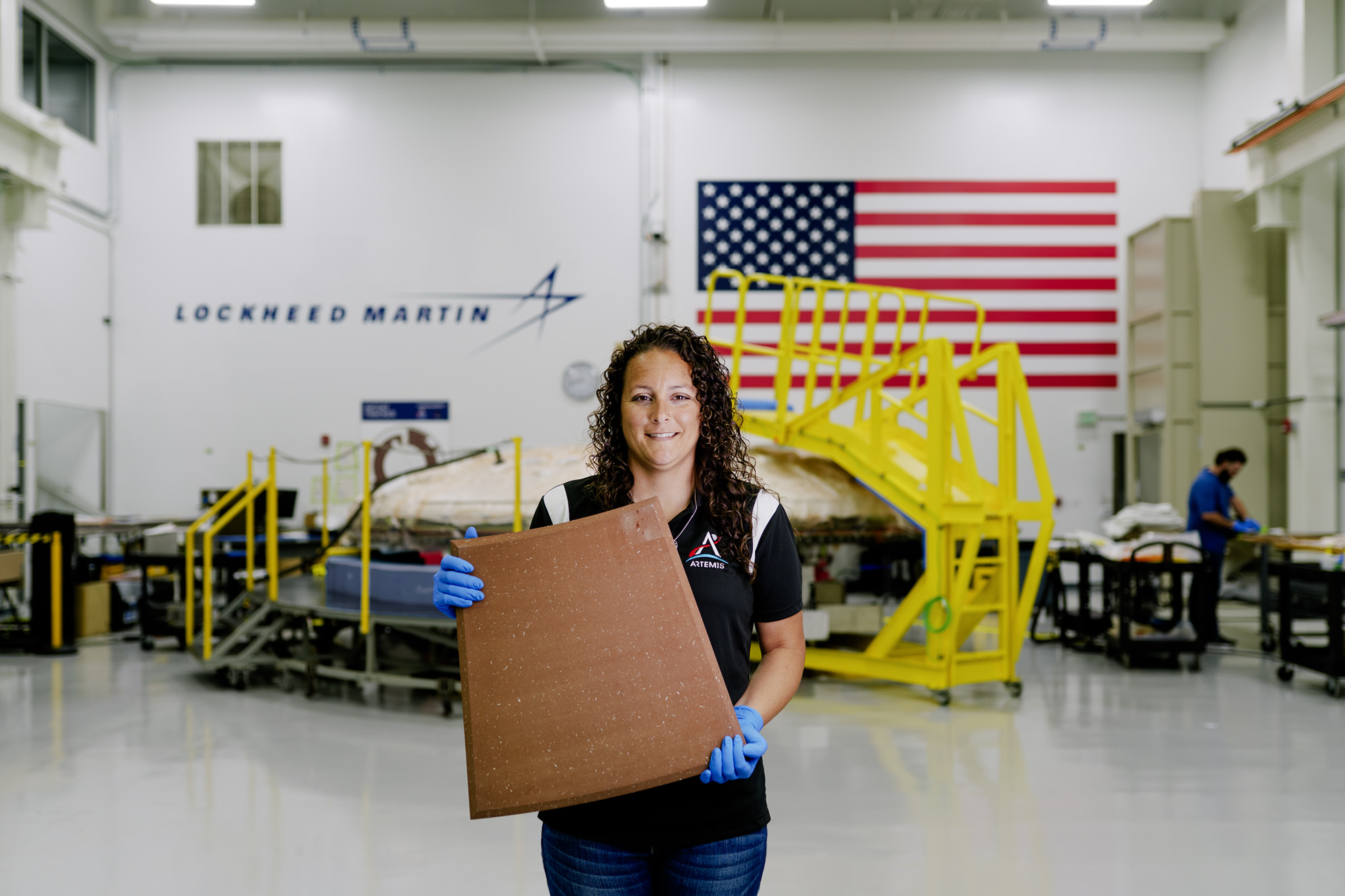
Diamond St. John: Continuing a Legacy of Space Exploration
In the realm of space exploration, certain families have forged legacies that span generations. Diamond St. John is one such individual who continues her family’s rich history of contributing to human spaceflight at NASA’s Kennedy Space Center in Florida. St. John’s journey is intertwined with the Apollo missions of the past and the Artemis missions of the present, as she plays a pivotal role in NASA’s ambitious plan to return humans to the Moon.
As an engineer at Lockheed Martin, St. John is integral to the Orion program, which is NASA’s spacecraft designed to transport astronauts to and from the Moon. Her expertise lies in the development of the Orion heat shield—an essential component tasked with ensuring the safety of astronauts as they re-enter Earth’s atmosphere. The heat shield must withstand extreme temperatures nearing 5,000 degrees Fahrenheit, making it a critical element of the mission’s success.
At Lockheed’s Spacecraft, Test, Assembly, and Resource Center in Titusville, Florida, St. John spearheads the production workflow for the Orion heat shield. This component is the largest of its kind globally, and her responsibilities ensure that each stage of its production is meticulously executed. The team is keenly aware of the importance of their work, knowing that the lives of astronauts depend on the quality and precision of the heat shield’s construction.
The Artemis III Mission: Unveiling the Heat Shield
St. John and her team are currently focused on the Artemis III mission, which aims to land astronauts on the lunar surface. The process involves bonding 186 Avcoat tiles to the heat shield’s underlying structure. Avcoat is a material specifically designed for thermal protection, and its application is crucial for the heat shield’s effectiveness. The process begins with sanding the blocks to minimize gaps, followed by bonding, filling, and rigorous testing. Once these steps are completed, the heat shield is painted and taped, ensuring its readiness for the mission.
The dedication and precision required for this task reflect the seriousness with which the team approaches their work. The safety of astronauts is paramount, and the heat shield’s integrity is a critical factor in ensuring a successful mission return.
A Journey Through the Orion Program
St. John’s involvement with the Orion program began with the Artemis I spacecraft. Her initial role was as a technician intern with the subcontractor ASRC Federal, where she worked on the clean room floor. Her commitment and passion for space exploration led her to a full-time position in quality inspection while she pursued her bachelor’s degree in engineering. Her career trajectory took a defining turn when she joined Lockheed Martin as a manufacturing engineer.
Reflecting on her career path, St. John acknowledges the significance of being part of a mission that continues the legacy of her great-grandparents, who contributed to the Apollo missions. "Everything has been Artemis from the beginning," she notes, proud to follow in the footsteps of her ancestors. The familial connection to space exploration adds a layer of personal fulfillment to her professional achievements.
The Importance of the Heat Shield
The heat shield is not merely a technical component; it is a lifeline for the astronauts aboard the Orion spacecraft. As the spacecraft re-enters Earth’s atmosphere at high speeds, it faces intense heat and pressure. The heat shield’s role is to absorb and deflect this heat, preventing it from reaching the spacecraft’s interior and ensuring the safety of its occupants. This responsibility underscores the importance of precision engineering and meticulous attention to detail in its construction.
The Artemis Mission: A Step Towards the Future
The Artemis mission represents a significant milestone in space exploration. It aims to establish a sustainable human presence on the Moon and lay the groundwork for future missions to Mars. The success of Artemis III, and subsequent missions, relies on the collective efforts of engineers like Diamond St. John, who are dedicated to advancing human spaceflight technology.
The Artemis program’s objectives extend beyond lunar exploration. It seeks to inspire future generations to pursue careers in science, technology, engineering, and mathematics (STEM). By showcasing the accomplishments of individuals like St. John, the program highlights the diverse opportunities available in the field of space exploration.
Reflections and Future Prospects
Diamond St. John’s journey is a testament to the enduring legacy of human space exploration. Her work on the Orion heat shield is a crucial component of NASA’s vision for the future. As the Artemis program continues to evolve, it will undoubtedly inspire new generations of engineers, scientists, and explorers.
The story of Diamond St. John is a reminder of the profound impact that individual dedication and expertise can have on the broader goals of space exploration. Her contributions to the Orion program exemplify the spirit of innovation and perseverance that defines NASA’s mission to explore the unknown. Through her work, St. John not only honors her family’s legacy but also paves the way for future explorers to reach new frontiers.
For more information on the Orion program and the Artemis mission, visit NASA’s official website.
For more Information, Refer to this article.