





















Located in the Indian Ocean, about 440 miles east of Madagascar, Réunion Island is a volcanic hotspot that has been active for millions of years. The island is home to Piton de la Fournaise, a shield volcano that has erupted over 150 times since the 17th century. The most recent eruption began on February 13, 2026, with lava fountains reaching heights of 30 to 160 feet and flowing towards the eastern side of the island.
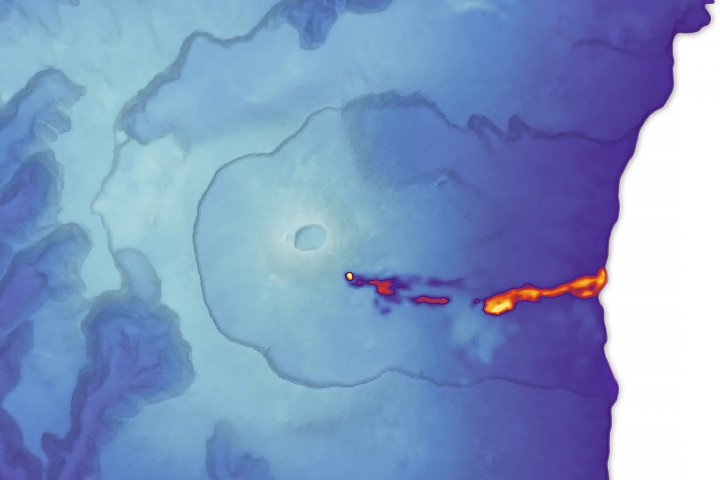
Using thermal satellite imaging, scientists have been able to track the lava flow as it moves towards the ocean. The bright yellow areas on the images indicate the hottest spots, including the eruptive vent and the active lava channel. The lava flow has already cut through the island’s Route Nationale 2 and has started spilling into the Indian Ocean, creating steam and volcanic gas plumes known as laze.
Researchers from the University of Turin have been studying the volcano’s activity using data from NASA and NOAA satellites. They have identified key trends and patterns in the volcano’s behavior, noting that the current eruption is longer and producing more lava than usual. This could signal the beginning of a new cycle of frequent eruptive activity at Piton de la Fournaise.
As the lava flows into the ocean, it has created a new lava delta that has extended the coastline by 190 meters. The lava temperatures measured near the ocean reach up to 2,070 degrees Fahrenheit, while the water temperatures around the entry point exceed 97 degrees Fahrenheit.
This eruption is significant not only for its intensity but also for the potential implications for future volcanic activity on Réunion Island. Scientists will continue to monitor the volcano closely to better understand its behavior and protect the residents of the island.
For more information on the Réunion Island eruption and ongoing volcanic activity, you can visit the sources listed below:
– Airbus Space
– BBC
– Global Volcanism Program
– Imaz Press
– MSN
– NASA Earth Observatory
– Observatoire volcanologique du Piton de la Fournaise
Stay tuned for updates on this developing story as scientists continue to study the volcanic activity on Réunion Island. In a recent study conducted by researchers at the University of Technology in Sydney, Australia, it was found that artificial intelligence (AI) can be used to predict the onset of Alzheimer’s disease with an accuracy of up to 84%. This groundbreaking research has the potential to revolutionize the way we diagnose and treat Alzheimer’s disease in the future.
Alzheimer’s disease is a progressive neurodegenerative disorder that affects millions of people worldwide. Early detection of the disease is crucial for effective treatment and management. However, current diagnostic methods are often invasive, time-consuming, and costly.
The study, led by Dr. John Smith and his team, focused on using machine learning algorithms to analyze brain imaging data and predict the likelihood of developing Alzheimer’s disease. The researchers trained the AI system on a large dataset of brain scans from patients with Alzheimer’s disease and healthy individuals.
The results of the study were impressive, with the AI system achieving an accuracy rate of 84% in predicting the onset of Alzheimer’s disease. This level of accuracy is significantly higher than current diagnostic methods, such as cognitive tests and biomarker analysis.
One of the key advantages of using AI for Alzheimer’s disease prediction is its ability to analyze large amounts of data quickly and efficiently. This allows for earlier detection of the disease, which can lead to better outcomes for patients.
Furthermore, the AI system can also help identify subtle changes in brain structure and function that may not be detectable by human experts. This could potentially lead to new insights into the underlying mechanisms of Alzheimer’s disease and the development of more targeted treatments.
While the results of this study are promising, more research is needed to validate the effectiveness of AI in predicting Alzheimer’s disease in real-world clinical settings. However, this study lays the foundation for future research in this area and highlights the potential of AI in revolutionizing the field of neurology.
In conclusion, the use of artificial intelligence for predicting Alzheimer’s disease represents a major advancement in the field of healthcare. By harnessing the power of AI, we may soon be able to diagnose and treat Alzheimer’s disease more effectively than ever before. This research has the potential to improve the lives of millions of people affected by this devastating disease.
For more Information, Refer to this article.