


















The spawning season for Pacific herring (Clupea pallasii) has arrived in the waters off British Columbia, Canada. Every year from mid-February to early May, thousands of these small, shiny fish gather in shallow coastal areas around Vancouver Island, creating a mesmerizing sight that can even be seen from satellites.
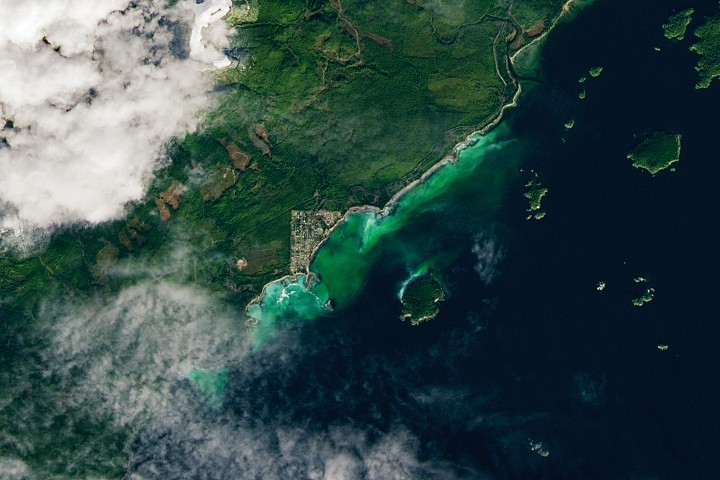
One of the prime locations for these spawning events is Barkley Sound, on the southwestern side of Vancouver Island. On February 19, 2026, the Landsat 9 satellite captured early-season activity near Forbes Island, where female herring lay their eggs on various surfaces like kelp, seagrass, and rocks, while males release sperm-containing fluid into the water, giving it a greenish hue.
These spawning events near Forbes Island have been documented since the 1970s, with herring preferring sheltered areas with rocky substrate and reduced salinity for spawning. According to Jessica Moffatt, a biologist with the Island Marine Aquatic Working Group (IMAWG), Barkley Sound meets many of these criteria, along with factors like collective memory and predation pressure influencing the size and location of spawns.
Spawning events can last anywhere from a few hours to several days, with fish staging in the area weeks before actual spawning begins. Observers reported herring activity near Forbes Island from February 19 to February 21, 2026, with changes in water color signaling the presence of spawning fish and attracting wildlife like whales, sea lions, eagles, wolves, and bears.
Traditionally, tracking herring spawn activity has been limited by aerial and dive surveys, remote reporting, and fisheries priorities. However, researchers at the University of Victoria have utilized satellite observations to enhance historical spawn records and develop methods for future detections, providing valuable insights into herring behavior and ecosystem dynamics.
Pacific herring and their roe hold cultural significance as a food source for First Nations communities and play a crucial role in British Columbia’s commercial fisheries. As a forage fish species, herring are essential to the marine ecosystem, supporting the food chain for predators like salmon. Understanding the locations of spawning areas can offer valuable information about changes in the marine environment over time.
In conclusion, the annual Pacific herring spawn in British Columbia is not only a natural spectacle but also a significant event with far-reaching ecological implications. By leveraging satellite technology and scientific research, we can gain a better understanding of herring behavior and the interconnectedness of marine life in the region.
References:
– California Marine Species Portal (2024) Pacific Herring Enhanced Status Report
– CBC (2026, February 25) First signs of herring spawn spark excitement on Vancouver Island
– Fisheries and Oceans Canada (2026, January 20) Pacific herring fisheries
– Ha-Shilth-Sa (2024, November 29) No commercial catch in 2025, despite herring population growth, say Ha’wiih – but spawn-on-kelp being explored
– IMAWG (2026) Island Marine Aquatic Working Group
– Island Marine Aquatic Working Group, via Facebook (2026) Pacific Herring Spawn Reporting – IMAWG
– NASA Earth Observatory (2025, May 5) Spawning Spectacle
– Spectral and Remote Sensing Laboratory, University of Victoria, Herring Spawn Habitat: Spatiotemporal analysis of historical spawning sites using satellite remote sensing
For more Information, Refer to this article.