













![[Video] Samsung Color E-Paper: A Smarter Alternative to Traditional Posters](https://www.hawkdive.com/media/samsung-tvs-and-displays-samsung-color-e-paper-samsung-vxt-digital-signage_thumb932-218x150.jpg "Samsung introduces Color E-Paper as innovative poster alternative.")







Steve Platnick’s Legacy at NASA and the Future of Earth Science Missions
After a remarkable 34-year career intertwined with NASA, Steve Platnick, the Deputy Director for Atmospheres within the Earth Sciences Division at NASA’s Goddard Space Flight Center (GSFC), has decided to step down as of August 8, 2025. His journey with GSFC began in 2002 as a civil servant, but his association with the center dates back to 1993. Initially, he worked as a contractor, later becoming one of the pioneering employees at the Joint Center for Earth Systems Technology (JCET). Over the years, Steve played a pivotal role in the advancement and sustainability of NASA’s Earth Observing System platforms and data. He was a key contributor to the Moderate Resolution Imaging Spectroradiometer (MODIS) Science Team, where he significantly advanced several components of the MODIS instrument. Additionally, from 2012 to 2020, he served as the NASA Lead/co-Lead for the Suomi National Polar-orbiting Partnership (Suomi NPP), focusing on cloud optical and microphysical products.
In 2008, Steve took on the role of Senior Project Scientist for the Earth Observing System (EOS). This position placed him at the helm of the EOS Project Science Office, where he supported airborne sensors, ground networks, and calibration laboratories. His contributions have been celebrated in the Kudos article titled “Steve Platnick Steps Down from NASA After 34 Years of Service,” which provides a detailed overview of his career and the numerous awards he has received.
With Steve’s departure, a vacancy has emerged in the position of author for “The Editor’s Corner” in the Earth Observer. Barry Lefer, the Associate Director of Research for the Earth Science Division at NASA Headquarters, will temporarily fill this role. Alan Ward, the Executive Editor of the Earth Observer, expressed gratitude for Steve’s longstanding support and welcomed Barry to his new responsibilities.
Successful Launch of the NISAR Mission
On July 30, 2025, a significant milestone in Earth science was achieved with the successful launch of the joint NASA–Indian Space Research Organization (ISRO) mission, known as the Synthetic Aperture Radar (NISAR). The mission launched from the Satish Dhawan Space Centre on India’s southeastern coast at 5:40 PM Indian Standard Time (IST) or 8:10 AM Eastern Daylight Time (EDT), aboard an ISRO Geosynchronous Satellite Launch Vehicle (GSLV) rocket. About 20 minutes post-launch, ISRO ground controllers established communication with NISAR, confirming that it was functioning as expected.
NISAR employs two distinct radar frequencies—L-band and S-band—to penetrate clouds and forest canopies. This innovative use of dual-frequency radar echoes NASA’s long history with Synthetic Aperture Radar (SAR) missions, which began with the launch of Seasat in 1978. For ISRO, this technological journey started in 2012 with the Radar Imaging Satellite (RISAT-1) and continued with RISAT-1A in 2022, serving a wide array of applications within India.
By combining data from these two radar frequencies, NISAR will provide researchers with the ability to globally map Earth’s surface changes with centimeter-level precision. This high-resolution data offers unprecedented insights into complex processes ranging from ecosystem disturbances to natural disasters and groundwater issues. Crucially, all NISAR science data will be freely accessible to the public.
Following its launch, NISAR entered a 90-day commissioning phase to test its systems before transitioning to operational science activities. A major highlight of this phase was the deployment of the 39-foot (12-meter) radar antenna reflector on August 15, 2025. This deployment was a meticulously orchestrated process beginning on August 9, as the satellite’s boom unfolded joint by joint until fully extended. On August 15, small explosive bolts released the reflector assembly, allowing the antenna to unfurl like an umbrella. Motors and cables then locked the antenna into its final position.
The radar reflector is a critical component for directing and receiving microwave signals. By analyzing differences between the L-band and S-band measurements, scientists can deduce various surface characteristics. With NISAR passing over the same locations every 12 days, researchers can compare data over time to uncover new insights into Earth’s dynamic surfaces.
As the radar reflector reaches its full operational capability, scientists are now focused on fine-tuning and testing the radar in preparation for the commencement of Science Operations, expected around November. The successful launch and deployment of the radar reflector mark a significant achievement for the NISAR team, and anticipation builds within the science community for the discoveries that will emerge from this data-rich mission.
Contributions and Future of the SMAP Mission
In related news, the Soil Moisture Active Passive (SMAP) mission has achieved a decade of success in collecting global L-band radiometry observations. These data have resulted in enhanced surface soil moisture, vegetation optical depth (VOD), and freeze/thaw state estimates, surpassing previous products. SMAP’s soil moisture data have significantly advanced scientific understanding of the interconnections between carbon, water, and energy cycles on land. The data have been instrumental in improving drought assessments, flood predictions, and the accuracy of numerical weather prediction models.
The mission’s Early Adopter program has been pivotal in connecting SMAP data with users and organizations in need. It has expanded awareness of the mission’s products, broadened the user community, and increased collaboration, thereby facilitating the distribution and application of SMAP products. For instance, the L-band VOD data are being used to enhance understanding of water exchanges within the soil–vegetation–atmosphere continuum.
The SMAP Active–Passive (AP) algorithm, which integrates data from SMAP and the European Copernicus Program Sentinel-1 C-band SAR, will be adapted to incorporate L-band data from the freshly launched NISAR mission. This adaptation will enable global soil moisture estimates at a spatial resolution of 1 kilometer or better approximately once per week.
The data generated by the SMAP mission are poised for continued enhancement through the European Union’s proposed Copernicus Imaging Microwave Radiometer (CIMR) mission. If launched, this multichannel microwave radiometry observatory will include L-band and other microwave channels, sharing a large mesh reflector similar to SMAP’s. The CIMR mission aims to follow SMAP’s approach for radio-frequency interference detection while meeting desired instrument specifications.
For more insights into SMAP’s accomplishments, readers are encouraged to explore the article “A Decade of Global Water Cycle Monitoring: NASA Soil Moisture Active Passive Mission.”
Continued Success of the OCO Mission
NASA’s Orbiting Carbon Observatory-2 (OCO-2) has been a benchmark for atmospheric carbon dioxide (CO2) observations from space for over a decade. Data from OCO-2 provide valuable insights into plant health, forest management, crop yield forecasting, fire-risk modeling, and drought anticipation.
Launched to the International Space Station (ISS) in 2019, OCO-3 extends the global CO2 measurement legacy while adding new capabilities, such as detailed views of urban and tropical regions. The OCO mission is not just about data and hardware; it is a tapestry of human stories that have shaped its success. The article "A Tapestry of Tales: 10th Anniversary Reflections from NASA’s OCO-2 Mission" illuminates these personal narratives, from the excitement and anxiety surrounding OCO-2’s launch to fieldwork experiences and internships where OCO-2 data have improved wildfire models. These stories reveal the determination and passion driving the mission’s achievements.
The Landsat Program’s Enduring Impact
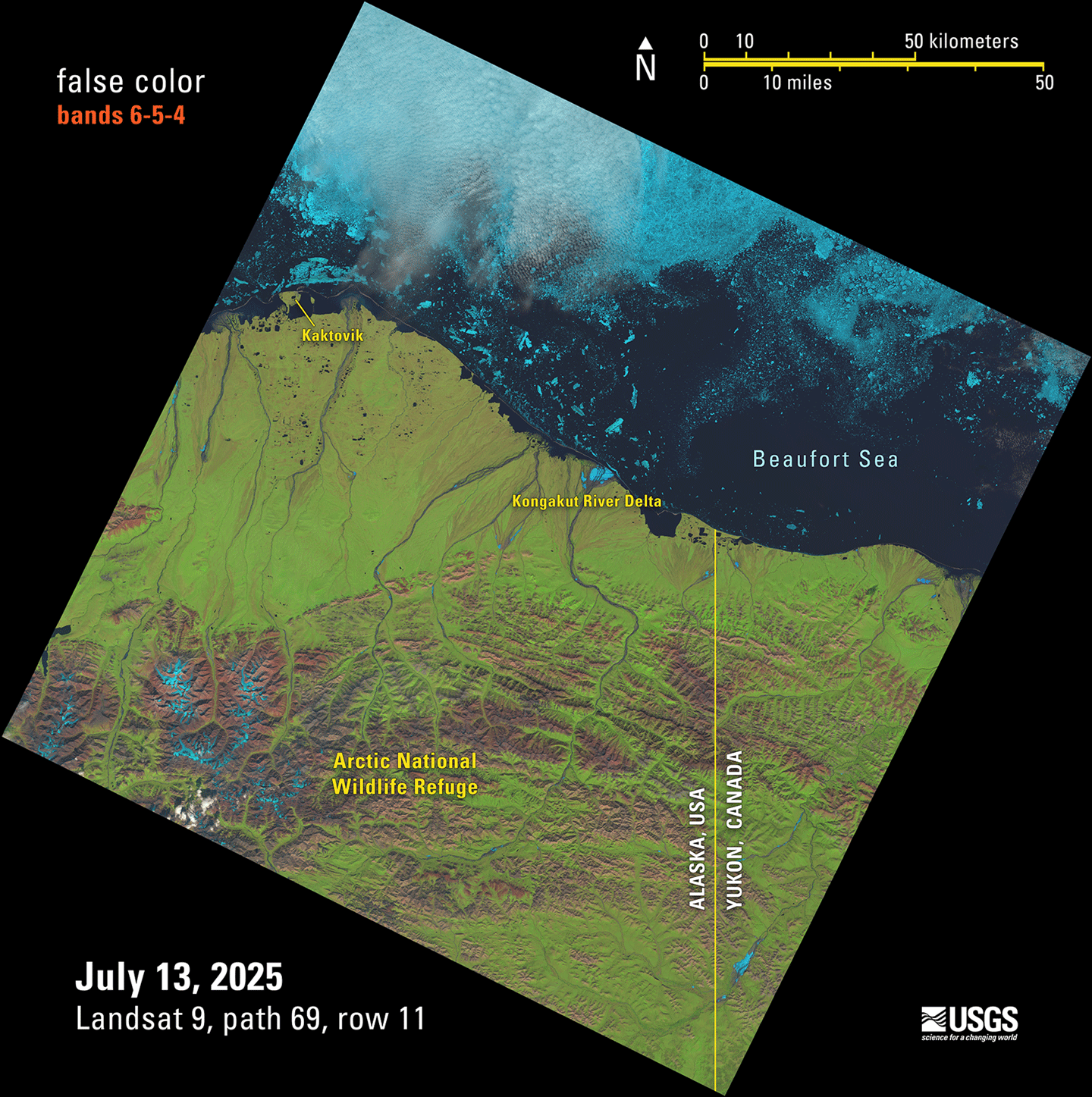
The joint NASA–U.S. Geological Survey (USGS) Landsat program has been a cornerstone of Earth observation for over five decades. On July 13, 2025, Landsat 9 captured its millionth image, showcasing the Arctic National Wildlife Refuge in Alaska. Landsat 9, the latest in the series, operates alongside Landsat 8, together providing invaluable data about Earth’s changing land surface every eight days.
Landsat 7, after amassing over 3.3 million images during its 26-year orbit, was decommissioned on June 4, 2025. The mission’s achievements and technical triumphs are summarized in a YouTube video released at the time of decommissioning. Additionally, The Earth Observer featured an article for the 20th anniversary of Landsat 7, providing a comprehensive history and insights into the mission’s accomplishments.
A notable strength of the Landsat program is its potential for data integration with other satellites. The Harmonized Landsat and Sentinel-2 (HLS) product exemplifies this collaborative approach, combining data from Landsat 8 and 9 with data from the European Space Agency’s Copernicus Sentinel-2 missions. This integration allows researchers to monitor short-term changes in Earth’s land surface more effectively.
HLS became one of the most-downloaded NASA data products in fiscal year 2024, with further growth anticipated. In February 2025, the program expanded with nine new vegetation indices based on HLS data, with historical processing back to 2013 to be completed by early 2026. Low-latency HLS products will also be available in late 2026. For a detailed account of HLS’s development, readers can refer to the feature: “Harmonized Landsat and Sentinel-2: Collaboration Drives Innovation.”
Revival of the GEDI Mission
Following a 13-month hibernation, the Global Ecosystem Dynamics Investigation (GEDI) mission was reinstalled on the ISS and resumed operations on April 22, 2024. Since then, GEDI’s lasers have been functioning as expected, continuing to produce high-quality observations of Earth’s three-dimensional structure, with 33 billion land surface returns recorded as of late 2024.
The mission team has been actively processing and releasing post-storage data to the public, with Version 2.1 of GEDI L1B, L2A, L2B, and L4A data products now available for download. The new L4C footprint-level Waveform Structural Complexity Index (WSCI) product using pre-storage data has also been released. The team is preparing Version 3.0 of all data products, incorporating post-storage data and improving quality, geolocation accuracy, and algorithm performance.
The 2025 GEDI Science Team Meeting brought together mission scientists, collaborators, stakeholders, and data users. It marked the first in-person gathering of the second competed science team, who shared updates on their research projects. The meeting provided a platform for brainstorming, knowledge-sharing, and discussion as the GEDI mission enters its second epoch. For more details, see “Summary of the 2025 GEDI Science Team Meeting.”
Conclusion of the ABoVE Experiment
The Arctic–Boreal Vulnerability Experiment (ABoVE) is in its final year, concluding a decade-long scientific journey that has transformed our understanding of environmental change in Alaska and western Canada. Funded by NASA’s Terrestrial Ecology Program, ABoVE has progressed through three phases: ecosystem dynamics, ecosystem services, and the current analysis and synthesis phase.
As ABoVE concludes, it encompasses 67 NASA-funded projects with over 1000 participating researchers. This collaborative scale is essential to addressing complex Arctic–boreal ecosystem questions. The program’s integrated approach, combining field research, airborne campaigns, and satellite remote sensing, has provided unprecedented insights into how changes in these regions affect ecosystems and society.
The final ABoVE Science Team Meeting showcased the program’s evolution, highlighting successful community engagement, cutting-edge research on carbon dynamics, and innovative science communication strategies. ABoVE is poised to deliver comprehensive insights that will inform Arctic and boreal research for years to come. For more information, refer to “Summary of the 11th and Final ABoVE Science Team Meeting.”
Recognition of Compton J. Tucker
Finally, it is worth acknowledging Compton J. Tucker, who retired from NASA in March 2025 after 48 years of public service. In April, he was elected to the National Academy of Sciences (NAS), one of the highest honors in American science. Compton’s career began at GSFC as a NAS postdoc before he joined NASA as a civil servant. A pioneer in satellite-based environmental analysis, his research has focused on global photosynthesis, land cover determination, drought and food security monitoring, and ecologically coupled disease outbreaks. For more details about Compton’s achievements, see “Compton J. Tucker Retires from NASA and is Named NAS Fellow.”
Barry Lefer, Associate Director of Research, Earth Science Division
For more Information, Refer to this article.