




















Curiosity Rover Continues Exploration with Diverse Scientific Activities
In an update from NASA’s Jet Propulsion Laboratory, Ashley Stroupe, a Mission Operations Engineer, shares the latest details about the Curiosity rover’s ongoing expedition on Mars. As the winter season continues on the Red Planet, the mission team is optimizing the rover’s schedule to conserve energy. By planning most activities during the warmer afternoon hours, they reduce the need for additional heating, allowing the rover to "sleep in" during the colder morning hours.
As the Systems Engineer and Engineering Uplink Lead for the day, Stroupe was responsible for coordinating the necessary heating and other maintenance activities to ensure the rover’s smooth operation.
Diverse Scientific Investigations
The day’s agenda started with a comprehensive remote science session. One of the key tasks involved the Mastcam, a camera system designed to capture high-resolution images in color, which was used to study a nearby trough for any signs of sand movement. The Mastcam also focused on a displaced block named “Ouro,” situated near a circular depression that could potentially be a small crater. Another target, the “Volcán Peña Blanca” ridge, was examined for sedimentary structures, which could offer clues about its geological history and formation.
The ChemCam, short for Chemistry and Camera complex, joined forces with the Mastcam to analyze the “Los Andes” target, a dark section of exposed bedrock. ChemCam uses a laser to vaporize rock surfaces and study the resulting plasma, which helps identify the chemical elements present. Additionally, the team utilized the ChemCam’s Remote Micro-Imager (RMI) and the Mastcam to investigate a distant small outcrop, focusing on the geometry of rock layers to better understand the area’s geological context.
Environmental observations were also on the agenda, including a Mastcam solar tau measurement to assess atmospheric opacity and a Navcam line-of-sight survey to monitor dust levels in the atmosphere. The Navcam, or Navigation Camera, assists in both navigation and scientific observations.
Contact Science and Surface Analysis
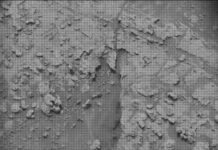
After a brief rest period, known as a nap, the Curiosity rover engaged in “contact science” activities on two specific bedrock targets: “Cataratas del Jardín” and “Rio Ivirizu.” By examining these adjacent targets, scientists aim to gather information on the variability of the local geology.
The Cataratas del Jardín target underwent brushing to remove surface dust, allowing for a clearer examination by two other instruments: MAHLI and APXS. MAHLI, or the Mars Hand Lens Imager, provides close-up images with details comparable to a geologist’s hand lens, while APXS, the Alpha Particle X-Ray Spectrometer, analyzes the composition of rocks and soil.
Fortunately for the rover’s Arm Planner, both targets were relatively flat and easily accessible. Once the contact science tasks were complete, Curiosity stowed its robotic arm in preparation for its next drive the following sol, or Martian day.
Continued Exploration and Navigation
On the second sol, the focus remained on remote scientific exploration. The ChemCam and Mastcam investigated another piece of layered bedrock, “Torotoro,” while the ChemCam RMI created a mosaic of “Paniri,” a fascinating incision in the rock that contains a different material.
The mission team also conducted environmental observations, including a Navcam dust devil survey and a suprahorizon movie to capture atmospheric dynamics. Following another rest period, Curiosity set off on a new journey, traveling approximately 50 meters (164 feet) southwest. The team carefully navigated between sandy pits and around terrain that remains out of sight. Fortunately, this part of Gale Crater features relatively smooth driving conditions, with few large boulders, steep inclines, or sharp rocks that could damage the rover’s wheels.
After completing its drive, Curiosity carried out standard post-drive imaging to assist in planning future activities. The Navcam captured images to search for clouds, and the MARDI, or Mars Descent Imager, took a look beneath the rover before it settled in for the night.
Technical Insights and Future Implications
This update from the Mars exploration mission highlights the intricate planning and execution involved in operating a rover on another planet. The careful coordination of scientific observations, engineering tasks, and navigation demonstrates the complexity of interplanetary exploration.
The use of advanced instruments like ChemCam and MAHLI allows scientists to conduct remote geochemical analyses that would otherwise require human presence. By utilizing these tools, researchers gain invaluable insights into Mars’s geological history and potential for past habitability.
The Curiosity rover’s journey across Gale Crater continues to reveal new information about the Martian environment, contributing to our understanding of planetary processes and the potential for life beyond Earth. As the mission progresses, each sol brings new data and discoveries that will inform future exploration efforts and the eventual goal of sending humans to Mars.
Conclusion
The ongoing efforts of NASA’s Curiosity rover showcase the capabilities of robotic exploration in advancing planetary science. By methodically investigating the Martian surface, the mission team is piecing together a clearer picture of Mars’s past and present conditions. As Curiosity continues its journey, the scientific community eagerly anticipates the wealth of knowledge yet to be uncovered on the Red Planet.
For more detailed information and updates on the Curiosity rover’s mission, interested readers can visit NASA’s official Mars exploration website.
For more Information, Refer to this article.