




















NASA’s Artemis II Moon Mission: A Detailed Daily Agenda
Approximately eight minutes after liftoff of the Artemis II mission, the Orion spacecraft and its crew – NASA astronauts Reid Wiseman, Victor Glover, and Christina Koch, along with Canadian Space Agency astronaut Jeremy Hansen – will reach space. This nearly 10-day test flight will be packed with activities as the astronauts embark on a journey around the Moon and back to Earth, while mission personnel check Orion’s systems throughout the course. While the mission control teams may refine the crew’s daily activity program based on operational activities during the test flight, both ground personnel and the crew have a general plan for each day of the mission.
Launch/Flight Day 1:
After the main engines of the Space Launch System (SLS) rocket shut down, Orion and the interim Cryogenic Propulsion Stage (ICPS) will separate from the rest of the rocket. The ICPS still has work to do: about 49 minutes after launch, its engine will ignite to raise the perigee, or the lowest point of a spacecraft’s orbit, to a safe altitude of 160 kilometers (100 miles) above Earth. About an hour later, when Orion reaches that perigee, the ICPS will ignite again to continue raising the spacecraft to a high Earth orbit. The crew will have approximately 23 hours to conduct a thorough check of Orion’s systems while still relatively close to Earth.
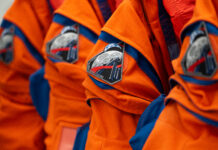
The crew will begin checking systems such as the water dispenser – which will provide drinking water and rehydrate the food they carry – the toilet, and the system that removes carbon dioxide from the air. The astronauts will also be able to remove the orange spacesuits they wore for launch and work in regular clothing. They will spend time reorganizing the interior of Orion to function as a living and working space for four floating individuals over the next 10 days.
About three hours into the mission, NASA will conduct tests on how Orion handles.
In future missions, Orion will dock with other spacecraft. To verify that Orion does this safely, the ICPS will be repurposed as a docking target. It will detach from Orion, and the crew will practice piloting their spacecraft towards the ICPS and around it in a demonstration of proximity operations. After this, the ICPS will fire its engines for a disposal orbital maneuver that will send it towards the Pacific Ocean, and Orion will continue in its high Earth orbit.
After about eight and a half hours in space, the astronauts will sleep for a short period of time. The crew will wake up after about four hours to perform an additional engine burn that will put Orion in the correct orbital geometry for its Translunar Injection (TLI) orbital maneuver on Flight Day 2. They will also take this opportunity to run a brief check of their emergency communications with the Deep Space Network at the farthest point of their high Earth orbit, which is necessary before TLI.
Following this, the astronauts will be able to sleep for another four and a half hours, concluding Flight Day 1.
Flight Day 2:
Wiseman and Glover will start the day by installing and checking Orion’s Inertial Measurement Unit exercise device before conducting their first physical workouts of the mission. Koch and Hansen are scheduled for their exercises in the second half of the day. The morning workouts will provide another test of Orion’s life support systems before leaving Earth orbit.
Koch will spend the morning preparing for the day’s main event: the Translunar Injection orbital maneuver. TLI is the final major engine burn of the Artemis II mission and will set Orion on a course towards the Moon. And since Orion will use a free return trajectory to swing around the far side of the Moon, the TLI engine burn will also set Orion on a course to return to Earth on Flight Day 10.
Koch will set up the Orion system to execute the orbital maneuver, which will be performed by the main engine of Orion in the European Service Module of the spacecraft. Also known as the Orbital Maneuvering System engine, it provides up to 2,722 kilograms (6,000 pounds) of thrust, enough to accelerate a car from zero to 96.5 km/h (60 mph) in about 2.7 seconds.
After TLI, the crew will have a less busy day, with time set aside to acclimate to the space environment. They will have an opportunity to engage in a space-to-ground video communication, the first of several that will take place throughout the mission. Except for Flight Day 7 – which will be the crew’s day off – and landing day, they are expected to have one or two of these opportunities each day of the mission.
Flight Day 3:
The first of three smaller engine burns, called the departure trajectory correction, will ensure that Orion stays on track for its trajectory around the Moon and will take place on Flight Day 3. In the morning, Hansen will prepare for this orbital maneuver, which is scheduled shortly after the crew’s midday meal.
The rest of the day will include various checks and demonstrations. Glover, Koch, and Hansen will demonstrate CPR procedures in space; Wiseman and Glover will review part of Orion’s medical kit, which includes a thermometer, a blood pressure monitor, a stethoscope, and an otoscope.
Koch has time reserved in the second half of the day to test Orion’s emergency communication system with the Deep Space Network.
Reference: NASA – Artemis II Moon Mission Daily Agenda
Review: The Artemis II Moon Mission offers a comprehensive look into the preparations and activities involved in a mission to the Moon and back. With detailed daily agendas and thorough system checks, NASA is paving the way for future crewed missions to explore beyond Earth’s orbit.
Reaction: The Artemis II Moon Mission showcases the dedication and precision of NASA’s astronauts and ground personnel in executing a complex mission to the Moon. The attention to detail and thorough testing of systems demonstrate the commitment to safety and success in space exploration. The entire crew will gather to rehearse the choreography for the scientific observations they will make on flight day 6, when Orion approaches the Moon.
Flight Day 4:
On the fourth flight day, a second orbital trajectory correction maneuver will continue refining Orion’s path to the Moon as the crew perfects some of their own preparations. Each astronaut will spend an hour reviewing the geographic targets from which they will be asked to capture images on flight day 6. Since these targets will vary depending on the exact time and day of the crew’s final launch, this serves as an opportunity to study exactly what they will observe as they approach the lunar surface. Although they are likely to take photographs and videos from Orion’s windows frequently, flight day 4 has 20 minutes in the schedule specifically dedicated to taking pictures of celestial bodies from the spacecraft’s windows.
Flight Day 5:
Orion will enter the lunar sphere of influence on flight day 5, marking the point at which the Moon’s gravity will become stronger than Earth’s gravity.
As they approach the Moon, the crew will have a full day, dedicating the morning almost entirely to conducting tests of their space suits. Officially known as the Orion crew survival system, the orange suits protect the crew during launch and reentry, but could also be used in case of emergency to provide each crew member wearing the suit with a breathable atmosphere for up to six days in the event that Orion loses pressure. As the first astronauts to use these new suits in space, the Artemis II crew will test their ability to quickly don and pressurize the suits; install their seats and sit in them with the suits on; eat and drink through a port located in the helmets of the space suits, and other functions.
During the crew’s afternoon, the final orbital trajectory correction maneuver will be carried out before Orion’s lunar flyby on flight day 6.
Flight Day 6:
The Artemis II crew will reach their closest point to the Moon on flight day 6, while traveling to their farthest point from Earth. Depending on the launch day, Artemis II could set a record for the farthest distance a human has traveled from Earth, breaking the current record of 400,171 kilometers (248,655 miles) set in 1970 by the Apollo 13 crew. The distance the Artemis II crew will travel will depend on the exact day and time of their launch.
Throughout the day, the crew will be at a distance of between 6,400 and 9,700 km (4,000 and 6,000 miles) from the lunar surface as they loop around the far side of the Moon. The Moon should appear to them the size of a basketball held at arm’s length. They will spend most of the day taking photographs and videos of the Moon and recording their observations, as they become the first humans to see with their own eyes some parts of the Moon.
Because the angle of the Sun over the Moon changes by almost one degree every two hours, the crew will not know what lighting conditions await them on the lunar surface until the moment of launch. If the Sun is high in the lunar sky during the flyby, there will be few shadows and the crew will look for subtle variations in color and surface texture. If the Sun is lower on the horizon, long shadows will extend over the surface, enhancing the relief and revealing the depths, ridges, slopes, and edges of craters that are often difficult to detect in full lighting. If the Sun is overhead from Orion’s perspective — like noon on Earth — shadows will be few or nonexistent, creating ideal lighting conditions for close-up images of specific lunar features.
The crew will record their observations in real-time as they take photographs and videos, even when they lose communication with Earth for 30 to 50 minutes as they pass behind the Moon. This way, their observations can be later linked to the exact images they have captured.
Flight Day 7:
Orion will leave the lunar sphere of influence in the morning of flight day 7. Before the Artemis II crew drift too far from the Moon, scientists on the ground, eager to hear from them while the experience is still fresh in their minds, will have time to speak with the crew.
In the second half of the crew’s day, Orion’s engine will reignite for the first of three return trajectory correction maneuvers that will adjust Orion’s path back to Earth.
The crew will have much of the rest of the day free, giving them the opportunity to rest before resuming their final tasks prior to their return to Earth.
Flight Day 8:
The main activities for flight day 8 include two demonstrations by Orion.
First, the crew will evaluate their ability to protect themselves from high radiation events such as solar flares. They will use Orion’s supplies and equipment to build a shelter and shield themselves if necessary. Radiation will be a constant concern as humans venture into deep space, and various experiments will be conducted to gather data on radiation levels inside Orion.
At the end of the day, the crew will conduct a test of Orion’s manual piloting capability by maneuvering the spacecraft through a series of tasks. On the ninth day of the Artemis II mission, the crew will focus on preparations for their return to Earth. They will study reentry and splashdown procedures, as well as engage with flight control personnel. The crew will also perform an orbital trajectory correction maneuver to ensure a smooth return journey.
In addition to these preparations, the crew will conduct demonstrations to address any remaining tasks on their checklist. This includes testing waste collection systems in case the Orion toilet malfunctions, as well as checking garment adjustments to combat orthostatic intolerance. Orthostatic intolerance, which can cause symptoms like dizziness and lightheadedness when standing upright, is a common issue for astronauts returning to Earth. Compression garments worn under spacesuits can help alleviate these symptoms.
The crew will try on these garments, take body measurements, and complete a questionnaire on the fit and ease of wearing and removing this clothing.
Moving on to the tenth day of the mission, the primary focus will be on safely returning the crew to Earth. A final orbital trajectory correction maneuver will ensure that Orion is on the correct path for splashdown. The crew will also return the cabin to its original configuration, with equipment stowed and seats in place, and don their spacesuits once again.
The crew module will separate from the service module, which has guided them around the Moon and back to Earth. This will expose the crew module’s heat shield, which will protect the spacecraft and crew as they reenter the Earth’s atmosphere at temperatures of up to 1,650 degrees Celsius (3,000 degrees Fahrenheit). After safely passing through the heat of reentry, the cover protecting the spacecraft’s forward bay will be jettisoned to allow for the deployment of a series of parachutes: two drogue chutes to slow the capsule to 494 kilometers per hour (307 miles per hour), followed by three pilot chutes that will deploy the main three parachutes. These will further slow Orion to nearly 27 km/h (17 mi/h) for splashdown in the Pacific Ocean, where NASA and US Navy personnel will be awaiting their arrival, marking the conclusion of the Artemis II mission.
Overall, the Artemis II mission showcases the intricate planning and execution required for crewed space missions, highlighting the importance of preparation and attention to detail in ensuring the safety and success of astronauts in space. The mission also serves as a valuable learning opportunity for future missions, providing insights into the challenges and requirements of human space exploration beyond low Earth orbit.
For more information on the Artemis II mission and NASA’s ongoing efforts to return humans to the Moon and beyond, visit the official NASA website.
For more Information, Refer to this article.