





















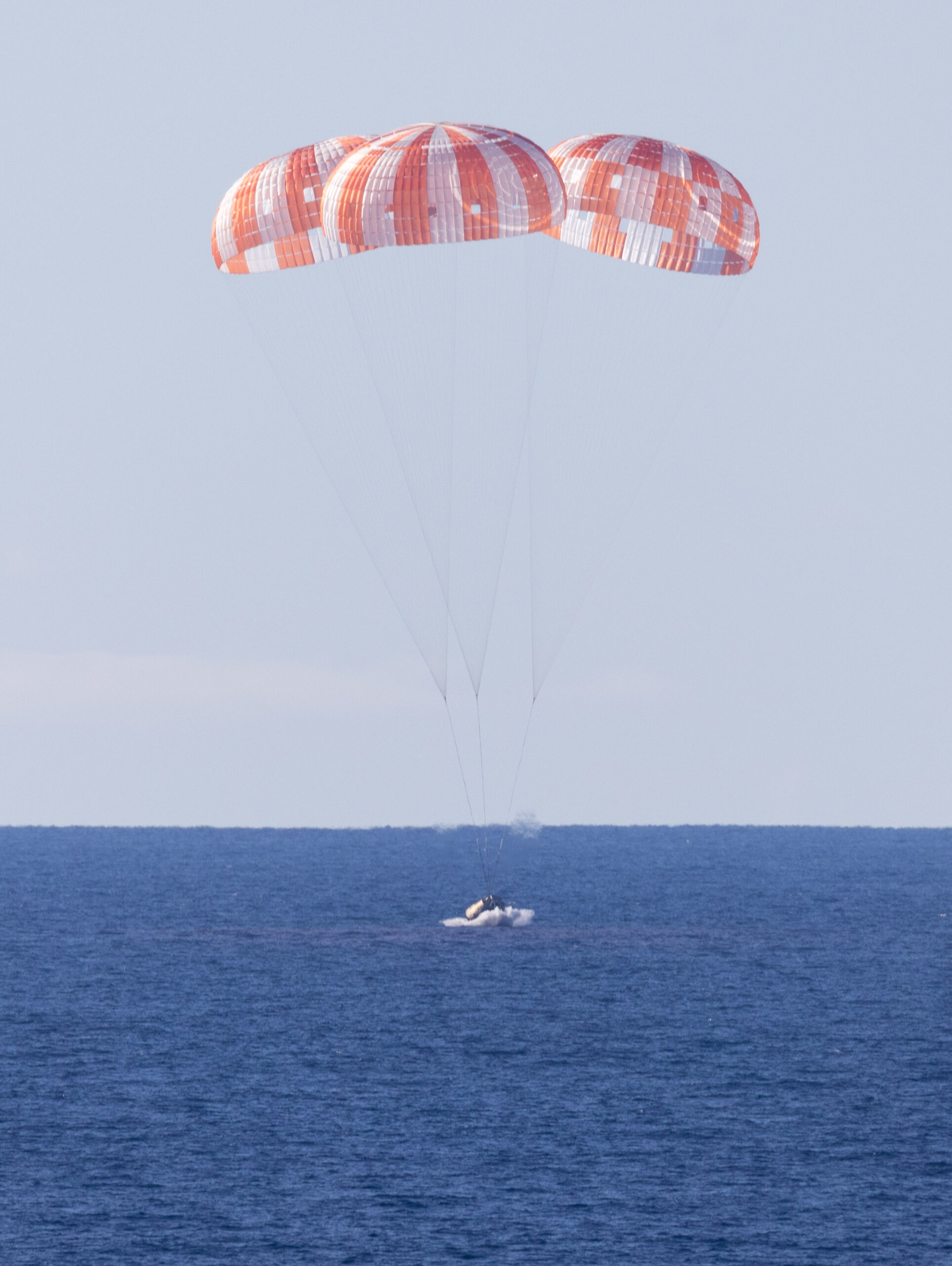
Historic Splashdown Marks End of Artemis II Mission
The Artemis II mission has successfully concluded with the safe return of its crew, marking the first time astronauts have traveled to the Moon in over 50 years. NASA astronauts Reid Wiseman, Victor Glover, Christina Koch, and Canadian Space Agency astronaut Jeremy Hansen splashed down in the Pacific Ocean off San Diego at 5:07 p.m. PDT on April 11, after a nearly ten-day journey covering a record-breaking distance of 694,481 miles.
A Journey Beyond Limits
During their mission, the crew reached a remarkable distance of 252,756 miles from Earth, surpassing the previous record set by Apollo 13 in 1970. NASA Administrator Jared Isaacman praised the crew’s courage and skill, stating that their journey pushed both the Orion spacecraft and the Space Launch System (SLS) rocket to new frontiers. This mission not only tested technology but also laid the groundwork for future lunar exploration.
Upon splashdown, a joint NASA and U.S. military team was on hand to assist the astronauts out of their spacecraft and transport them to USS John P. Murtha for initial medical evaluations. The crew is expected to return to NASA’s Johnson Space Center in Houston following their recovery.
The Mission’s Milestones
The Artemis II mission launched from Kennedy Space Center in Florida on April 1 at 6:35 p.m., utilizing an impressive 8.8 million pounds of thrust from the SLS rocket. The launch was executed flawlessly by NASA’s Artemis launch control team. Once in space, the astronauts conducted system checks on their spacecraft, named Integrity, confirming that all systems were operational before heading toward the Moon.
On day two of their flight, Orion’s service module fired its main engine, placing them on a trajectory that brought them within 4,067 miles of the lunar surface. This trajectory allowed for critical evaluations of various spacecraft systems while testing life support capabilities essential for future deep-space missions.
Scientific Contributions and Observations
The Artemis II crew played a significant role in scientific research during their flight. They conducted experiments designed to prepare astronauts for extended stays on the Moon and beyond. Notable studies included AVATAR (which examines human tissue responses to microgravity) and other health performance assessments crucial for long-duration missions.
Throughout their lunar flyby on April 6, the astronauts captured over 7,000 images showcasing diverse lunar landscapes and phenomena such as solar eclipses from Orion’s perspective. Their observations included striking views of Earthrise and impact craters that will inform future exploration efforts.
The crew also documented topographical features along the lunar terminator—the line separating day from night—where conditions mimic those expected during planned landings at the Moon’s South Pole region in 2028. Their insights into potential landing sites will be invaluable as NASA prepares for subsequent missions aimed at establishing a permanent lunar presence.
Looking Ahead: The Future of Lunar Exploration
With Artemis II successfully completed, NASA is now focused on preparing for Artemis III scheduled for next year. This upcoming mission will involve testing integrated operations with commercially built Moon landers in low Earth orbit. The lessons learned from Artemis II will directly influence how future missions are designed and executed.
NASA aims to create an enduring human presence on the Moon while simultaneously laying plans for Mars exploration. As part of this Golden Age of space exploration, Artemis missions are set to tackle increasingly challenging objectives that promise not only scientific discovery but also economic benefits through sustainable practices.
What This Means
The successful completion of Artemis II signifies a pivotal moment in human space exploration history. It reaffirms international collaboration in space endeavors while advancing technological capabilities critical for future missions beyond Earth. As NASA transitions toward establishing a long-term presence on the Moon and preparing for Mars expeditions, this mission serves as a testament to what can be achieved through dedication and innovation in aerospace engineering.
For more information, read the original report here.