


















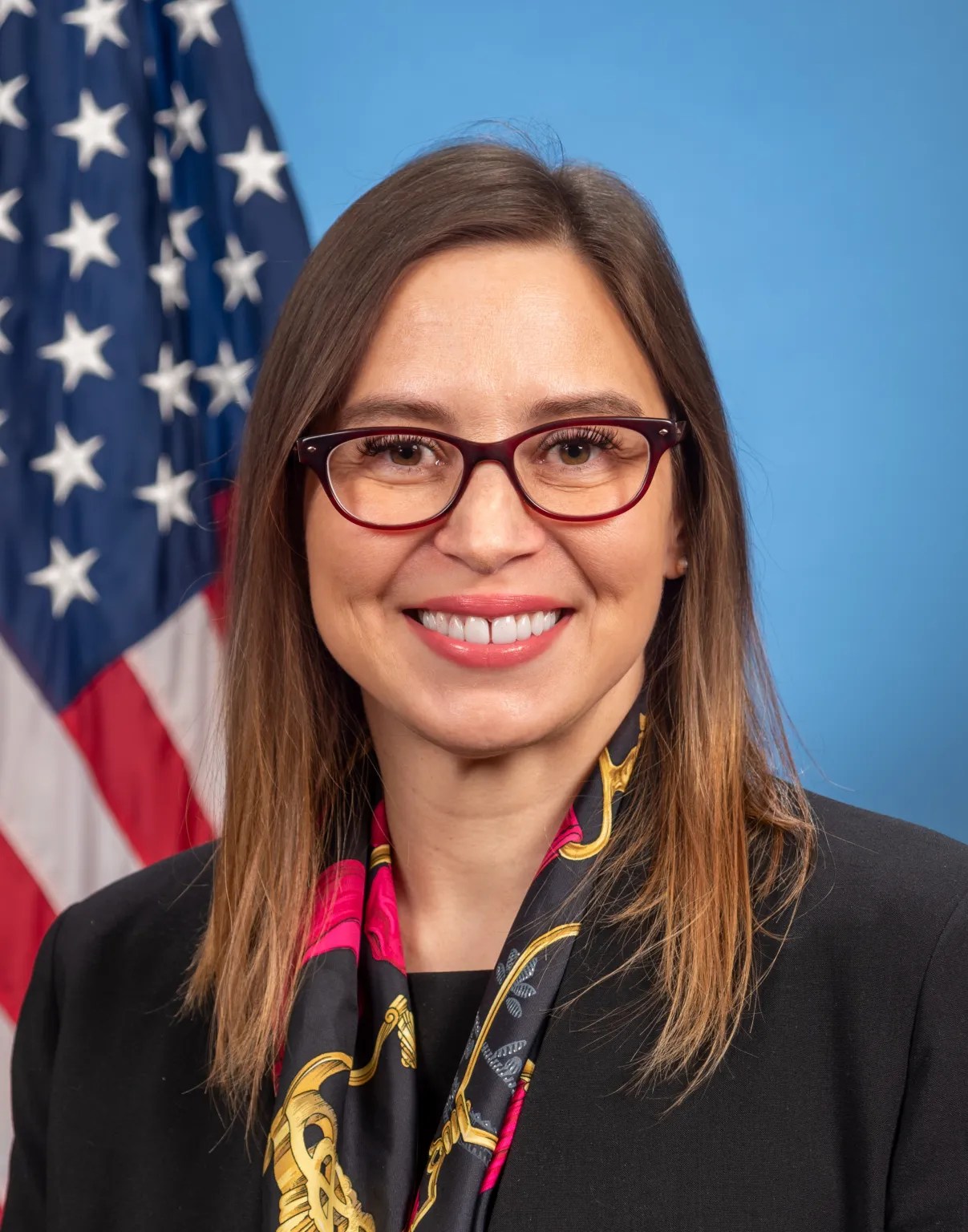
NASA has recently announced a significant change in leadership at one of its most important facilities. Dr. Makenzie Lystrup, the esteemed director of NASA’s Goddard Space Flight Center in Greenbelt, Maryland, will be stepping down from her position on Friday, August 1. Her departure marks the end of a notable tenure that began in April 2023.
During her time as center director, Dr. Lystrup was pivotal in guiding not just the Goddard Space Flight Center but also played a significant role in overseeing several other crucial NASA installations. These included the Wallops Flight Facility in Virginia, the Katherine Johnson Independent Verification & Validation Facility in West Virginia, the White Sands Complex in New Mexico, and the Columbia Scientific Balloon Facility in Texas. Her leadership was instrumental in maintaining the high standards and operational success of these facilities.
Dr. Lystrup’s career is marked by her extensive experience in both the science and aerospace sectors, where she has held various roles in both civilian and government capacities. She has been a key figure in the development and execution of several of NASA’s critical scientific missions. Notably, she contributed significantly to the successful operations of the James Webb Space Telescope and the Imaging X-Ray Polarimetry Explorer. Her efforts also extended to the development of the Roman Space Telescope, among other projects. Vanessa Wyche, the acting NASA associate administrator, expressed gratitude for Dr. Lystrup’s leadership and contributions, highlighting her role in inspiring a new generation of explorers, scientists, and engineers during what has been described as a Golden Age.
Managing a workforce of over 8,000 civil servants and contractors, Dr. Lystrup led Goddard with a focus on innovation and scientific excellence. Before her time at NASA, she was the senior director for Ball’s Civil Space Advanced Systems and Business Development. In that role, she managed business activities with NASA, the National Oceanic and Atmospheric Administration (NOAA), and other civilian government agencies, as well as academic and scientific organizations. Her expertise in space sciences was further honed during her tenure in Ball’s Strategic Operations organization, based in Washington, where she oversaw the space sciences portfolio.
Dr. Lystrup also served as an American Institute of Physics – Acoustical Society of America Congressional Fellow from 2011 to 2012. In this role, she managed a diverse portfolio that included technology, national defense, nuclear energy, and nuclear nonproliferation, showcasing her broad expertise and ability to navigate complex scientific and policy landscapes.
Her commitment to science and technology extends beyond her professional roles. Dr. Lystrup has been an active participant on various boards and committees, including those for the University Corporation for Atmospheric Research, the International Society for Optics and Photonics, the University of Colorado, and the American Astronomical Society. Her contributions to the fields of planetary science and infrared astronomy, along with her advocacy in science policy and aerospace leadership, earned her the distinction of being named an American Association for the Advancement of Science fellow in 2019. Additionally, she has served as an AmeriCorps volunteer, focusing on promoting STEM education.
Dr. Lystrup’s academic credentials are equally impressive. She holds a bachelor’s degree in physics from Portland State University and pursued her graduate studies at University College London, where she earned a doctorate in astrophysics. Her postdoctoral work was supported by a National Science Foundation Astronomy & Astrophysics Postdoctoral Research Fellowship, during which she conducted research at the Laboratory for Atmospheric & Space Physics in Boulder, Colorado, and the University of Liege in Belgium. As a planetary scientist and astronomer, her research has concentrated on using both ground-based and space-based observatories to study the interactions and dynamics of planetary atmospheres and magnetospheres.
Following Dr. Lystrup’s departure, Cynthia Simmons, the current deputy center director, will step in as the acting center director of NASA’s Goddard Space Flight Center. Simmons brings her own wealth of experience and expertise to the role, ensuring a smooth transition and continued excellence in the center’s operations.
Dr. Lystrup’s departure represents a significant moment for NASA and the Goddard Space Flight Center. Her leadership and visionary approach have left a lasting impact on the agency’s scientific missions and the broader scientific community. As she moves on to new endeavors, her contributions to NASA and the field of space science will be remembered and appreciated by many.
For more information about NASA and its current projects, please visit their official website at NASA.
For more Information, Refer to this article.