





















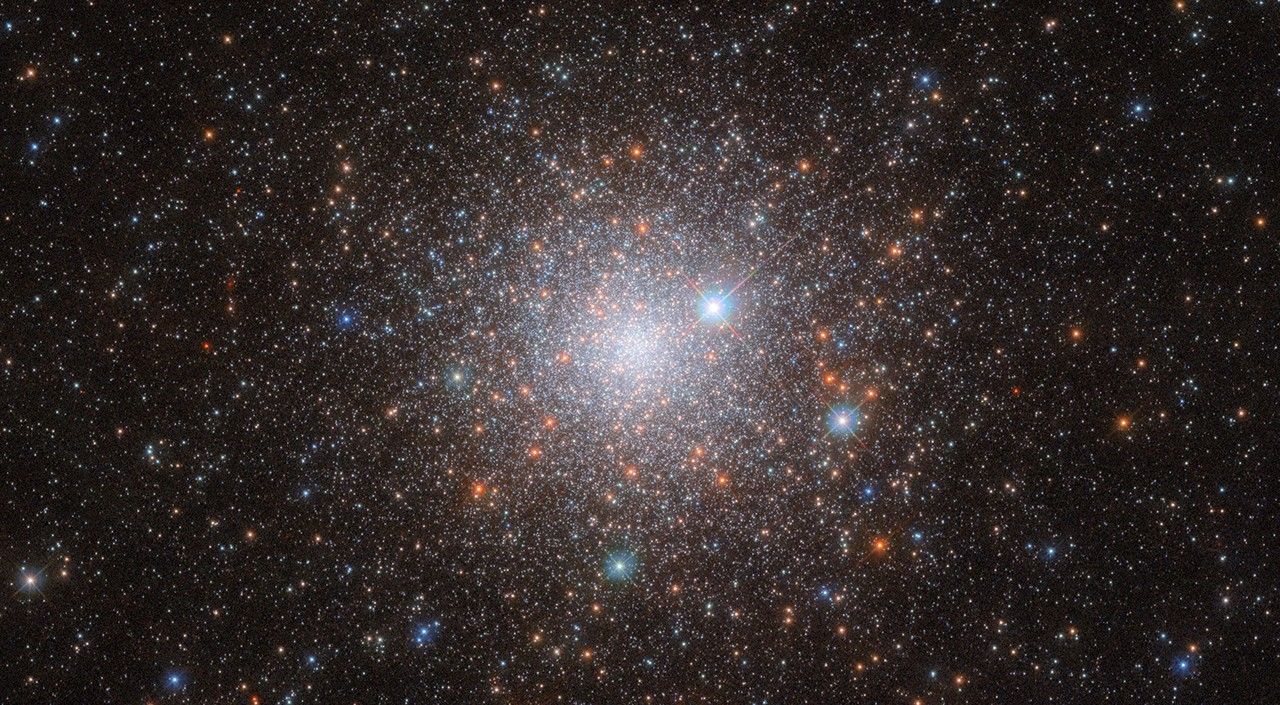
In a captivating view from the NASA/ESA Hubble Space Telescope, we are presented with an image of NGC 1786, a rich field of stars. This globular cluster is located in the Large Magellanic Cloud (LMC), which is a small satellite galaxy orbiting the Milky Way. Situated approximately 160,000 light-years away from Earth, NGC 1786 is part of the constellation Dorado. The cluster was first discovered in 1835 by Sir John Herschel, a notable figure in the history of astronomy.
This detailed image is part of a scientific effort to compare old globular clusters found in nearby dwarf galaxies, such as the LMC, the Small Magellanic Cloud, and the Fornax dwarf spheroidal galaxy, with those found in our own Milky Way galaxy. Our galaxy hosts over 150 of these ancient, spherical gatherings of tightly packed stars. These clusters have been extensively studied, especially with the help of Hubble’s high-resolution imagery, which provides views that were previously impossible to achieve. Due to their stable and long-lived nature, globular clusters serve as galactic time capsules. They offer a preserved snapshot of stars from the early stages of a galaxy’s formation.
Historically, astronomers believed that all stars within a globular cluster formed simultaneously. However, further study of old globular clusters within the Milky Way revealed that these clusters actually consist of multiple populations of stars, each with different ages. Understanding how these clusters formed and where the various-aged stars originated is crucial for using globular clusters as historical markers.
This particular observing program aimed to investigate whether old globular clusters in external galaxies, like NGC 1786 in the LMC, also contain multiple star populations. Findings from this research can significantly enhance our understanding of how the LMC was originally formed, and even offer insights into the formation history of the Milky Way itself.
### Understanding Globular Clusters
Globular clusters are massive, spherical collections of stars bound together by gravity. They are among the oldest known objects in the universe, with ages that can reach up to 13 billion years. These clusters are typically found in the halos of galaxies and contain hundreds of thousands to millions of stars. The stars within a globular cluster are mainly old and low in metal content, which refers to elements heavier than hydrogen and helium.
The study of these clusters is crucial for astronomers because they offer a glimpse into the early universe. By analyzing the properties and compositions of stars within globular clusters, scientists can infer the conditions that existed when these clusters formed.
### The Large Magellanic Cloud
The LMC is a prominent satellite galaxy of the Milky Way. It is the fourth largest galaxy in the Local Group, a collection of over 50 galaxies that includes the Milky Way, Andromeda, and the Triangulum Galaxy, among others. The LMC is visible to the naked eye from the Southern Hemisphere and is recognized for its irregular shape, which is a result of gravitational interactions with the Milky Way and the Small Magellanic Cloud.
The LMC is home to a variety of astronomical phenomena, including numerous star clusters and nebulae. One of its most famous features is the Tarantula Nebula, an immense region of star formation.
### The Importance of Hubble’s Observations
The Hubble Space Telescope has been instrumental in advancing our understanding of globular clusters. Its ability to capture high-resolution images allows astronomers to resolve individual stars within these dense clusters. This level of detail is essential for studying the composition, age, and distribution of stars in globular clusters.
Hubble’s observations have provided critical data that challenge previous assumptions about globular clusters. The discovery of multiple star populations within clusters has prompted astronomers to reevaluate theories about star formation and the evolution of galaxies. These findings suggest that globular clusters are more complex than previously thought and that their formation processes may vary across different galaxies.
### Broader Implications
The research conducted on globular clusters has broader implications for our understanding of the universe. By studying the properties and behaviors of these ancient star groups, astronomers can gain insights into the formation and evolution of galaxies. This knowledge can help scientists develop more accurate models of the universe’s history and evolution.
Furthermore, the study of globular clusters can inform our understanding of stellar evolution. By examining stars of different ages within clusters, astronomers can learn about the life cycles of stars and the processes that govern their formation and development.
### Conclusion
The Hubble Space Telescope’s stunning image of NGC 1786 offers a mesmerizing glimpse into the depths of the cosmos. This globular cluster, residing in the Large Magellanic Cloud, serves as a valuable tool for astronomers seeking to unravel the mysteries of galaxy formation and evolution. Through detailed observations and analysis, scientists are uncovering the complex histories of these ancient star clusters, shedding light on the origins and development of galaxies, including our own Milky Way.
The ongoing study of globular clusters continues to challenge our understanding of the universe, providing new insights and prompting fresh questions about the nature of stars and galaxies. As researchers delve deeper into the cosmos, each discovery brings us closer to comprehending the vast and intricate tapestry of the universe. For those interested in exploring more about the Hubble Space Telescope and its contributions to astronomy, additional information is available on the NASA website.
For more Information, Refer to this article.