












![[Interview] Inside Spatial Signage: How Samsung Brought Glasses-Free 3D Displays to Life](https://www.hawkdive.com/media/samsung-tvs-and-displays-spatial-signage-interview_thumb932-218x150.jpg "Samsung’s Glasses-Free 3D Displays: The Inside Story [Interview]")









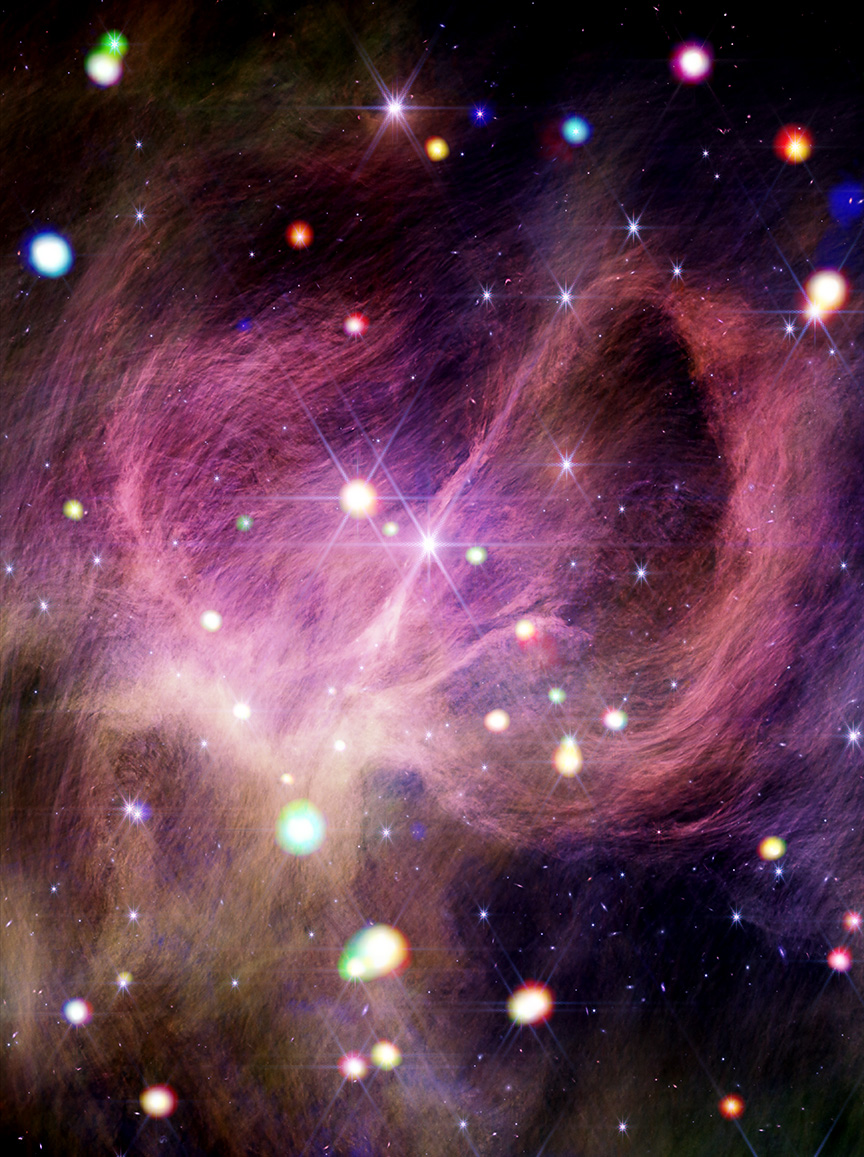
A Stunning Cosmic Portrait: NASA’s Chandra and Webb Telescopes Unveil Star-Forming Secrets of IC 348
In an extraordinary fusion of technology and cosmic wonder, data from NASA’s Chandra X-ray Observatory and the James Webb Space Telescope have been combined to present an awe-inspiring image of the star-forming region known as IC 348. Released on July 23, 2025, this image not only captivates the imagination but also provides valuable insights into the processes that shape star formation.
IC 348 is located in the constellation Perseus, approximately 1,000 light-years from Earth. This region is a treasure trove for astronomers because it offers a relatively close-up view of the stellar nursery where new stars are born. The image showcases a mesmerizing interplay of colors, with X-rays from Chandra depicted in red, green, and blue, while infrared data from the Webb telescope are illustrated in pink, orange, and purple.
Understanding Reflection Nebulae
The wispy structures that dominate this cosmic view are a classic example of a reflection nebula. Such nebulae occur when interstellar dust and gas scatter and reflect the light emitted by nearby stars. In IC 348, the reflection nebula is illuminated by the young stars within the cluster, creating an ethereal glow that astronomers find both beautiful and informative. The light bouncing off the particles in the nebula allows scientists to study the composition and behavior of these stellar nurseries.
Young Stars in Formation
The point-like sources visible in Chandra’s X-ray data are young stars that are still in the process of forming. These stars are often obscured in visible light due to the dense clouds of gas and dust surrounding them. However, X-ray and infrared observations allow astronomers to peer through these clouds, providing a clearer view of the stellar evolution. X-rays are emitted by the energetic activities of young stars, such as strong stellar winds and magnetic activity, which are common during the early stages of star development.
The Role of Advanced Telescopes
The collaboration between Chandra and Webb highlights the importance of using different wavelengths of light to study the universe. Each telescope offers unique insights: Chandra’s X-ray vision is crucial for detecting the energetic processes and high-energy phenomena associated with young stars, while Webb’s infrared capabilities excel in penetrating dust clouds and unveiling the cooler, hidden aspects of star formation. By integrating data from both observatories, scientists can construct a more comprehensive picture of the dynamic processes occurring in regions like IC 348.
The Science Behind the Image
The image processing involved in creating this composite view is a meticulous task. It requires aligning data from multiple sources and carefully adjusting colors to represent different wavelengths accurately. This process not only enhances the visual appeal of the image but also ensures that the scientific information is conveyed clearly. The resulting image is not just a piece of art but a powerful tool for scientific inquiry.
Implications for Astronomy
Studying regions like IC 348 is essential for understanding the lifecycle of stars and the formation of planetary systems. By examining the conditions under which stars form, astronomers can gain insights into the factors that influence the birth and evolution of stars similar to our Sun. This knowledge is crucial for understanding the broader context of our solar system’s formation and the potential for life elsewhere in the universe.
Furthermore, the advancements in telescope technology, as demonstrated by the capabilities of Chandra and Webb, are pushing the boundaries of what we can observe and comprehend. As these technologies continue to evolve, they promise to unlock even more secrets of the cosmos, providing answers to some of humanity’s most profound questions about our place in the universe.
A Broader Perspective
While the image of IC 348 is a scientific triumph, it also serves a broader purpose. It reminds us of the beauty and complexity of the universe we inhabit. The intricate dance of light and matter depicted in this image is a testament to the wonders of nature and the human spirit of exploration.
As we gaze upon this cosmic masterpiece, we are invited to reflect on our own journey of discovery. The pursuit of knowledge, driven by curiosity and innovation, continues to propel us forward, expanding our horizons and deepening our understanding of the cosmos.
Conclusion
The unveiling of the star-forming region IC 348 through the combined efforts of NASA’s Chandra X-ray Observatory and the James Webb Space Telescope is a remarkable achievement in astronomical research. This captivating image not only showcases the beauty of the universe but also provides valuable insights into the processes that govern star formation. As we continue to explore the cosmos, we are reminded of the limitless potential of human ingenuity and the endless wonders that await our discovery.
For more Information, Refer to this article.