






















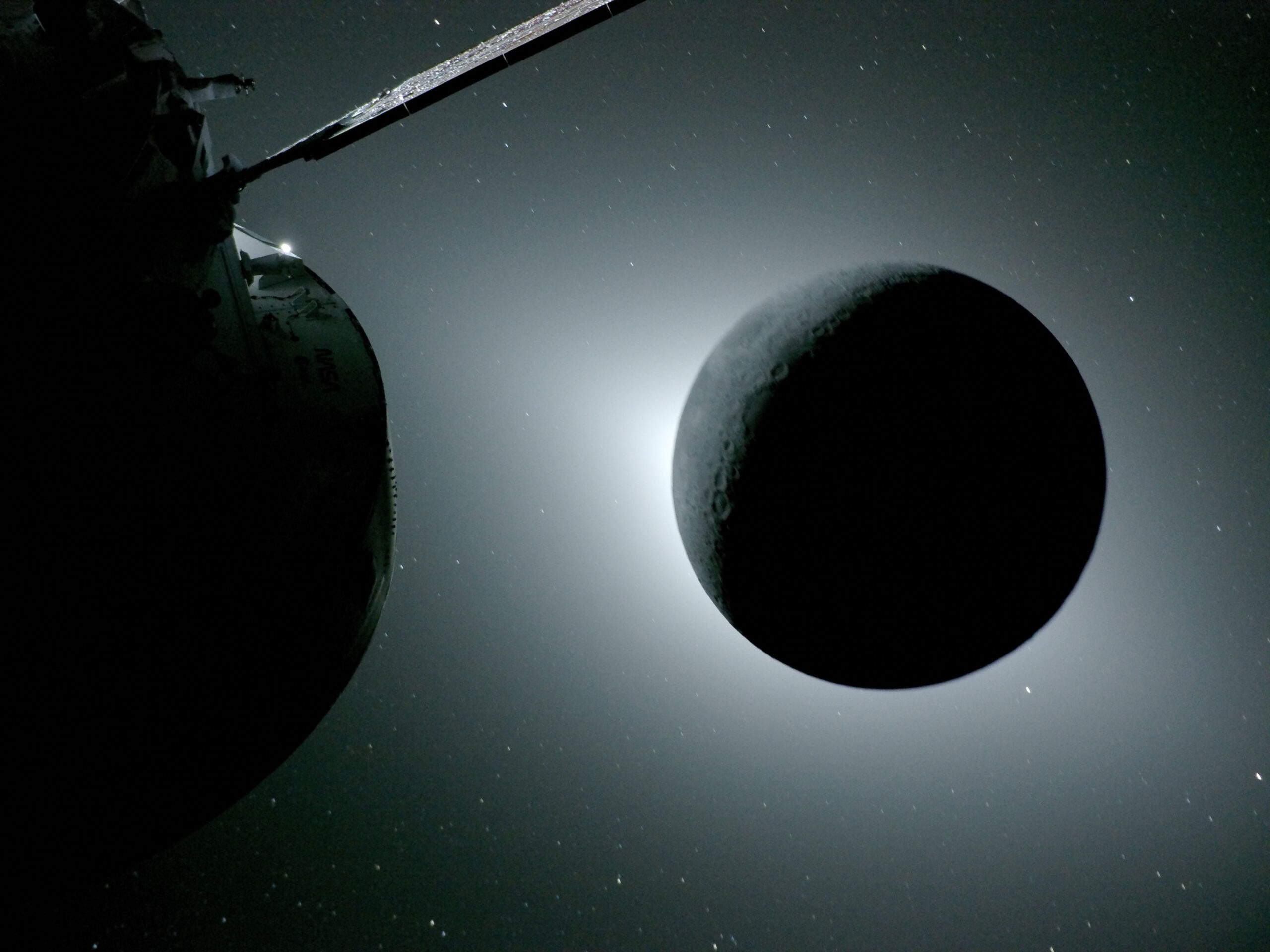
Artemis II Astronauts Capture Unique Solar Eclipse During Lunar Flyby
During a historic lunar flyby on April 6, 2026, the Artemis II astronauts aboard the Orion spacecraft witnessed a solar eclipse visible only from their vantage point. This remarkable event was documented by cameras mounted on the spacecraft’s solar array wings, showcasing the Moon backlit by the Sun. The unique positioning of the crew allowed them to experience this celestial phenomenon in a way that no one else on Earth could.
Details of the Artemis II Mission
The Artemis II mission is part of NASA’s broader Artemis program, which aims to return humans to the Moon and eventually pave the way for future Mars exploration. Launched in 2024, Artemis II serves as a critical test flight for crewed missions, following the uncrewed Artemis I mission that successfully orbited the Moon. The current mission includes four astronauts who are tasked with testing Orion’s capabilities and systems during its journey beyond low Earth orbit.
The lunar flyby is not just a technical milestone; it also serves as a platform for scientific observation. The crew is equipped with various instruments designed to gather data about both lunar and solar phenomena. This includes studying cosmic radiation levels and testing communication systems in deep space, which are essential for future missions.
The Significance of the Solar Eclipse
The solar eclipse observed during this flyby holds significant scientific value. Eclipses provide unique opportunities for astronomers to study various aspects of celestial bodies, including their atmospheres and surface compositions. For the Artemis II crew, witnessing this event firsthand offers invaluable insights into how light interacts with different elements in space.
Moreover, such experiences enhance astronaut training and preparation for long-duration missions. Understanding how to observe and document astronomical events can improve data collection methods for future explorations. The images captured during this eclipse will contribute to ongoing research in astrophysics and planetary science.
Public Engagement and Educational Outreach
Nasa has made efforts to engage the public through multimedia content related to the Artemis II mission. The agency has released a series of photographs taken during the mission, including those of the solar eclipse. These images are not only visually stunning but also serve as educational tools that inspire interest in space exploration among students and enthusiasts alike.
By sharing these experiences, NASA aims to foster a deeper understanding of space science and encourage future generations to pursue careers in STEM (science, technology, engineering, mathematics) fields. The stunning visuals from this mission are expected to captivate audiences around the world, making complex scientific concepts more accessible.
Future Implications for Space Exploration
The successful execution of Artemis II sets a precedent for upcoming missions under NASA’s Artemis program. As humanity prepares for sustained lunar presence and eventual Mars exploration, each mission contributes critical knowledge about living and working in space. The data collected during this flyby will inform not only future lunar missions but also long-term plans for human habitation on other celestial bodies.
Additionally, advancements made through this mission could lead to improved technologies in spacecraft design, life support systems, and deep-space navigation—all essential components for future exploration endeavors beyond our Moon.
What This Means
The unique solar eclipse witnessed by the Artemis II astronauts highlights both the scientific potential and public interest surrounding space exploration today. By capturing such extraordinary events, NASA not only enhances its research capabilities but also engages a global audience eager to learn about our universe. As humanity stands on the brink of returning to the Moon and beyond, each step taken by missions like Artemis II brings us closer to unlocking new frontiers in space science.
For more information, read the original report here.