




















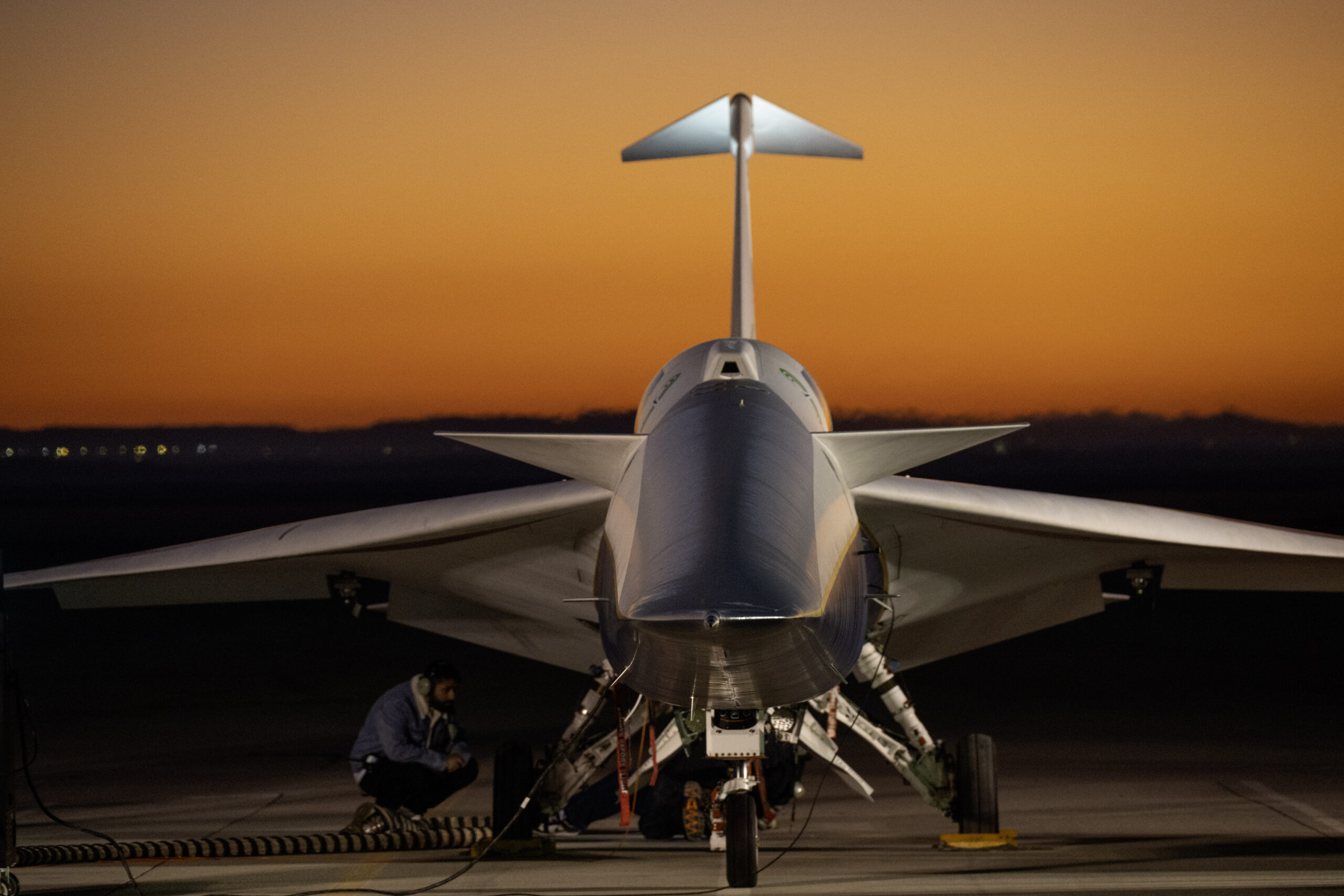
NASA’s X-59 experimental aircraft is gearing up for its second flight, marking a significant milestone in the ongoing testing process that is set to continue through 2026.
In the upcoming months, NASA will be pushing the quiet supersonic jet to higher speeds and altitudes, all while ensuring the safety and performance of the aircraft through a process known as envelope expansion.
Test pilot Jim “Clue” Less will be at the controls for the second flight of the X-59, taking off and landing at Edwards Air Force Base, close to the aircraft’s base at NASA’s Armstrong Flight Research Center in California.
Less, who is flying an X-plane for the first time, expressed his focus on executing the test cards accurately. He will be joined by NASA test pilot Nils Larson, who will be flying a NASA F/A-18 nearby to observe the X-59 during the flight.
The X-59 completed its first flight on October 28, 2025, with Larson as the pilot. Following the successful flight, NASA and Lockheed Martin, the contractor, conducted a thorough round of post-flight maintenance and inspections. This involved the removal and reinstallation of various components such as the engine, tail section, seat, and multiple panels.
The recent ground test conducted on March 12 involved firing up the X-59’s modified F-18 Super Hornet F414-GE-100 engine, a crucial step before the second flight. The successful engine run marked a significant progression in the testing process for the X-59.
As the second flight approaches, the team is focused on closely monitoring the aircraft’s performance to ensure that it meets the expected standards. The flight is part of the envelope expansion tests for the X-59, where the aircraft will be tested at higher speeds and altitudes.
The ultimate goal of the X-59 is to pave the way for a new era of quiet supersonic flight over land. Through NASA’s Quesst mission, the aircraft aims to demonstrate that supersonic flight can be achieved with reduced noise levels compared to traditional sonic booms.
Following the envelope expansion tests, Phase 2 of the Quesst mission will focus on validating the X-59’s acoustic performance. The team will analyze how the aircraft’s design helps disperse shock waves, ultimately leading to a quieter sonic profile.
Once the acoustic validation is completed, NASA plans to fly the X-59 over selected U.S. communities to gather data on how people perceive the aircraft’s quieter sound signature. The results of these flights will be shared with regulators in the United States and internationally.
The X-59’s journey towards supersonic flight at Mach 1.4 and 55,000 feet is a carefully planned process, with incremental steps taken to ensure the safety and performance of the aircraft. NASA’s commitment to advancing the future of aviation through innovative technology and rigorous testing is evident in the ongoing development of the X-59.
For more Information, Refer to this article.