





















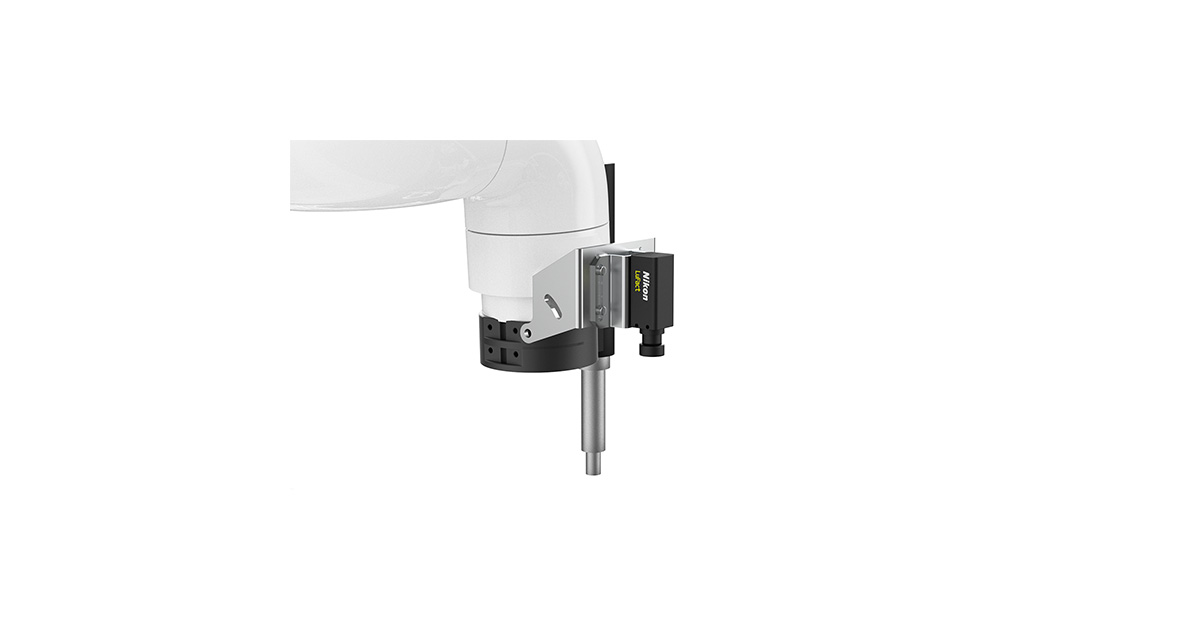
Nikon Introduces Advanced 2D Vision Tracking System for Robotic Arms
In a significant advancement for industrial automation, Nikon Corporation has unveiled its latest robot vision system model. This new system specializes in 2D vision tracking, facilitating high-speed and flexible movement for robotic arms. Central to this innovation is Nikon’s ultra-compact machine vision camera, LuFact, which significantly reduces the sensor’s weight and size attached to the robot arm. The sensor weighs just 25.5 grams and measures 20 x 20 x 43.2 mm, enabling high-speed image processing capabilities.
The compact and lightweight design of the camera allows for a broader range of workpieces to be handled and a variety of robotic hands to be employed. This flexibility in sensor mounting positions makes it possible to build a more agile vision tracking system, especially useful in production lines dealing with various workpiece sizes.
Product Overview
The newly launched model, NSE-L-1, includes several key components such as the sensor (camera) AH-020MR, an I/F conversion unit A1000-G, an engine (control PC), and a calibration board. Set to be released in October 2025, this product is designed to meet the evolving needs of industries facing challenges like labor shortages and the demand for multiproduct variable-volume production.
Development Background
Industries such as automotive manufacturing have been grappling with the need to automate simple tasks due to labor shortages. Nikon’s robot vision system, initially introduced in October 2024, responded to this need by providing automation solutions for production lines. These lines typically use conveyors and other transport equipment, which require automation and labor-saving strategies for diversified workpiece picking and assembly operations.
The new model focuses on achieving a lightweight and compact size while specializing in vision tracking. It adeptly picks and assembles workpieces while tracking them smoothly on a moving conveyor. The previous model incorporated both 2D and 3D sensors, catering to applications like vision tracking and bin picking. However, this new release is dedicated solely to 2D vision tracking, making it ideal for production environments that do not require 3D support.
Key Features
Lightweight and Compact Size
One of the standout features of this system is its use of the LuFact ultra-compact industrial camera. The reduced size and weight allow for a wider array of workpieces and robot hands to be used. This enables the use of smaller, more cost-effective robots instead of larger, expensive ones with high load capacities. The compact design also minimizes restrictions on the robot arm’s movement path, allowing for more efficient and customizable operations.
High-Speed Image Processing for Vision Tracking
The product’s high-speed image processing capabilities enable instantaneous workpiece status determination, facilitating seamless vision tracking. This is particularly useful in production settings, such as inserting and tightening bolts on workpieces on a conveyor without needing to halt the line. Even with unexpected changes in conveyor speed or workpiece positioning, the system can make real-time corrections, ensuring stable and continuous operation without stopping transport equipment.
Reduced Setup Time and Elimination of Synchronization Work
Thanks to its high-speed image processing, the system can automatically follow, pick, and assemble workpieces without needing to synchronize robots and transport equipment. This significantly reduces the time and effort required for setup, allowing for smoother integration into production environments.
Understanding the Robot Vision System
The robot vision system comprises a sensor (camera) and an engine (control PC), enabling high-speed and flexible robot arm operation by providing dynamic vision and brain functions. This system can instantly determine a workpiece’s status and operates with high-speed image processing, a capability Nikon developed through its experience in camera product development.
About the LuFact Camera
LuFact is Nikon’s industrial camera engineered for ultra-compactness and lightweight functionality. This is achieved by separating the sensor, which captures images, from the unit that processes them.
Main Specifications
Sensor (Camera)
- Product Name: AH020-MR
- Image Sensor: 1/2.8” CMOS
- Active Pixels: 1945 (H) x 1097 (V) 2.13 MP
- Effective Pixels: 1920 (H) x 1080 (V)
- Effective Image Size: Horizontal: 5.568 mm, Vertical: 3.132 mm, Diagonal: 6.388 mm
- Scanning Method: Progressive scan
- Color Filter Array: Monochrome
- Shutter Type: Rolling shutter
- Lens Mount: S mount
- Dimensions: 20 x 20 x 43.2 mm
- Weight: 25.5 g
Note: A lens, a light, and a cable are sold separately. These items should be prepared as needed.
I/F Conversion Unit
- Item: A1000-G
- Dimensions: 54 x 35 x 96 mm
- Weight: 203.5 g
- Power Supply: PoE (IEEE802.3af compliant)
- Interface: GigE Vision
- Output (Pixel Format): GVSP Mono8/Mono10Packed/Mono12Packed
Engine (Control PC)
- Engine Dimensions: 260 x 240 x 123 mm
- Applicable Robot Manufacturers: YASKAWA, FANUC, Universal Robots (Contact Nikon for details)
Conclusion
Nikon’s latest robot vision system model represents a significant leap forward in industrial automation, providing a robust solution for industries looking to improve efficiency and address labor shortages. By focusing on 2D vision tracking, the system offers a streamlined, high-performance option for production lines that do not require 3D support. Its compact size, high-speed image processing, and reduced setup time make it an attractive option for companies aiming to enhance their automation capabilities.
For more Information, Refer to this article.