




















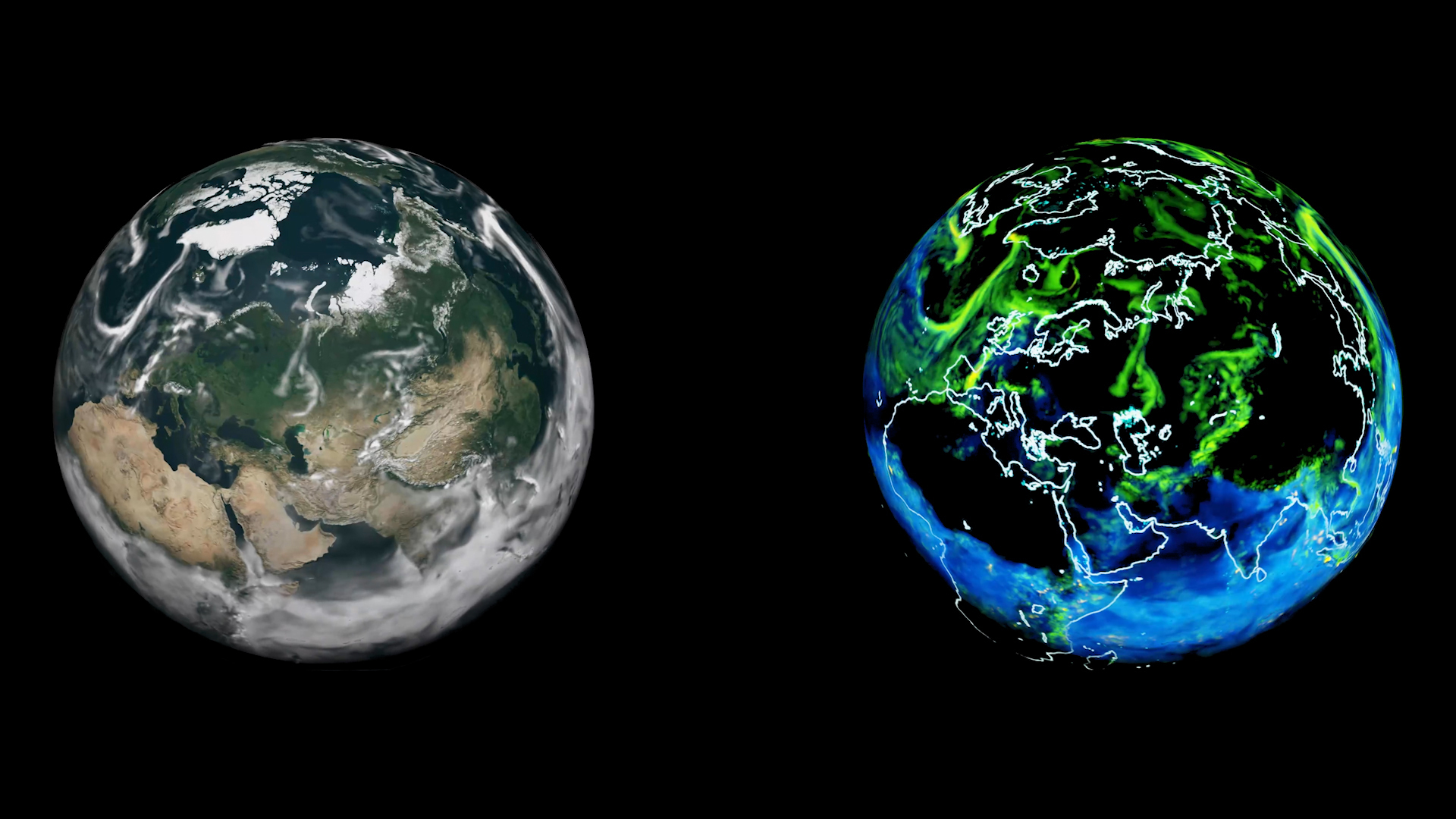
In the ongoing quest to grasp the complexities of Earth’s evolving climate, efficiency and precision are crucial. However, many of the current climate simulation models fall short in one key area: they struggle to accurately depict small-scale atmospheric phenomena, such as thunderstorms and towering tropical clouds. This is primarily due to the computational limitations of these models, which hinder their ability to process and simulate these intricate processes.
To address these challenges, scientists have developed ultra-high-resolution simulations known as cloud-resolving models (CRMs). These advanced simulations are designed to meticulously track the formation and development of clouds. Unfortunately, their high computational demand renders them impractical for long-term global climate forecasts. Running a CRM for a decade of global predictions is not feasible with current technology and resources.
However, a novel approach is emerging that promises to harness the precision of these detailed simulations while operating at speeds significantly faster than traditional models. This innovation is embodied in ClimSim-Online, a groundbreaking framework designed to develop and deploy hybrid models that integrate physics and machine learning at scale. This initiative is a collaborative effort launched by NVIDIA’s Earth 2 team in partnership with an international group of climate modelers from government and academic institutions. The project is also supported by a National Science Foundation-funded science and technology center based at Columbia University, which is exploring the future of AI-driven climate simulation technology.
### From Terabytes to Turnkey: Training AI to Emulate Complex Climate Physics
ClimSim-Online builds upon the award-winning ClimSim dataset, which was introduced at NeurIPS 2023. This dataset is available on the ClimSim Hugging Face repository and was created using the Energy Exascale Earth System Model-Multiscale Modeling Framework (E3SM-MMF). This next-generation climate simulator incorporates thousands of localized, computationally intensive CRMs into the atmospheric columns of a larger, coarse-grid climate model. This innovative method aims to generate climate predictions while minimizing the number of assumptions typically required about fine-scale physics. However, the approach is so computationally demanding that it is not used in mainstream international climate projections. This is where AI comes into play, offering a potential solution by taking over these complex calculations.
The host climate model of the E3SM-MMF operates at a horizontal resolution of about 1.5 degrees, or roughly 150 kilometers, while each embedded CRM functions at a much finer 2-kilometer resolution. This allows for detailed simulations of clouds and convection. Over a simulated ten-year period, the E3SM-MMF produced a staggering 5.7 billion samples. Each of these samples provides insight into how small-scale physical processes impact the broader atmospheric state. These processes include the formation of clouds due to turbulent updrafts, the development of microphysical droplets, the organization of convection from individual clouds to large, organized cloud complexes, and the interactions between these cloud systems and solar and infrared radiation, which play a critical role in climate regulation.
This extensive dataset forms the foundation for training machine learning models that can replicate subgrid physics, potentially replacing the costly embedded CRMs that consume about 95% of total computational resources. The dataset has already inspired a global Kaggle competition, attracting over 460 teams from around the world to develop and benchmark machine learning solutions on this high-fidelity climate dataset. Such collaborative efforts are accelerating progress in climate modeling through open and innovative approaches.
### The Challenge of Stability in Hybrid Climate Models
The primary challenge for these models is not just achieving accuracy in offline settings but ensuring stability when integrated into a live climate simulator. These hybrid physics-machine learning models must maintain realistic atmospheric conditions over extended periods, running continuously without allowing the virtual atmosphere to drift into unrealistic states. This is particularly challenging in cases where the host physics model cannot be easily made differentiable. Some host models can be modified to be differentiable, allowing for direct optimization of hybrid dynamics. However, many models are so complex and nonlinear that rewriting them for direct optimization is impractical. Full-featured climate simulators, which often consist of millions of lines of source code, are a prime example of this complexity.
ClimSim-Online was developed by NVIDIA to make hybrid climate modeling accessible to the broader machine learning community. The framework provides a reproducible, containerized workflow, bypassing the typical obstacles associated with running fully-featured climate simulators. These obstacles often include dependencies on specific supercomputers and software environments, which limit the community’s ability to interact with them. With just a TorchScript model file, users can integrate their trained machine learning models into the Fortran-based E3SM climate simulator and initiate hybrid simulations. This can be done on local workstations, high-performance computing clusters, or cloud virtual machines. Additionally, users can utilize standardized diagnostics to measure their model’s success.
### Achieving Plug-and-Play Climate Emulation
ClimSim-Online offers an entirely plug-and-play climate emulation experience. The system operates within a preloaded container that includes all necessary libraries and dependencies. Users simply load the container, mount it, and begin their simulations. Instructions for setting up the container are available in the ClimSim-Online repository. The complete workflow—from accessing data and training the machine learning model to running and evaluating hybrid climate simulations—is detailed in the ClimSim repository.
NVIDIA’s Research and Development of Technology organizations have achieved a significant breakthrough using these new application programming interfaces (APIs). Their latest paper, published in the Journal of Advances in Modeling Earth Systems (JAMES), demonstrates multi-year stable hybrid simulations utilizing a U-Net neural network trained on the ClimSim dataset with PhysicsNemo. This open-source deep-learning framework allows users to explore, develop, validate, and deploy state-of-the-art methods for science and engineering that combine physics-based knowledge with data.
The true breakthrough here is the advent of physics-informed machine learning. To prevent simulations from running amok and producing unrealistic cloud behaviors, researchers have embedded microphysical constraints directly into the neural network architecture. These constraints include ensuring that all condensates follow temperature-based phase partitioning, similar to the cloud-resolving model the neural network is designed to emulate, and avoiding lingering ice clouds above the tropopause.
By implementing these hard constraints, researchers have stabilized previously drifting simulations and significantly improved the realism of cloud climatologies, particularly in the tropics, where unconstrained models tended to overestimate clouds at high altitudes.
The research process that led to these solutions was greatly accelerated by ClimSim-Online. The ability to rapidly iterate on evolving hybrid model pathologies was key to identifying the clues that ultimately guided the development of these scientifically sound solutions.
### Pioneering New Frontiers in Climate Simulation
In hybrid simulations, temperature biases remained under 2 degrees Celsius, and humidity biases were kept below 1 gram per kilogram within the troposphere. This represents a new state-of-the-art result under the multiscale modeling framework. Additionally, the research team achieved stable simulations exceeding five years, with explicit cloud condensate modeling, real geography, and land-atmosphere coupling—an achievement not previously demonstrated in this class of hybrid simulations.
ClimSim-Online significantly lowers the barrier for AI-climate collaboration by making it easy to train machine learning models with world-class simulation data, benchmark offline skills, and, most importantly, evaluate online performance within a full-scale climate simulator—the ultimate test of real-world readiness.
Whether you are an AI researcher eager to contribute to climate science or a climate scientist curious about hybrid modeling’s potential, ClimSim-Online provides the tools to join the next wave of climate simulation advancements.
While the researchers have demonstrated a domain science-informed approach to addressing the primary issues of hybrid modeling, much work remains to bring hybrid biases down to truly acceptable levels. New ideas and innovations are needed. For instance, could the reinforcement learning community develop an even more robust, domain-agnostic solution? With ClimSim-Online making it easier to sample the downstream, non-differentiable reward signal, the answer may soon be within reach. The future of hybrid physics-machine learning climate simulation awaits, promising more accurate and efficient climate modeling for years to come.
For more Information, Refer to this article.