













![[Video] Samsung Color E-Paper: A Smarter Alternative to Traditional Posters](https://www.hawkdive.com/media/samsung-tvs-and-displays-samsung-color-e-paper-samsung-vxt-digital-signage_thumb932-218x150.jpg "Samsung introduces Color E-Paper as innovative poster alternative.")







NASA’s Parker Solar Probe: Capturing Unprecedented Images Near the Sun
NASA’s Parker Solar Probe, an extraordinary spacecraft, has accomplished a remarkable feat by capturing the closest-ever images of our Sun. Positioned merely 3.8 million miles away from the solar surface, these images offer unprecedented insight into the Sun’s atmosphere and its continuous influence across our solar system. These revelations are pivotal in comprehending solar phenomena, particularly the solar wind, which significantly impacts Earth.
The Parker Solar Probe’s mission has allowed scientists to witness the Sun’s dynamic atmosphere firsthand. Nicky Fox, the associate administrator of NASA’s Science Mission Directorate, emphasized the importance of these observations. She highlighted that these images provide a direct view of where potential space weather threats to Earth originate. This new data is instrumental in enhancing space weather predictions, which are crucial for safeguarding both astronauts and technological infrastructure on Earth and beyond.
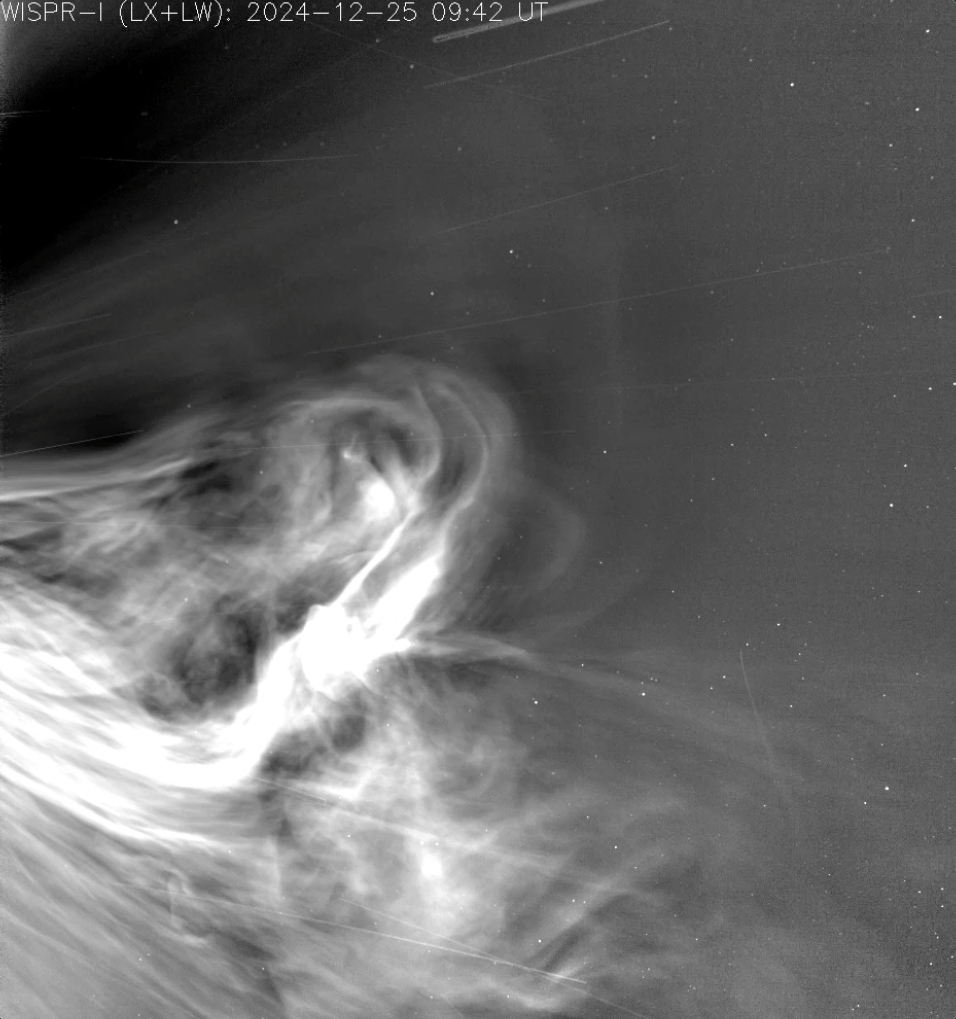
On December 24, 2024, the Parker Solar Probe embarked on its closest approach to the Sun, entering the Sun’s outer atmosphere known as the corona. During this period, the spacecraft collected invaluable data using a suite of scientific instruments, including the Wide-Field Imager for Solar Probe (WISPR). This revolutionary technology has provided an in-depth look at the sun’s corona and the solar wind—a continuous stream of electrically charged particles emanating from the Sun.
The solar wind is a fascinating phenomenon with far-reaching effects throughout the solar system. It influences planetary atmospheres, generates captivating auroras, and can even disrupt power grids and communication systems on Earth. Understanding the solar wind’s origin is crucial to predicting these impacts accurately. The WISPR images have given scientists a closer look at how the solar wind behaves shortly after leaving the Sun’s corona. These images have revealed the heliospheric current sheet, a region where the Sun’s magnetic field changes direction, as well as the collision of multiple coronal mass ejections (CMEs), which are significant drivers of space weather.
CMEs, when they collide, can change trajectories, making it challenging to predict their paths. Additionally, their merger can accelerate charged particles and mix magnetic fields, posing potential threats to astronauts and satellites in space and technology on Earth. The Parker Solar Probe’s proximity to the Sun allows scientists to better prepare for such space weather events, ensuring the safety of both space and terrestrial assets.
The concept of the solar wind was first proposed by renowned heliophysicist Eugene Parker in 1958. Initially met with skepticism, Parker’s theories have since revolutionized our understanding of the solar system. Prior to the launch of the Parker Solar Probe in 2018, other missions, such as Mariner 2, Helios, Ulysses, Wind, and ACE, provided valuable insights into the solar wind’s origins, albeit from a distance. The Parker Solar Probe, named in honor of Eugene Parker, is now filling in the gaps by exploring the Sun’s environment more closely than ever before.
On Earth, the solar wind appears as a gentle breeze, but the Parker Solar Probe has revealed its true nature near the Sun. When the spacecraft ventured within 14.7 million miles of the Sun, it encountered zig-zagging magnetic fields known as switchbacks. These switchbacks, which occur in clumps, were more prevalent than anticipated. This discovery was made possible through data collected by the Parker Solar Probe, shedding light on the complex interactions occurring within the Sun’s corona.
In 2021, when the Parker Solar Probe crossed into the corona about 8 million miles from the Sun’s surface, it discovered that the corona’s boundary was far more intricate than previously believed. As the spacecraft got even closer, it helped scientists identify the origin of switchbacks at specific regions on the Sun’s surface where magnetic funnels form. In 2024, scientists announced that the fast solar wind, one of the two main types of solar wind, is partially powered by these switchbacks, unraveling a mystery that has persisted for five decades.
Understanding the slow solar wind, which travels at approximately 220 miles per second, half the speed of the fast solar wind, remains a significant challenge. Nour Rawafi, the project scientist for Parker Solar Probe, explained that comprehending the slow solar wind’s generation and its ability to escape the Sun’s gravitational pull is a major scientific endeavor. The slow solar wind, which is twice as dense and more variable than its fast counterpart, can create solar storm conditions on Earth that rival those caused by CMEs.
Before the Parker Solar Probe, distant observations suggested that there are two types of slow solar wind, differentiated by their magnetic field characteristics. The Alfvénic slow solar wind exhibits small-scale switchbacks, while the non-Alfvénic type does not show these variations. As it spiraled closer to the Sun, the Parker Solar Probe confirmed the existence of these two types and is now helping scientists understand their distinct origins. It is believed that the non-Alfvénic wind may originate from helmet streamers, while the Alfvénic wind could come from coronal holes.
In its current orbit, just 3.8 million miles from the Sun, the Parker Solar Probe continues to gather vital data during its passes through the corona. The next close approach is scheduled for September 15, 2025, and scientists eagerly anticipate further insights into the slow solar wind’s origins. According to Adam Szabo, the Parker Solar Probe mission scientist at NASA’s Goddard Space Flight Center, while a final consensus has not yet been reached, the wealth of new data is highly intriguing.
The Parker Solar Probe’s mission represents a remarkable leap forward in our understanding of the Sun and its influence on the solar system. By capturing the closest-ever images of the Sun, the spacecraft is providing scientists with invaluable data to unravel the mysteries of the solar wind and its effects on Earth. This mission is a testament to human ingenuity and our relentless pursuit of knowledge about the universe. For more information, you can refer to NASA’s official website.
For more Information, Refer to this article.