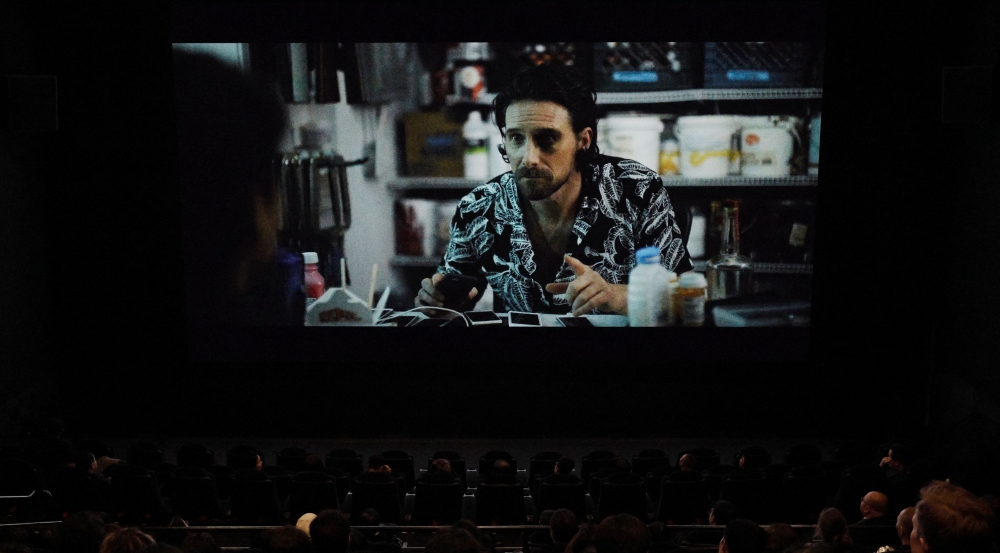























The 2025 Asian World Film Festival (AWFF) made its return to Culver City, showcasing an array of captivating films from across Asia. These films, deeply rooted in tradition, creativity, and imagination, were at the heart of this cinematic celebration. As a pivotal partner of this festival, Samsung Electronics introduced its Onyx Cinema LED technology, providing a viewing experience that celebrated the craftsmanship behind each film.
Now in its 11th year, AWFF remains dedicated to promoting Asian filmmakers on a global scale. This year, Samsung’s involvement added a subtle yet significant enhancement to the festival. Rather than introducing a new technological layer, Samsung elevated the experience by ensuring that each story reached its audience with an unprecedented level of care.
Filmmakers Discover a New Dimension for Their Stories
For many directors debuting their work at AWFF, presenting their films on an Onyx Cinema LED screen was more than just a technical upgrade—it was a moment of validation. Traditional projection often introduces discrepancies in brightness, shadows, and colors, which can detract from the intended cinematic experience. However, inside the Onyx auditoriums, directors experienced a version of their films that closely mirrored what they had envisioned during the grading process.
For instance, Al Chang, the director of the short film "Cindy," immediately noticed the difference. Having screened films in various theaters, he was struck by the consistency and clarity offered by the Onyx screen: “I’ve had short films screen in a lot of theaters, and there’s always some variation—washed-out blacks or colors that don’t translate the way we graded them. Here, it was like watching it on my own TV.”
Executive producer Kira T. Bixby, whose film "Rooftop" explores a Korean American narrative set in Los Angeles, emphasized the visual impact on the story’s emotional depth. “Everything really popped for us—the colors, the compositions, the details we worked so hard to craft,” she noted. “Film is such a visual language, so how you’re able to see it really matters.”
This precision in presentation was echoed by filmmakers from the Korean Parallel Smartphone Film Festival (KPSFF), a program empowering creators, including those with disabilities, to produce films using smartphones. Viewing their work on a large LED cinema screen was both a surprise and a validation.
Director Byun Seung Chae, renowned for her color-centric storytelling, was taken aback by the clarity of the image as the film commenced: “What struck me right away was how unbelievably clear the image was. The colors were beautiful, and I was amazed that a film could look that sharp on such a large screen. I turned to the person next to me and said, ‘I didn’t expect it to look this good!’”
Similarly, LA-based filmmaker Zenon Samuels, who often works with nighttime visuals and neon-rich palettes, was impressed after experiencing an Onyx screening for the first time. “The blacks are super dark, and with a film that’s so bright and colorful, the high dynamic range made the colors really pop and helped bring the energy and nighttime aesthetic to life.”
These testimonies reveal a consistent theme: Onyx technology didn’t alter the filmmakers’ work—it respected and accurately reproduced their creative decisions. For directors and performers, seeing their work in this format was both a cinematic and personal experience.
Audiences Rediscover the Magic of Cinema with Samsung Onyx
For many festival attendees encountering Onyx for the first time, the level of clarity and contrast was a revelation compared to traditional projection methods.
New York attendees Jack Joyce and Matthew Gallopo described how the presentation shaped their experience: “Those darker colors—and not having that graininess—kind of put you in the moment a little bit. It was cool,” Joyce remarked. Gallopo added, “The color certainly popped, and a lot of it was pretty crisp.”
For some, the impact was as emotional as it was technical. Entertainment lawyer Jesse Weiner, who views films professionally as part of his work, noted how the detail and richness transformed his connection with the on-screen narrative. “Watching this film on Samsung Onyx, the picture was bright, rich… about as good as I can imagine seeing a film with that kind of quality and texture,” he said. “It looked very lifelike—almost like being immersed in the action of the film.”
Others reflected on what such experiences could mean for the future of theaters. As streaming, gaming, and home entertainment continue to evolve, festivalgoers were reminded of how an elevated cinema environment can once again unite audiences.
According to Georges N. Chamchoum, Executive Director of AWFF, "Innovations in the cinema industry should help audiences truly see the story, and Samsung’s Onyx screens do just that."
Across various ages, backgrounds, and filmmaking experiences, audience conversations converged on a single point: cinema still holds immense power. When the screen complements rather than competes with the storytelling, the theatrical experience becomes even more compelling.
A Forward-Thinking Discussion on Cinema’s Future
During this year’s festival, Samsung hosted a panel discussion titled "Redefining the Cinema Experience with Samsung Onyx," bringing together influential voices in modern filmmaking. The panel included:
- Glenn Gainor, CEO & Producer, Hollywood Ventures Group
- Steven Poster (ASC, CSC), Board Member, 6P Color; President Emeritus, International Cinematographers Guild Local 600
- Philip Holland, Director, Cinematographer, Digital Cinema Specialist & Color Scientist
- Craig German, Former C-Suite Executive, Amazon Studios and Paramount
Throughout the hour-long session, panelists explored how advancements in High Dynamic Range (HDR), color accuracy, and display technology are reshaping both creative possibilities and audience expectations. A significant portion of the discussion centered on how deeper blacks, wider color gamuts, and consistent presentations can enhance cinematic emotion without altering it.
Gainor shared insights into the evolving audience expectations as viewing environments improve across the board, noting, “Clearly, I work in the movie business, so my home system is probably pretty good. [But it’s] never going to be as good as what we just saw. This is an entirely different, immersive experience.”
Steven Poster highlighted the importance of technology that supports—rather than interferes with—creative intent. “Samsung was one of the first to listen to creators with filmmaker mode—and that really mattered,” he said. “Motion interpolation destroyed suspension of disbelief, and now we can have that back.”
Philip Holland emphasized how emissive displays enhance emotional immersion by revealing details often lost in projection. “Because this tech can achieve such deep black, you don’t get milky shadows,” he explained. “In a room like this, there were moments when you couldn’t see the edge of the frame—you felt like you were there.”
The panelists agreed that depth and precision are crucial themes as HDR expands the range of storytelling. Gainor described it as an expansion of storytelling itself: “The art of storytelling allows us to get the darkest of dark and the brightest of bright.” Poster added: “We had the ability to capture it on film, but not to project it—until now.”
AWFF 2025: The Intersection of Art and Technology
Throughout the festival, a recurring theme resonated across screenings, discussions, and panels: when the viewing experience honors the filmmaker’s intent, the bond between audience and story is strengthened. This philosophy also shaped AWFF leadership’s reflections on this year’s collaboration with Samsung.
Georges N. Chamchoum, the Emmy and multiple award-winning film director and producer, stated, “AWFF has always been about cultural exchange, introducing Asian filmmakers to the world and giving their stories the visibility they deserve. Samsung’s support strengthens that mission.” He emphasized that “innovations in the cinema industry should help audiences truly see the story, and Samsung’s Onyx screens do just that.”
Co-Founder and Managing Director Asel Sherniyazova underscored the importance of presenting films with care: “A film may travel across continents before reaching our stage. Seeing it presented with this level of precision gives filmmakers confidence that their work is being treated with respect.”
Samsung’s contribution to AWFF 2025 reaffirmed the notion that technology, when applied thoughtfully, can amplify the heart of a story. By enabling films to reach audiences exactly as their creators intended, this year’s festival offered a hopeful glimpse into how cinemas can continue to inspire, connect, and bring stories to life, while respecting the artistic vision inherent in each film.
For further details, you may refer to the original source here.
For more Information, Refer to this article.