


















Software Innovations Empower Satellite Swarms for Future Space Missions
The future of space exploration is on the brink of a revolutionary transformation, thanks to advancements in software that could provide spacecraft with unprecedented levels of autonomy. This innovation could usher in an era where swarms of satellites operate with minimal human intervention, achieving scientific objectives and navigating the vastness of space more efficiently.
As humanity looks towards longer missions on the Moon and Mars, astronauts will need robust satellite networks for essential services such as navigation, weather monitoring, and communication relays. Managing these complex missions could be significantly streamlined by automating satellite communications, allowing space explorers to concentrate on critical tasks instead of being bogged down by manual satellite operations.
The Challenge of Deep-Space Communication
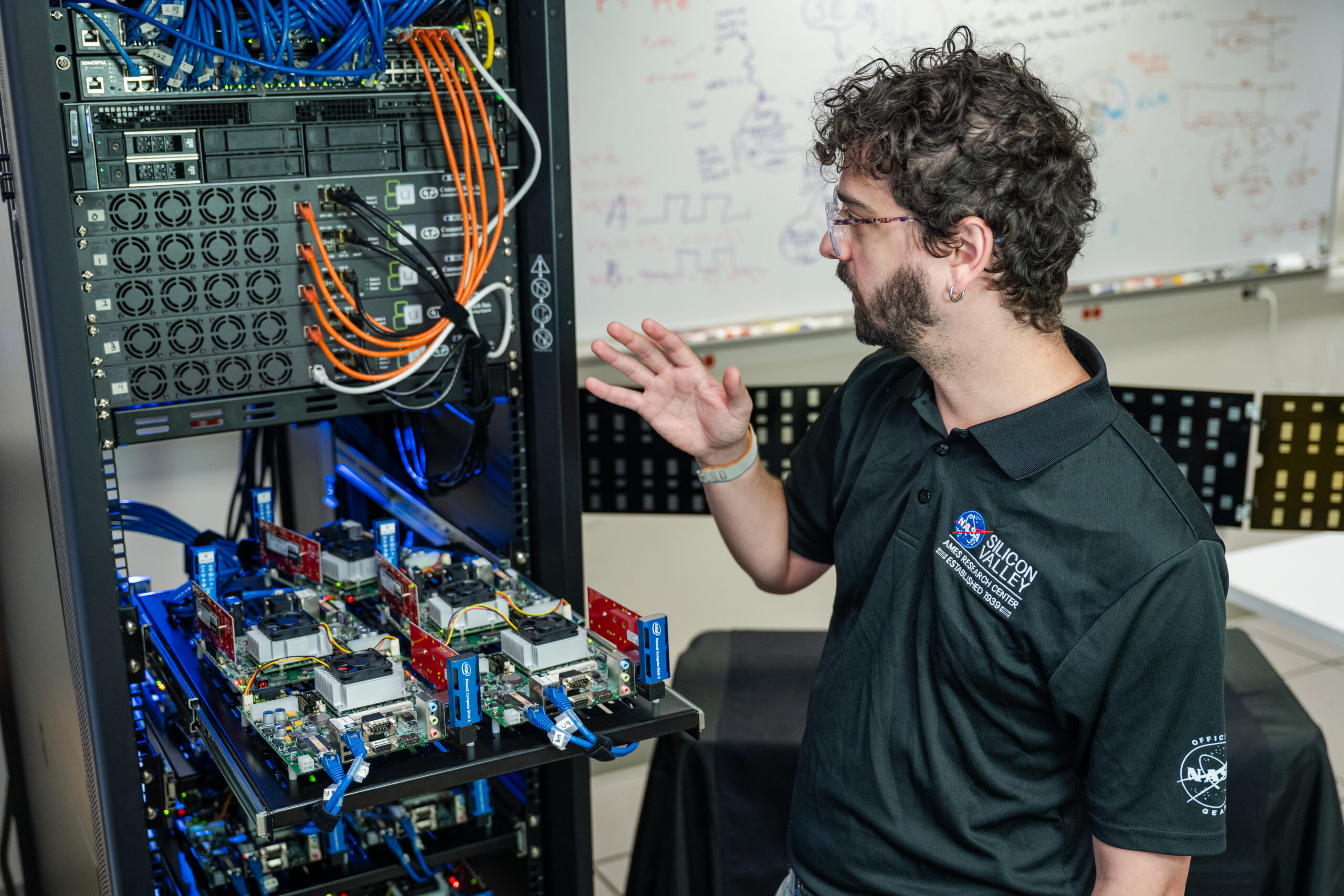
One of the significant hurdles in deep-space missions is the communication delay between Earth and satellites orbiting distant planets like Mars. These delays can impede mission efficiency as satellite operations require real-time decisions. The Distributed Spacecraft Autonomy (DSA) project, spearheaded by NASA’s Ames Research Center in California’s Silicon Valley, aims to tackle this challenge. By testing shared autonomy across distributed spacecraft missions, DSA seeks to enable swarms of satellites to make independent decisions, adapt to changes, and perform maintenance with minimal human input.
The Concept of Autonomous Satellite Swarms
Autonomous satellites are capable of executing tasks without waiting for direct commands from ground operators. By distributing autonomy across multiple satellites functioning as a cohesive swarm, these spacecraft can collaborate using a collective "shared brain." This collective operation allows them to achieve goals that would be unattainable if each satellite operated independently.
The DSA software, developed by NASA researchers, equips the satellite swarm with a prioritized task list. It integrates each spacecraft’s unique observations and priorities into a comprehensive plan of action for the entire swarm. This approach is supported by decision trees and mathematical models that guide the swarm in choosing subsequent actions, responding to changes, or addressing problems.
Real-World Demonstration: The Starling Mission
The inaugural in-space demonstration of DSA took place aboard the Starling spacecraft swarm, a group of four small satellites designed to showcase various swarm technologies. Since its launch in July 2023, the Starling mission has served as a platform to test and validate autonomous swarm operations. The Starling swarm utilized DSA to optimize scientific observations, autonomously determining what to observe without pre-programmed directives. This autonomy led to the collection of data that might have been overlooked if each satellite required individual instructions.
A key achievement of the Starling mission was the measurement of electron content in the plasma between the spacecraft and GPS satellites. This data helped capture rapidly changing phenomena in Earth’s ionosphere, the layer where the Earth’s atmosphere meets space. The DSA software empowered the swarm to independently decide what to study and how to allocate tasks across the four spacecraft.
Each satellite in the Starling swarm operates as an independent entity. If one member encounters an issue, the others can adapt to ensure the mission’s objectives are still met. The Starling 1.0 demonstration marked several milestones: it was the first instance of fully distributed autonomous operation of multiple spacecraft, the first use of space-to-space communications for autonomous status sharing, and the first demonstration of distributed reactive operations. These breakthroughs laid the groundwork for the continuation of the mission with Starling 1.5+.
Advancing Satellite Autonomy
Following the success of DSA on Starling 1.0, the team began exploring further applications of the software to support the health and efficiency of satellite swarms. Continued testing during the extended Starling mission involved PLEXIL (Plan Execution Interchange Language), a programming language developed by NASA for reliable and flexible automation of complex spacecraft operations.
Onboard the Starling swarm, the PLEXIL application demonstrated autonomous maintenance capabilities, enabling the swarm to manage regular operations, resolve issues, or distribute software updates across individual spacecraft. This enhanced autonomy makes it feasible for swarms to operate in deep space environments, reducing the need for constant communication with Earth.
Simulating Future Swarm Missions
To assess the scalability of DSA, the team used ground-based flight computers to simulate a lunar swarm of virtual small spacecraft. These simulations tested swarms providing position, navigation, and timing services on the Moon, akin to GPS services on Earth. This setup utilizes a network of satellites to pinpoint locations.
Over two years, the DSA team conducted nearly one hundred tests, demonstrating swarms of varying sizes at different lunar orbits. Insights gained from these early tests paved the way for further scalability studies. The second round of testing, slated to begin in 2026, will involve larger swarms, using flight computers that could eventually be deployed in orbit with DSA software onboard.
Implications for Future Space Exploration
The orbital and simulated tests of DSA represent a significant step towards widespread use of distributed autonomy in spacecraft swarms. By developing and validating these technologies, NASA enhances its capabilities, reducing costs and increasing efficiency. The successful implementation of autonomous spacecraft swarms could play a pivotal role in supporting missions to the Moon, Mars, and beyond.
Key Milestones in the DSA Project
- October 2018: Development of the DSA project begins.
- April 2020: Start of the development for lunar position, navigation, and timing simulation demonstrations.
- July 2023: DSA is launched onboard the Starling spacecraft swarm.
- March 2024: DSA experiments aboard Starling meet success criteria.
- July 2024: Development of DSA software for the Starling 1.5+ mission extension begins.
- September 2024: Successful conclusion of LPNT simulation demonstrations.
- October 2024: Extended mission of DSA as part of Starling 1.5+ commences.
Collaborative Efforts and Future Prospects
The Distributed Spacecraft Autonomy and Starling projects are led by NASA Ames, with funding from NASA’s Game Changing Development program within the Space Technology Mission Directorate. The Starling mission and the DSA project receive funding and management from NASA’s Small Spacecraft Technology program, part of the Space Technology Mission Directorate.
As these projects advance, the potential for autonomous spacecraft swarms to revolutionize space exploration becomes increasingly tangible. By minimizing reliance on Earth-based operations and maximizing the independence of satellite networks, NASA is paving the way for more efficient and cost-effective space missions. For more detailed information and updates, interested readers can explore resources provided by NASA’s official channels.
For more Information, Refer to this article.