



















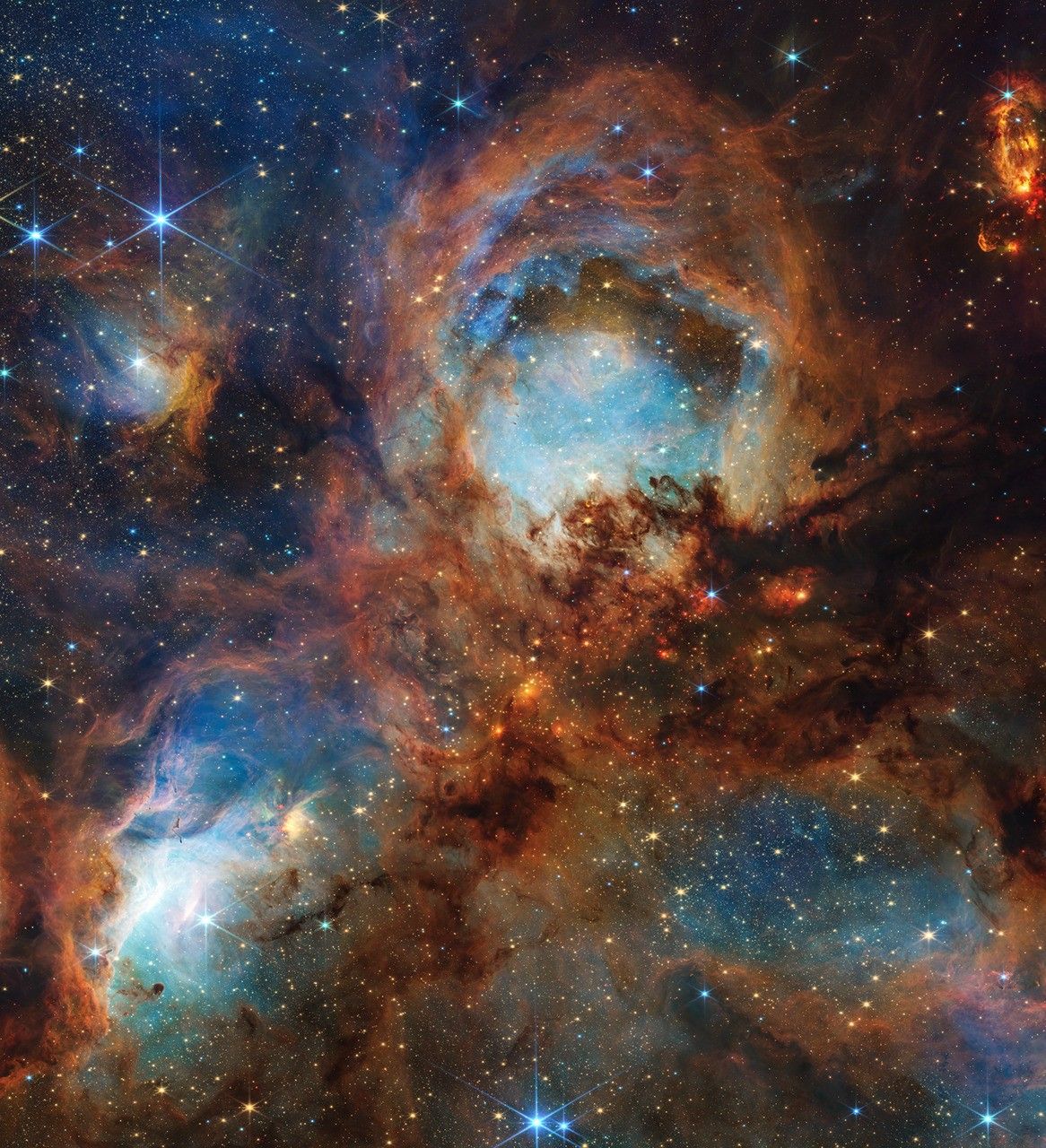
NASA’s James Webb Space Telescope has once again captured the imagination of scientists and the public alike with its latest achievement. Celebrating its third year of operation, the telescope has unveiled a new perspective on a portion of the Cat’s Paw Nebula, also known as NGC 6334. This celestial region, located approximately 4,000 light-years away in the constellation Scorpius, is a bustling hub of star formation. The telescope’s detailed infrared imagery has provided an unprecedented view into the nebula’s dense dust and gas, revealing young stars shaping their cosmic environment.
The James Webb Space Telescope (JWST) has been a transformative tool in space observation since it began its mission in July 2022. Utilizing its NIRCam (Near-Infrared Camera), the telescope has been able to peer through thick cosmic dust layers, offering a view into the nebula that was previously obscured. This capability is crucial for understanding the complex processes involved in star formation.
The Cat’s Paw Nebula has been a subject of interest for astronomers due to its active star-forming regions. The nebula originates from a large molecular cloud, a type of interstellar cloud whose density and size allow for the formation of molecules, most commonly molecular hydrogen. The transformation of this molecular cloud into massive stars involves numerous stages that researchers are still working to comprehend fully. The detailed observations from the JWST provide critical insights into these processes, building on the foundation laid by previous studies conducted using NASA’s Hubble and the now-retired Spitzer Space Telescope.
One of the most striking features identified by the Webb telescope is a region within the nebula referred to as the ‘Opera House’ due to its circular, tiered structure. This area is illuminated by bright yellowish stars and potentially other sources still hidden behind dense dust. These stars, with their immense luminosity, are responsible for the bright blue nebulous glow that characterizes the scene. However, this is a transient phase. The energy and radiation emitted by these massive stars will eventually disperse the surrounding material, halting the star formation process in that region.
The telescope’s infrared imaging capabilities allow it to detect various phenomena within the nebula. For instance, diffraction spikes—patterns of light created by the telescope’s optics—highlight the presence of massive stars that have carved out their immediate surroundings. Despite the intense radiation from these stars, certain dense clumps of dust persist, indicating areas where protostars, or nascent stars, are forming. These dense dust filaments suggest regions of active star formation, even though they remain obscured by the surrounding material.
Moreover, the JWST has revealed several small, fiery red clumps scattered throughout the nebula. These clumps signify regions of intense star formation, although the process remains hidden from direct view. The interplay between the radiation from massive stars and the surrounding material creates a dynamic environment, constantly reshaping the nebula.
A particularly intriguing aspect of the Webb telescope’s image is a bright red-orange oval that appears at the top right of the scene. This area, with its low background star count, represents a dense region at the nascent stages of star formation. Although only a few visible stars are present, they contribute to the illumination of the surrounding material, hinting at the energetic processes occurring within.
The James Webb Space Telescope is designed to address some of the most profound questions in astrophysics. According to Shawn Domagal-Goldman, acting director of the Astrophysics Division at NASA Headquarters, the telescope has not only met but exceeded expectations, uncovering previously hidden aspects of the universe. Its findings are paving the way for future missions, such as the Nancy Grace Roman Space Telescope, which will focus on the mysteries of dark matter, and the Habitable Worlds Observatory, aimed at identifying Earth-like planets.
The success of the JWST is a testament to the collaborative efforts of NASA, the European Space Agency (ESA), and the Canadian Space Agency (CSA). This international partnership has enabled significant advancements in our understanding of the universe, from the intricate details of star formation to the exploration of distant galaxies and worlds.
For those interested in delving deeper into the Cat’s Paw Nebula and the discoveries made by the James Webb Space Telescope, NASA provides a wealth of resources. The Space Telescope Science Institute offers high-resolution images and narrated tours that explore the nebula in detail. These resources allow enthusiasts and researchers alike to appreciate the intricate beauty and complexity of the cosmos as seen through the eyes of the Webb telescope.
The James Webb Space Telescope continues to be at the forefront of space exploration, pushing the boundaries of our knowledge and inspiring future generations of astronomers and space enthusiasts. Its contributions are invaluable, offering a glimpse into the processes that govern star and galaxy formation, and ultimately, our place in the universe.
For more information about the James Webb Space Telescope and its ongoing mission, you can visit NASA’s dedicated webpage at science.nasa.gov/webb. Here, you can access a comprehensive collection of images, news updates, and scientific insights related to the telescope’s discoveries.
In conclusion, the James Webb Space Telescope’s exploration of the Cat’s Paw Nebula is a remarkable milestone in its mission to unveil the universe’s hidden secrets. It serves as a powerful reminder of the incredible capabilities of modern technology and the endless possibilities that lie beyond our world. As the telescope continues its journey, the scientific community and the public eagerly await the next chapter of discoveries that will further illuminate our understanding of the cosmos.
For more Information, Refer to this article.