





















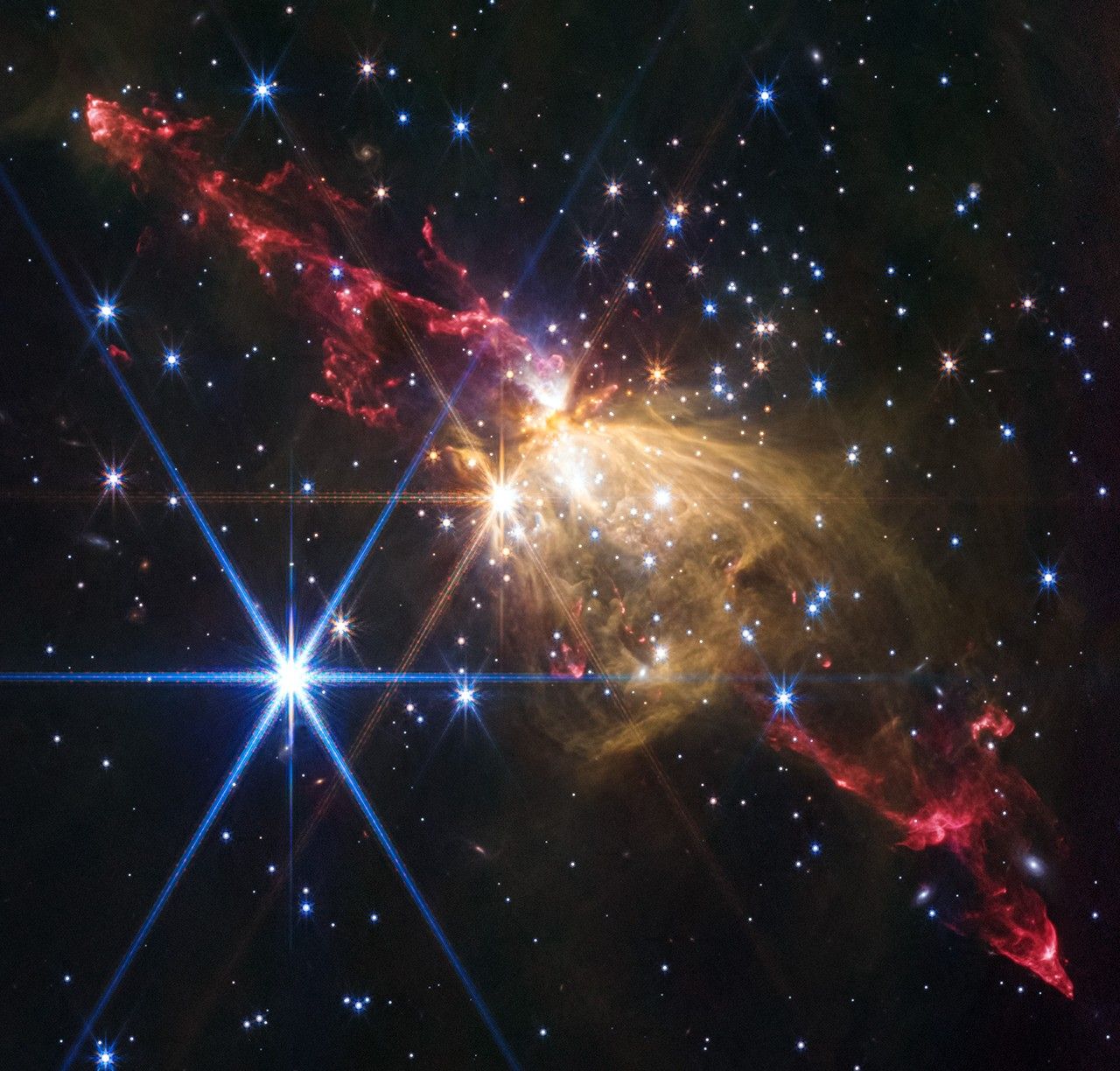
The cosmos never ceases to amaze, and the recent observations captured by NASA’s James Webb Space Telescope have unveiled yet another celestial wonder. A colossal jet of gas, erupting from a burgeoning star that is still in its infancy, has been imaged. This event, akin to a cosmic blowtorch, stretches across an astonishing 8 light-years. To put this into perspective, this distance is about twice the length between our Sun and the nearest star system, Alpha Centauri. Such an extraordinary stellar phenomenon, located in the nebula named Sharpless 2-284 (or Sh2-284), is deemed a rarity by astronomers.
Traveling at phenomenal speeds reaching hundreds of thousands of miles per hour, this jet mirrors the iconic double-bladed lightsaber from the Star Wars saga. At the heart of this spectacle is a protostar with a mass ten times that of our Sun, situated around 15,000 light-years away on the fringes of the Milky Way. This discovery was not something astronomers were specifically looking for; rather, it was a serendipitous find. As Yu Cheng from the National Astronomical Observatory of Japan puts it, "We didn’t realize there was such a massive star with this super-jet before observing it. Such a significant outflow of molecular hydrogen from a massive star is rare in our galaxy."
The imagery captured by Webb provides more than just a stunning visual. It offers evidence that the size of protostellar jets is directly proportional to the mass of the star from which they emanate. Simply put, the larger the mass of the star, the more substantial the jet it can produce. This aligns with theoretical models suggesting that the energetics and scale of these jets are influenced by the star’s physical characteristics.
These jets, which are essentially streams of plasma, serve as a birth announcement for new stars. They emerge when some of the accumulating gas around a young star is expelled along its rotational axis, possibly influenced by magnetic fields. Historically, astronomers have primarily observed these jets around stars with relatively low mass. Therefore, the discovery of such a massive jet is groundbreaking.
Jonathan Tan from the University of Virginia and Chalmers University of Technology remarked on the unexpected order, symmetry, and scale of the jet when it was first observed. This finding reinforces the theory that protostellar jets scale with the mass of the star driving them – a more massive star results in a larger jet.
The intricate structure of the jet, as depicted in the detailed imagery from Webb, reveals the interaction with interstellar material. This interaction forms distinct knots, bow shocks, and linear chains. The jet’s extremities, pointing in opposite directions, tell the tale of the star’s formation over approximately 100,000 years.
Located almost twice the distance from the galactic center as our Sun, the proto-cluster hosting this impressive jet resides on the Milky Way’s periphery. Here, several hundred stars are still in the process of formation. Due to its location in the galaxy’s outskirts, these stars have a lower abundance of elements heavier than hydrogen and helium, known as metallicity. This characteristic makes Sh2-284 a rare window into the early universe’s environment, which also lacked heavier elements. Yu Cheng noted, "Massive stars, such as the one in this cluster, significantly impact galaxy evolution. Our discovery illuminates the formation mechanisms of massive stars in environments with low metallicity, offering insights into earlier cosmic history."
The gravitational energy released as a star gathers mass powers these stellar jets, encoding the protostar’s formation history. Webb’s recent images suggest that massive star formation can occur via a stable disk around the star, a notion supported by the core accretion model of star formation. This model proposes that a star grows by gradually accumulating material from a disk. According to Tan, "Once we identified a massive star launching these jets, we used Webb’s observations to test theories of massive star formation. Our new theoretical models imply that the star, which is about 10 times the Sun’s mass, is still growing and has been powering this outflow."
For decades, astronomers have debated the formation of massive stars. Some propose a chaotic process called competitive accretion, where material falls from various directions, causing the disk’s orientation to change. This would result in an outflow that twists and turns. However, the observed symmetry of the jets in Sh2-284 suggests otherwise. Tan stated, "The nearly 180-degree separation of the jets indicates a stable central disk, supporting the core accretion theory."
The presence of one massive star suggests the possibility of others in this remote region of the Milky Way. Some stars may not yet have begun producing such jets. Research using data from the Atacama Large Millimeter Array in Chile, included in this study, hints at another dense stellar core in an earlier developmental stage.
The research findings have been accepted for publication in The Astrophysical Journal. The James Webb Space Telescope, a collaboration between NASA, ESA (European Space Agency), and CSA (Canadian Space Agency), continues to be a leading observatory for space science. It is unraveling mysteries of our solar system, exploring distant worlds, and probing the universe’s enigmatic structures and origins.
For further insights into the James Webb Space Telescope, visit NASA’s official page dedicated to Webb at NASA Science.
Additionally, if you’re intrigued by similar phenomena, you can explore Webb’s images of other protostar outflows, such as HH 49/50, L483, HH 46/47, and HH 211. Further data visualizations and animation videos, like "Exploring Star and Planet Formation," are available for those interested in delving deeper into the subject.
In conclusion, the James Webb Space Telescope continues to push the boundaries of our understanding of the universe, shedding light on the processes that shape the stars and galaxies we observe today. Such discoveries not only deepen our scientific knowledge but also fuel our curiosity and wonder about the cosmos.
For more Information, Refer to this article.